Microbes
Microbes
The Structure of Microorganisms
A microscope is needed to observe microorganisms.
Eukaryotes – organisms that have a nucleus.
Fungi
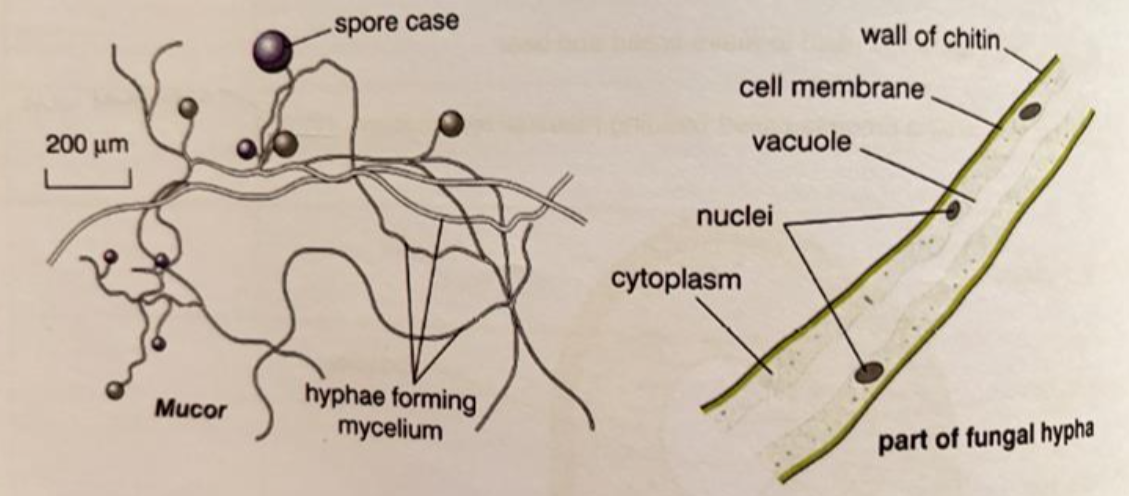
Cell walls are made of chitin (not cellulose as in plants).
No chloroplasts → cannot photosynthesise.
Feed by saprotrophic nutrition: they secrete enzymes onto organic material and absorb the products.
Two main groups of fungi:
Single-celled fungi – Yeasts
Single-celled organisms used in bread and beer production.
Reproduce mainly by budding, a type of mitosis.

Multicellular fungi – Moulds
Found on rotting food; used in food (e.g., blue cheese) and antibiotics (penicillin).
Grow as hyphae, thread-like structures forming a mycelium.
Hyphae are multinucleate (several nuclei per cell).
Reproduce by forming spores.
Protoctists
A diverse group of eukaryotic microorganisms.
Some resemble animal cells, such as amoeba.
Others resemble plant cells, such as chlorella.
Malaria is caused by a protoctist called plasmodium.

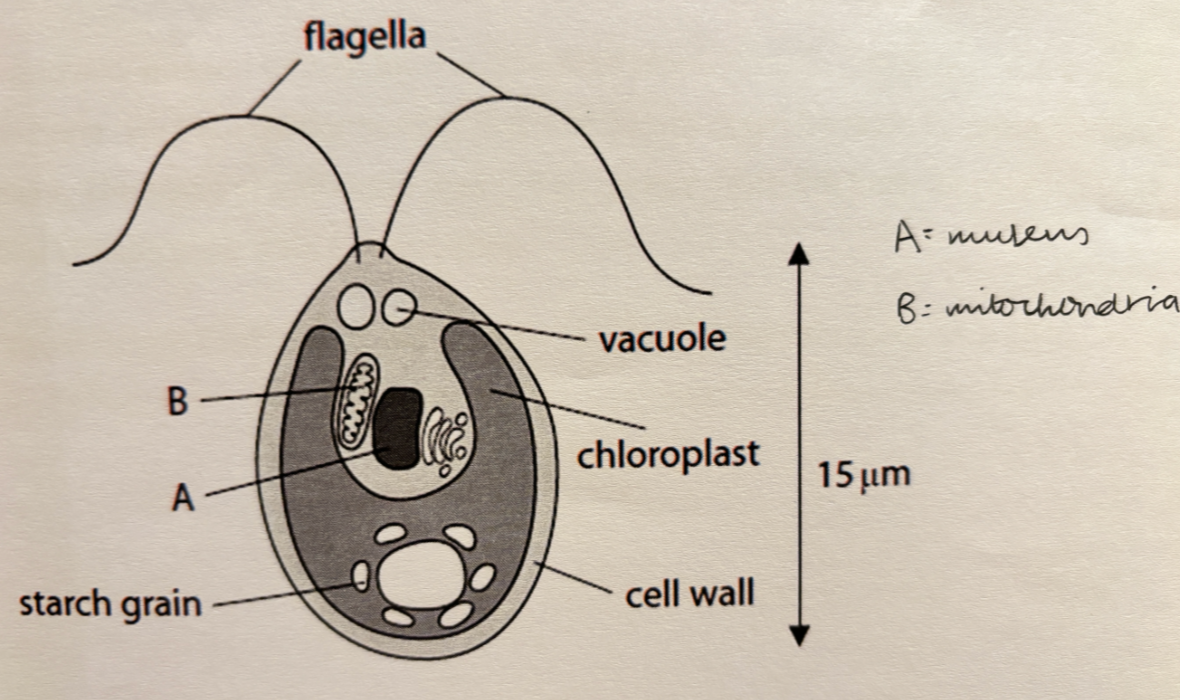
Some, like chlamydomonas, show features of both plant and animal cells.
Prokaryotes – Bacteria
Very small, simple cells essential for life; most do not cause disease.
Do not have a nucleus, mitochondria, or chloroplasts.
Have cell walls, but not made of cellulose or chitin.
Contain ribosomes.
DNA is circular in the cytoplasm; small extra circles of DNA are called plasmids, which can be used in genetic engineering.

Viruses
Not considered living: not made of cells and cannot carry out MRS C GREN.
Very simple: a molecule of genetic material (DNA or RNA) surrounded by a protein coat.

Discovery of Viruses
Demonstrated in 1890 by Dmitry Ivanovsky while researching tobacco mosaic disease.
Disease was infectious, but no bacteria or fungus could be found.
Ivanovsky filtered extract from a diseased plant to remove bacteria; the filtrate caused disease in healthy plants.
Named “virus” from Latin for poison.
Viruses were shown to reproduce and were first observed using electron microscopes in the 1940s.
Useful Microorganisms
Microbes can be used in fermenters to produce products like insulin and in food production.
Making Yoghurt – Industrial Process
Heat milk to 85°C for 15–30 min to sterilise.
Cool to 40°C.
Add Lactobacillus bacteria. They respire anaerobically, producing lactic acid.
Lactic acid lowers pH, denaturing proteins and thickening milk; also gives yoghurt its taste.
Making Yoghurt – Lab Method
Measure 20 cm³ milk, heat near boiling, cool to ~30°C.
Add half a teaspoon sugar, stir.
Add one teaspoon live yoghurt as starter culture.
Cover and incubate in a warm place until set.
Questions
Why boil the milk? To sterilise and kill unwanted microorganisms.
Why use live yoghurt as starter culture? Contains Lactobacillus that respires anaerobically to produce lactic acid.
Why leave in a warm place? Optimum temperature for bacterial respiration and growth.
What reaction produces set yoghurt? Anaerobic respiration: glucose → lactic acid + energy.
Making Bread
Yeast, a single-celled fungus, is used.
Mix sugar, yeast, flour, and water.
Leave at a warm temperature; yeast respires anaerobically.
Carbon dioxide forms bubbles in the dough, making it rise.
Baking kills the yeast and sets the structure of the bread.
Other Useful Microorganisms
Alcoholic drinks (beer, wine) are made using yeast.
Cheese is made using bacteria; blue veins in Stilton are fungal.
Quorn™ (vegetarian meat alternative) is a fungus.
Penicillin is produced by a fungus.
Working Safely with Bacteria
Use bacteria known not to be pathogens.
Incubate at 25 °C (below body temperature) to reduce risk.
Do not make an airtight seal; some pathogens grow better anaerobically.
Wear protective equipment: lab coat, goggles.
Work in sterile conditions: wipe benches with ethanol and sterilise equipment (e.g., with steam).
Fermenters
Fermenters are containers used to grow microorganisms under controlled conditions.
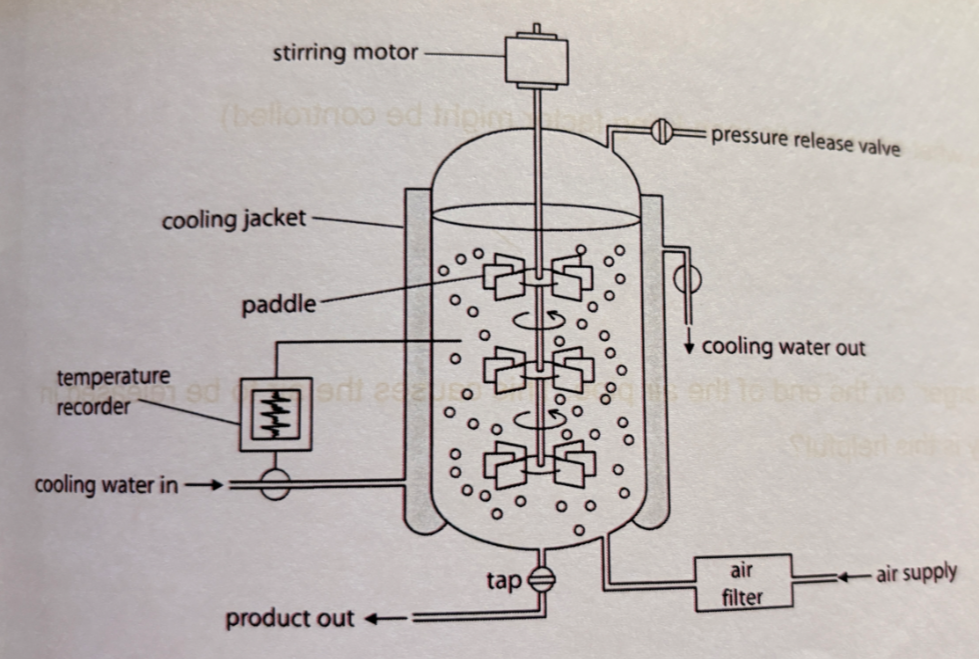
Part | Function |
|---|---|
Air supply and filter | Supplies oxygen for aerobic respiration; filter removes unwanted microbes from the air |
Cooling jacket | Prevents temperature from rising too high, protecting enzymes |
Stirring motor & paddles | Mix microbes, glucose, and oxygen for better collisions and respiration |
Tap | Removes the product |
Temperature recorder | Monitors temperature to keep it optimal for microbial activity without denaturing enzymes |
Pressure release valve | Releases CO₂ produced during respiration to prevent pressure build-up |
Fermenter Control and Products
Temperature:
Too low → enzymes have insufficient kinetic energy, reactions slow
Too high → enzymes denature, reactions stop
Other abiotic factors:
pH must be controlled; e.g., CO₂ dissolves in water to form carbonic acid, which can denature enzymes
Sparger:
Releases air as small bubbles for better mixing and more efficient aerobic reactions
Adds oxygen for aerobic respiration
Sterilisation:
Done using steam between uses
Strong bleach is avoided as it could contaminate the product
Anaerobic fermentation:
Remove the air supply but leave the air filter
Products:
Aerobic fermenters → penicillin, insulin
Anaerobic fermenters → beer, wine