Lecture 17: The Japanese Occupations
Short period of less than 3 years but one of the most traumatic experiences in the Philippines.
The end of the Japanese occupation will set the conditions for the direction that the Philippines will take in its future as an independent republic
The Greater East Asia Co-Prosperity Sphere
Just like the Americans had the concept of benevolent assimilation to justify their imperial desires in occupying the Philippines, the Japanese have their own version to establish their empire throughout Eastern Asia
The Greater East Asia Co-Prosperity Sphere has to do with the concept of unity among Asians. Asia for Asian concept and to keep Westerners out because Asians have a unique culture and only with their cooperation among each other through trade and cultural exchanges will Asians be able to maximize their potential in world affairs, justifying their conquest of China as early as 1931 extending towards the Philippines, Indonesia, and most of Southeast Asia.
From the image, you can see Japanese mocking Western colonial powers such as the Americans in the Philippines
Why are they not insulting French people?
Because when the Nazi Germany occupied France at the start of WW2 in Europe, the French government collaborated with Nazi Germany.
Since Nazis were allies of the Japanese by extension, the Vichy government of France which was occupying Indo-China which is now Laos, Cambodia, and Vietnam, technically also became allies of the Japanese
Japanese Expansion Before Pearl Harbor
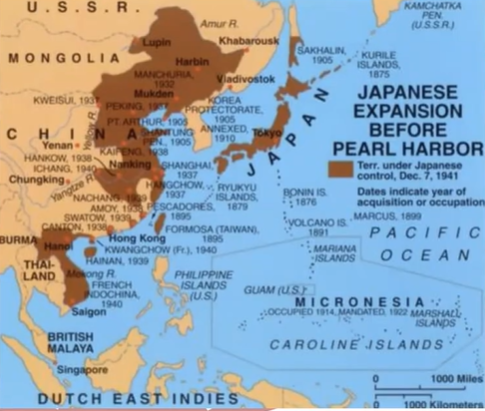
Before the invasion of Pearl Harbor on 7th of December 1941, which marked the official start of WW2 up in the Pacific and the official entry of the US into the second world war.
The dark brown markings shows that Japan had already conquered a lot of territory, including parts of China (now Pacific-Taiwan), Hong Kong, and next is the Philippines.
The Greater East Asia Co-Prosperity Sphere had economic motivations because Japan had limited natural resources and because the US embargoed their shipments of oil to Japan as a reaction to their territorial expansion, Japan had no choice but to get their oil from elsewhere.
Indonesia is actually a major oil producing country up to now. So, the oil fields of the Dutch East Indies became a prime target for Japanese forces, as securing these resources was critical for sustaining their military campaigns in the region.
To reach the Dutch East Indies, they had to go to the Philippines first. In the process, they had to defeat the American imperial presence in the Philippines
The Attacks on Pearl Harbor and Clark Field
On December 7-8, 1941, simultaneous attacks happened on Pearl Harbor and Clarkfield in which the aircraft of the US Army Air Force was completely destroyed before they had the chance to take-off.
The annals of military history is still not certain who was at fault, and who was being negligent as to why these planes were not able to put up a fight. If these airplanes had been able to fly, it could have altered the outcome of the war.
As the result of the initial defeat, MacArthur convinced Commonwealth government to declare Manila as an open city, to let the Japanese enter military, so the military would not defend Manila.
The Japanese propaganda already prepared Filipinos to supposedly welcome them.
UST is where the Japanese Imperial Government interned the American residents of the Philippines, who are now considered technically the prisoners of the Japanese.
The Fall of Bataan and Corregidor
As for the US military presence, they retreated to Bataan and Corregidor which was part of the plan called “War Plan Orange” in case Japanese have an initial victory in the invasion of the Philippines.
The United States Army Forces in the Far East (USAFFE) which is combination of American and Filipino forces would retreat to Bataan Peninsula and hold their ground until further American reinforcements arrive from the West Coast or from Hawaii but Pearl Harbor was already destroyed beforehand, so the help was never really coming immediately.
The Filipino-American forces were forced to surrender in what known as the biggest defeat of American forces in their history. The infamous Bataan Death March which resulted in the death of close to 10,000 prisoners, not only during the march but during their captivity as well.
The USAFFE were defeated but that doesn’t mean that resistance to the enemy invaders ended. In fact, throughout the Japanese occupation, guerilla forces engaged in hit and run tactics and intelligence gathering with the purpose of holding their ground until MacArthur returns. This is because before the fall of Corregidor, MacArthur retreated to Australia to prepare for the eventual liberation of the Philippines and uttered the famous phrase “I shall return”.
While waiting for MacArthur to return, some Americans who escaped from Bataan formed their own networks of guerilla forces, most of the guerillas were Filipinos themselves and were sponsored by the Americans as they were all part of the entire network to prepare for American liberation.
Among them were the Hunters ROTC comprised of cadets from the Philippine Military Academy at the time, Markings Guerillas, and Jesus Villamor, famous for shutting down a few Japanese planes at the start of the invasion and engaged in espionage for the Americans, and Ramon Magsaysay who was a genuine war hero who would eventually become supported by the Americans to be the president of the Philippines eventually.
When it comes to guerilla forces, one group that would be remembered is Hukbalahap, originally was conceived as a communist, so it is a communist movement. When the war started, they formed a larger organization with other peasant groups particularly in central Luzon. The leader of that movement is a UP professor from Los Banos and a pensionado but he was captured eventually with other Partido Komunista Filipina leaders.
After their capture, Luis Taruc will eventually be recognized as the supremo of the Hukbalahap in 1942. They would agree to cooperate with the Americans but with these guerilla groups, when they are operating within the same territory, they would be fighting among each other to establish who is actually the guerilla force, and who is ruling in that area.
Hukbalahap was not recognized by the Americans when they returned, but recognized all other guerilla groups even giving them arms and let them assist with the liberation of the Philippines. When the Americans encountered the Hukbalahap, the order was to disarm them because they were supposedly originally part of the communist movements which had always the intent of overthrowing the Philippine government.
Collaboration with the Enemy
There were also a lot of collaboration with the enemies which took place not only among the peasants, but at the higher levels of office.
On the left is the executive secretary of Manuel L. Quezon named Jorge B. Vargas, which was appointed by Quezon to be the chair of the Philippine Executive Commission. Because after the departure of Quezon, he wanted to make sure that the Philippine government still had representatives who would cooperate with the Japanese in order for the occupation to be not acceptable but less harsh in the Philippines.
The interior secretary of the Philippine Executive Commission eventually became head of the only political party that was sponsored by the Japanese Imperial government, the KALIBAPI (Kapisanan sa Paglilingkod sa Bagong Pilipinas) was no longer than the grandfather of the late president Benigno Aquino III.
After the establishment of the second republic, he would emerge as a speaker of the national ascent.
Jose P. Laurel became the president of the so-called “Second Republic”. Even when the second republic was established, the commonwealth government was still functioning while it was in exile as long as Manuel Quezon was alive and the vice president was there to succeed him.
The Commonwealth government was still functioning in exile in US and just waiting to return to the Philippines and resume its functions.
Makabayang Katipunan ng mga Pilipino (MAKAPILI)
a militant group formed in the Philippines during the Japanese occupation of World War II to aid the Imperial Japanese Army. They were used as guards for Japanese and government facilities and were later infamous for their role in identifying and targeting Filipino guerrillas. After the war, Makapili members faced trials for treason.
Anniversary of the Second Republic of the Philippines
To give the Philippines the impression of good intentions of the Japanese, they granted the Philippines its independence on October 14, 1943 but nobody remembers the state and celebrates it because it was a puppet government even though the Philippine flag was raised and the national anthem was sang. For the first time in Manila, everybody knew that it was a puppet regime under the control of the Japanese and everybody is just waiting for the Americans led by MacArthur
In the photo, Jose P. Laurel is delivering his inaugural arrest and beside him is the symbolic presence of Emilio Aguinaldo.
Everyone treats Laurel as a puppet president but he actually did his best to make life easier for the Filipinos, mainly through his efforts to ensure that the short supply of rice was able to reach the Filipino population who is in need of it.
Cartoons of Japanese Occupation
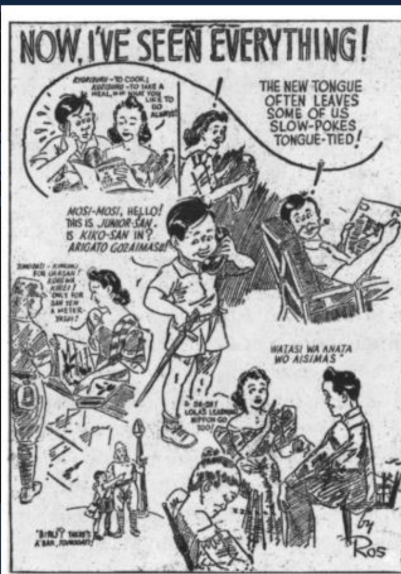
It is a depiction of how Filipinos are happy and adjusting to learning Japanese language and showing respect for the Japanese.
During the occupation, the Philippines was a part of the greater East Asia prosperity sphere. The Japanese tried to introduce Japanese culture and values into the Philippines
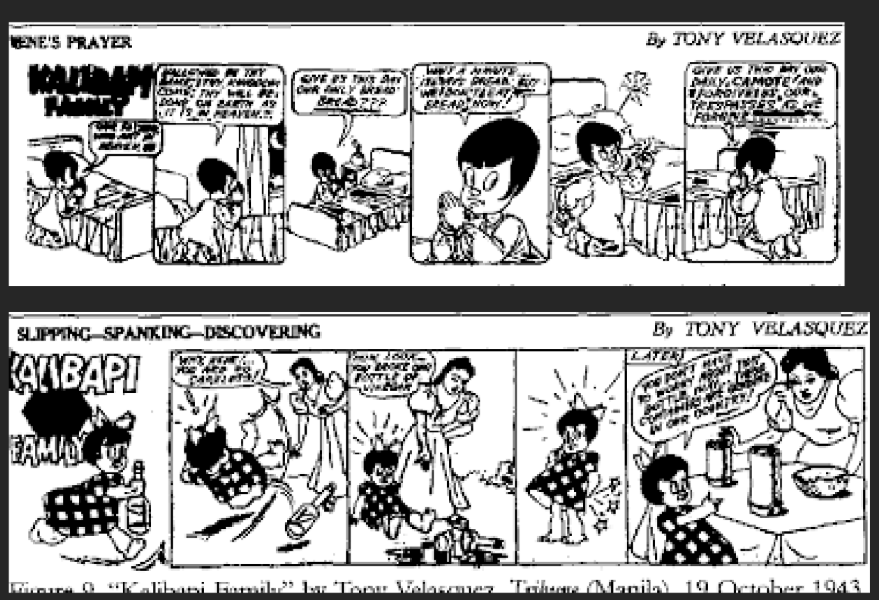
There was a rice shortage during this time. Even before the arrival of the Japanese, the Philippines was already a rice importing country, so all of these imports stopped.
In rice farms, a guerilla war is taking place so harvest would not be very normal.
Beside from having to feed Filipinos, the country’s rice supply also had to satisfy the needs of the 200,000 or so Japanese part of the occupation force.
Ketchup
Before the Japanese occupation, the Filipinos were used in consuming imported ketchup from the US which is made of tomatoes but since the importation of ketchups stopped, a very enterprising Filipino named Magdalo Francisco, came up with a formula to manufacture ketchups using bananas. The ketchup was named “Mafran” from MAgdalo FRANcisco.
Money
Japanese printed their own money
This was called the “Mickey Mouse” money because they look like toy money
Propaganda
Abusing our women
recruited young women as sex workers for the Japanese Army by force, leading to widespread suffering and trauma in the occupied territories.
Looting our homes
Working our men to death
Dictating the press
Ano ang dinala ng mga Kastila?
Relihiyon
Ano ang dinala ng mga Americano?
Edukasyon
Ano ang dinala ng mga Hapon?
Rasyon
Rice was very scarce.
Ang buhay sa PILApinas
One thousand peso bill
In the face of the 1000-peso bill, we celebrate the sacrifices of these three personalities who gave their lives to the nation during the Japanese occupation.
Vicente Lim - he’s a military general and the Japanese tried to convince him to be the leader of Philippine Constabulary and he refused. He used his wealth to finance activities where he was eventually caught when he was trying to escape to Australia and he died in captivity in Fort Santiago
Josefa Llanes Escoda - founder of the girls scout of the Philippines and was at the forefront of fighting for the right of women to vote. Towards the end of the war, she was confined in what is now known as “Far Eastern University” and she just died. She was last seen on January 6, 1945. It was suspected that she was killed by the Japanese and buried in an unmarked grave in the Manila North Cemetery
Jose Abad Santos - Unlike the other top government officials who collaborated with the Japanese. He was the justice secretary which refused. He was given an altumatim—collaborate or die.
Santos’ daughter begged to his father, “makisama ka na sa mga hapon”. Moments after his famous words, he was taken upstairs and was shot.
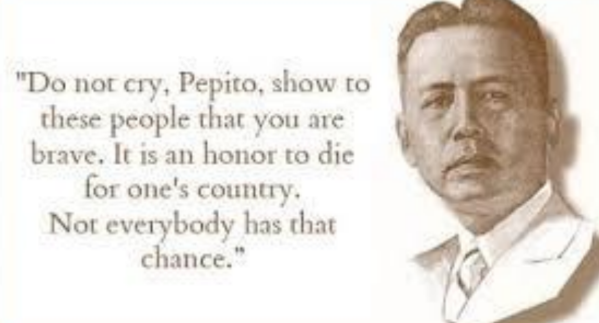
Statue of Wenceslao Vinzons
He was one of the youngest congressmen and became a guerilla leader.
In the Bicol region, he was captured and was killed. He is a real hero unlike Ferdinand Marcos who claimed to be the leader of the Maharlika guerilla group which according to the US army did not even exist. They have documents proving that he was a war criminal who was soliciting funds
The Anniversary of the Leyte Landing
October 20, 1944, just two and a half years after the fall of Corregidor. McArthur along with President Sergio Osmena finally made his return to the Philippines through Leyte