Estuaries, Rocky Shores, Sandy Shores
Estuaries
Where the river meets the ocean - structure is controlled by seaward flow of freshwater and tidal mixing. From creeks and marshes to seawater
Classified by basin types:
Drowned River Valleys (Chesapeake Bay) - land sinking or sea level rising
Fjords (Oslofjord, most famous fjords are in Norway/Denmark/Sweden) - drowned glacial valleys
Bar-built (Russian river, CA) - Wave action and longshore currents
Barrier-island (Bogue Banks, NC or Galveston Bay, TX) - glacial cycles, will disappear eventually.
Tectonic (San Francisco Bay, CA) - Active margin between convergent tectonic plates.
Estuary classification is based on freshwater input and circulation pattern related to tides. Saltwater is Denser than freshwater!!
Pos vs Neg: evaporation exceeds freshwater input - negative estuary)
Salt-Wedge
Moderately-Stratified (or Partially mixed)
Vertically homogenous (or well-mixed)
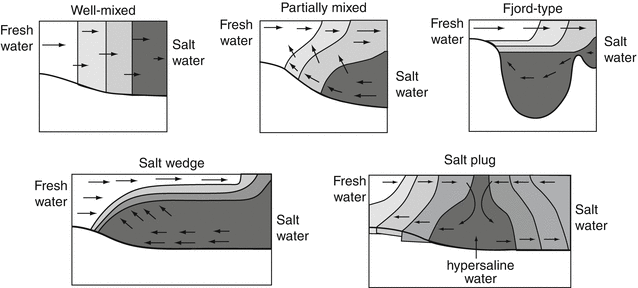
Salinity zonation in a stratified estuary creates sub-habitats.
Gradients in biodiversity depending on salinity - less salinity means freshwater species, more salinity means marine species. Critical salinity range - shift between species in a certain salinity level
Estuaries exhibit high variation (sometimes by the hour!) in: salinity, temperature, oxygen, turbidity, carbon dioxide, pH, etc. Highly adaptive organisms live in estuaries.
Geologically ephemeral (short-lived) but biologically rich. Impacted intensely by the watershed, can determine water and nutrient input and flow regime. Acts as an important fish nursery.
Associated habitats: marsh, seagrass bed, mangal (mangrove hub)
Impact of SLR is significant!
Rocky/Sandy intertidal zones
Rocky: Found on active tectonic margins (West Coast), ideal areas for surfers because the hard shore forms consistent waves.
Sandy: Can be found on passive margins (west and east coast)
Intertidal (littoral) zone: Area under water at high tide and exposed at low tide.
Strong zonation exists in rocky shore habitats
Zonation is less distinct in soft sediment beaches.
Ex of commonly found species succession through different rocky shore zones:
Lichen zone (far away from shoreline)
Periwinkle (Gastropod) zone
Barnacle dominated zone
Mussel zone
Seaweed zone (right at shoreline)
Tide pools
Determinants of vertical zonation: heat stress/desiccation, gas exchange - dissolved oxygen (how much can you breathe?), wave shock, biological interactions (competition, predation)
Heat stress: Varies on small spatial scales. body size, shape determine heat/water loss. Evaporative cooling and circulation of body fluids. Well-sealed exoskeletons. Stress measured in terms of energy budgets. Certain proteins are indicative of stress (High Stress Proteins)
Gas exchange - dissolved oxygen: intertidal animals usually cannot respire at low tide. Respiratory organs must be moist to acquire oxygen, are usually withdrawn at low tide. Some high intertidal animals can respire from air even at low tide if air is not too dry. Crabs have respiring organs on the legs?
Wave shock: Abrasion, pressure, drag. Abrasion can scrape delicate structures. Pressure of breaking waves can crush compressible structures. Drag can pull organisms or carry them away from burrows/living positions. ON BEACHES: swash riders - wave riders that change burrowing behavior depending on tide.
Adaptations and Consequences
Physiological tolerance at different levels of the shore (ex. desiccation in barnacles vs anemone, build up of waste products)
Feeding, growth, and reproduction: less time submerged may result in less time to feed, mobile organisms may migrate with tide.
Larval settlement strategies - larvae may settle at time of high tide at high levels, behavioral responses that keep them at certain levels of shore
Competition and predation: species may be capable of excluding others from certain levels of the shore
Disturbance is crucial in maintaining diversity via colonization events. Depending on the size of the disturbance, it may or may not result in spatial changes in communities. A large disturbance allows for more species to colonize an area.
Soft sediment intertidal habitats
Zonation is not as distinct as on rocky shores. Higher intertidal species burrow more deeply to avoid drying out. Water retention reduces vertical desiccation and temperature stress gradient.