LTM & Everday Memory
Components of Memory Processing
Encoding
Process by which transform what we perceive, think or feel into (enduring) memory.
Storage
Process of maintaining this information over time.
Retrieval
Process of bringing to mind information previously encoded and stored.
Long-Term Memory ‘systems’
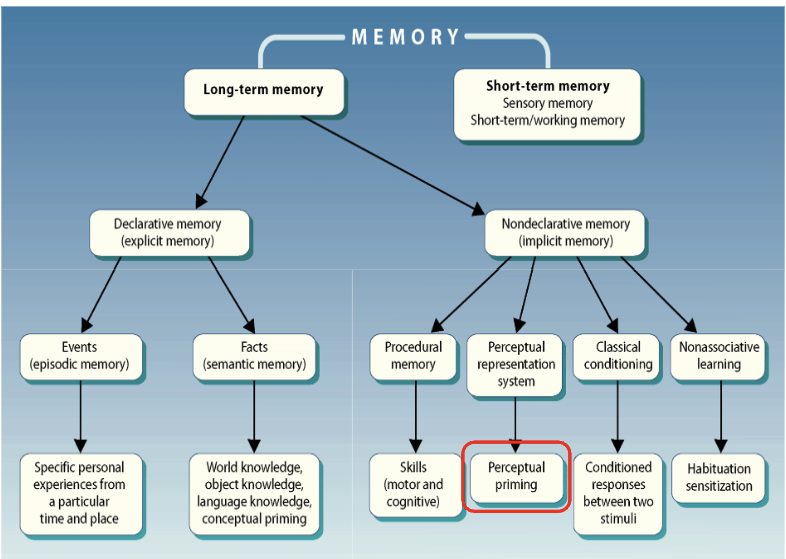
Priming - Facilitating processing of / response to target by presenting stimulus related to it before.
Declarative Memory
Conscious recollection (declare)
Events and Facts
Episodic Memory
What, Where and When of past experiences
Hippocampus
Semantic Memory
Knowledge about the world
Generalized, no reference to specific experience
Anterior temporal lobe
Declare - Usually to be described in words, things know to be the case.
What form does Episodic Memory take?
More efficient
Details are usually trivial and ‘expensive’ to produce semi-permanent record in brain.
Downside = error prone (false recognition & eyewitness testimony)
More likely to remember ‘gist’ as swe age compared with when younger.
False recognition (Brainerd& Mojardin, 1998)
More likely to remember ‘gist’ as we age
Presented children with series of sentences
‘The coffee is hotter than the tea’
‘The tea is hotter than the cocoa’
‘The cocoa is hotter than the soup’
Test sentences ‘The cocoa is cooler than the tea’
Importantly the content was accurate, but the sentence construction differed from originals.
Question: Was this specific sentence presented in original set?
Younger children are more likely to get it right than older children.
What form does Episodic Memory take?
Is more about being constructive, rather than remembering past events - for imagining and planning the future.
Hippocampus activated when imagining the future!
Concepts in Semantic Memory
Concepts are mental representation of categories
Hierarchy of concepts
Superordinate
Basic
Subordinate