VCE Australian and Global Politics Unit 1
Area of Study 1
Key Terms and Concepts
- Liberal democracy: individual freedoms and rights are recognised and protected and it emphasises the separation of powers
- Representative democracy: When the citizens elect people to represent them in the legislative branch
- Constitutional monarchy: A political system with a monarch, and their authority and powers are defined by the constitution
- Socialism: A left wing political ideology which revolves around the belief that the government should own production and wealth on the people’s behalf
- Fascism: A right wing political
ideologywhich usually has a dictatorial leader and their severe beliefs of nationalism, authoritarianism and anti-democracy - Authoritarianism: A system of government characterised by a strong central government and limited democratic rights and freedoms.
- Theocracy: A governmental system that centres religious beliefs
- Ideology: A set of values and beliefs a group of people have in common regarding how the world should be organised politically
- Political power: The use of a state’s internal political machinery to influence citizen’s actions. Ex. legislation, executive orders
- Authority: The power of a person or group over other people in a political power context
- Legitimacy: When political power is widely accepted by the population, typically through democratic means
- Federalism: A government system where law making powers are separated between a national/central government and state/regional governments
- Separation of powers: The three branches of government (parliament, executive and judiciary) should be kept separate from each other to avoid abuse of power and ensure power is evenly distributed
- Judiciary branch: Makes judgements on law, represented by the High Court of Australia
- Parliament branch: Make and change law, represented by the upper and lower house and the King (Governor-General)
- Executive branch: Put law into action, represented by the King (Governor-General), Prime Minister and ministers
- Representative government: A political system where the legislative and executive branches are operated by elected citizens on behalf of the people
Political Spectrum and Labelling 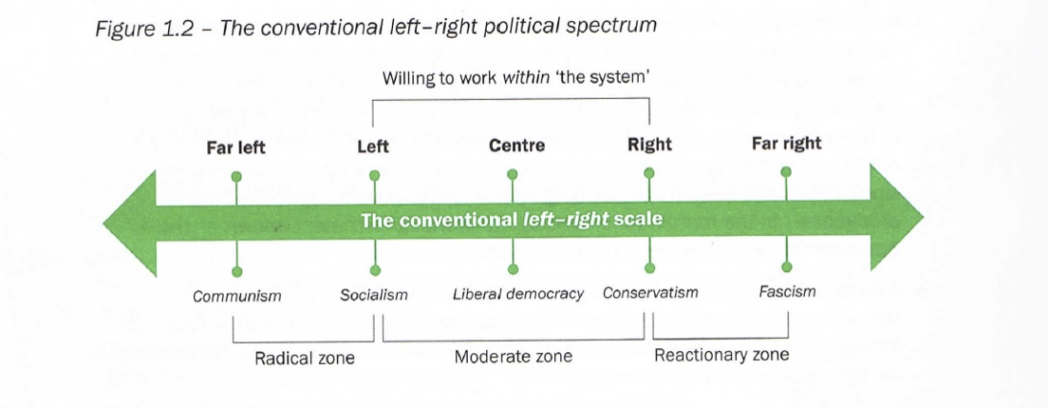
- Left-wing: This political label emphasises progress, reform and social equality
- Right-wing: This political label is based on conservative beliefs, reaction and tradition
- Conservative: This political ideology focuses on traditional family structures and social values
- Moderate: Rejecting extreme viewpoints and having a mainstream
- Liberal: Believing in equality, freedom and human rights
- Reactionary: Someone who wants to revert to traditionalism and reverse political changes
}}s}}USE CANVA PRESENTATION + NOTES
Characteristics of Australian Democracy
Another presentation?
- A written constitution (1901)
- Appointed head of state (King Charles III)
- Federal Government
- Westminster parliamentary government - Bicameral system
- Mandatory participation in elections
- Dominance of major parties - Australian Labor Party and Liberal Party of Australia
Case Study of a Non-democratic Political System - China
- {{Actor: China - People’s Republic of China (PRC){{
- {{Political System: Democratic dictatorship or Socialism w/ Chinese characteristics{{
- {{Political Party: The Communist Party of China{{
- {{Governing style: One-party state, Authoritarianism{{
Context of the Political System
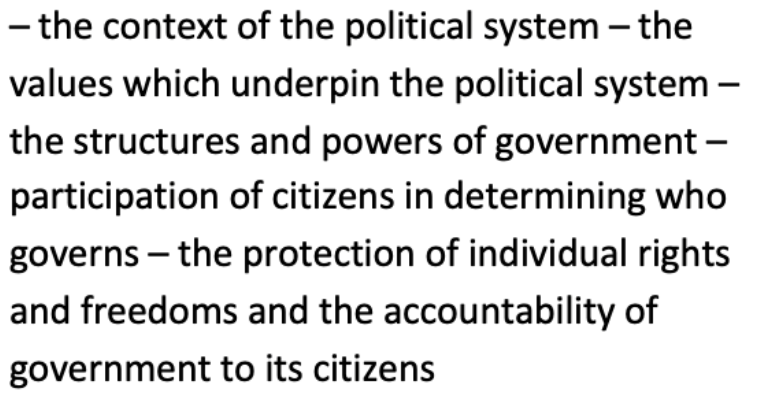
Values that underpin the political system
- }}Regime security: Associated w/ one party states. The lengths a ruling elite will go to in order to maintain power. Involving repression, violence, propaganda, rewarding of obedience and loyalty}}
- Mao Zedong thought: Known as Chinese communism
- Adapted from Marxism-Leninism thought
- Changed and edited to adhere to specific beliefs and circumstances
- Collective wisdom of veteran revolutionary leaders
Structures & powers of China’s government
- One party two coalitions → reaction to Mao Zedong’s reign to avoid the autocratic strongman rule
(insert organisational chart PAGE 59)
- Princeling Faction: Come from families of revolutionaries or high ranking individuals
- Economically well-developed coastal cities
- Financial beneficiaries
- t Faction: Advance in politics through the Chinese Communist Youth League
- AKA tuanpai → league faction
- Representing farmers, migrant workers, urban poor, etc
- Politburo Standing Committee: The core leadership group of CPC that enacts and amends all laws
- Comprised of 5-7 members who make decisions on major issues
- Highest level of executive government
- Transfer of power in the CPC is an internal matter
- Protections of rights and freedoms: Deemed an authoritarian society, has power over the citizens’ lives, less free and independent media outlets, prioritises economic rights over political freedoms
Chinese citizens’ participation in determining who governs & CPC’s accountability to its citizens
- No opportunity for citizens to engage in political decision making
- No multi-party system → lacks pluralism
- No free, fair and regular elections
- Transfer of power occurs internally
- Concentrated in Politburo Standing Committee
- Shape + direct government policy
Protection of individual rights & freedoms
PAGE 62!!!!!!
Power
- Power: The ability to direct people’s behaviour and have authority over others
- Hard power: When an actor uses force and coercion to get what they want
- Threatened with money or a material/monetary incentive
- Actor A wins, Actor B loses
- Eg. North Korea’s military system → use of 25% of GDP on military
- Soft Power: The use of appeal and attraction to achieve goals
- Actor A appeals to Actor B so they want the same thing → Actor A strategically makes situations to make the win favourable for Actor B
- Eg. Australia’s government system → focus on building connections with other countries with Australia’s internet at large
Politics Types
- Formal politics: The dominant frame of reference when considering the nature of politics, associated with the 24 hour news cycle
- Prominent political actors - Prime Ministers, Presidents
- Informal politics: Power structure of personal relations between people to obtain power
- Eg. Workplace structures, friend groups, relationships
Area of Study 2
Key Terms & Concepts:
- Political parties: Organised groups of people who hold similar views and ideas on a range of public policy issues and who seek to be elected to parliament. Political parties can vary in political ideals and allow for people to vote for representatives whose ideologies align with theirs.
- Eg. Australian Labor Party
- Interest group: A group of like-minded people who work to influence government policy and decision making, either for the benefit of those they represent or society more broadly, but do not seek election themselves. Many interest groups are non profit organisations and charities that advocate for certain issues and hope to make a positive impact on society.
- Eg. Amnesty International, UNICEF
- Traditional media: Commonly or 'older' accepted means of communication and expression, such as print newspapers, radio and television news. This form of media is more widely accessible for those who do not know how to access digital media.
- Eg. The live broadcast of 7News.
- Social media: Web based communication tools that enable people to interact, respond and communicate by sharing and consuming information. Social media can be used as a marketing tool in the digital age and has a major influence on younger audiences.
- Eg. Facebook, TikTok
- New media: A broad and evolving term including digital and web based forms of sharing information such as blogs, online news sites, which are easily accessible on demand via personal devices. New media encompasses content such as newspaper articles, podcasts and even music that can be accessed online.
- Eg. Vox, a news and opinion site.
- 24-hour news cycle: The understanding that news is now reported on, investigated and analysed quickly and continuously over a 24 hour period in all forms of the media. Over the 24 hour period, news can rapidly evolve and news outlets want to be the first to release new information and be ahead of the others.
- Eg. 10 News First
Roles & Functions of Political Parties
- Presenting ideas and policies: Use of media + marketing strategies to persuade voters that their ideas/policies are superior to other parties
- Representing sections of society: Carry out public interests of workers, farmers, environmentalists, the wealthy, etc
- Contesting elections: Nomination of candidates to seek to gain as much votes or influence as possible
Decline in support for major parties - emergence of minor parties
Long-term factors
- Historical political factors:
- Democratic Labor Party emerged in the 1950s
- Formation of the Australian Democrats
- Creation of the Australian Greens in 1992
Short-term factors
- Larger number of candidates → turn away from major parties
- Social changes: Weakening of parental influence, social media
Impact of public perceptions of politicians
- Increasing voter disillusionment
- Do not offer real policy choice
- Not perceived to uphold societal morals & values
- Major political parties not delivering on election promises
Roles & Functions of Interest Groups
- Advancing ideas and policies:
- Letters, protests, campaigns
- Source of expert information and education about specific issues:
- Amnesty International posts informative videos on YouTube and news on their social media platforms
- Amnesty International has researchers worldwide, cross checks research, puts this into reports
- Seeking to influence government decisions:
- Eg. Amnesty International reported about the inclusion of 17 y/os in the adult justice system → Queensland Government amended the law to include them in the youth justice system
- Engaging w/ the public to build support + membership
- Campaigns, petitions, protests, rallies, etc
Amnesty International:
- Human rights: mutual respect, compassion for all
- investigate and expose things that are against human rights
- keep governments accountable for their actions and promises → respect for international law
- based on the UN United Declaration of Human Rights
- helping empower marginalised groups
- abolishing the death penalty
Differences between Interest Groups and Political Parties
| Political Parties | Interest Groups |
|---|---|
| Common goals + principles regarding the political system | Aim to achieve specific objectives |
| Broad array of issues covered | Narrow focus on certain issues |
| Winning seats in the house of representatives (contest elections) | Influencing government policy |
| Must present unified face to the public | Do not have to because they do not want to be entrusted w/ public office |