Stem Cells and Tissue Renewal :04-17-2025
Stem Cells and Tissue Renewal
Multicellular Habitat
Cells of multicellular organisms are highly specialized.
Over 200 types of cells in the human body are arranged into tissues, organs, and organ systems.
Cells cannot survive outside their bodily "habitat."
Habit is modified and lives in an environment that they have created, essentially having a hierarchy
Most differentiated cells in the body—like liver cells, brain cells, skin cells—are like specialists in their field. Once they've chosen their "career," they’re pretty much locked into that role and "environment." A liver cell in the brain wouldn't know what to do, and it wouldn't survive well because the signals and support systems it relies on just aren’t there.
Unless you are a stem cell, ES cell, iPS
Specialized Cell Types
🧱 Differentiated cells = like finished LEGO models (e.g. a spaceship or a car) — built for a specific purpose.
🧩 Undifferentiated cells = like a bucket of LEGO pieces — you can build whatever you need from them
Early embryo cells are identical (undifferentiated).
Differentiation leads to the formation of specialized cell types.
Some differentiated cells can still divide.
Many others are terminally differentiated and do not divide.
Tissue stem cells are responsible for supplying replacement cells, especially in tissues where differentiated cells rarely divide.
Cell Hierarchy in the Crypt:
Cell Type | Location | Division Rate | Fate |
|---|---|---|---|
Stem Cells | Just above crypt base | Slow-dividing | Self-renew OR give rise to transit amplifying cells |
Transit Amplifying Cells | Middle/upper crypt | Rapid division (~12 hrs in mice) | Proliferate to amplify numbers, then differentiate and stop dividing. Since their divisions serve to amplify the number of differentiated cells that ultimately result from each stem-cell division |
Differentiated Cells | Migrate to villi or stay in crypt (Paneth) | Non-dividing | Carry out specialized functions; eventually undergo apoptosis (if on villi) |
What is a Stem Cell?
Not Terminally Differentiated
Stem cells are undifferentiated; they are not at the end of a differentiation pathway.
Unlimited Division Potential
Stem cells can divide indefinitely or maintain the capacity to divide, so they never lose their capacity to divide. (or for the lifetime of the organism).
This unique ability allows them to produce a wide variety of specialized cell types necessary for repairing and regenerating tissues.
Daughter cells have two possible fates:
Remain as stem cells.
Commit to terminal differentiation, often passing through intermediate cell types.
Stem cell systems are those tissues that rely on stem cells for renewal.
Function & Role of Stem Cells
Purpose: Stem cells maintain tissue homeostasis by replacing differentiated cells that cannot divide.
Division Rate: Many stem cells divide slowly, despite their long-term contribution to tissue maintenance.
Stem Cell Division
To maintain a stable population of stem cells, each stem cell division must, on average, produce:
1 daughter stem cell
1 daughter committed to differentiation
Environmental asymmetry(Intrinsic Mechanism):
Mechanism: The parent cell divides asymmetrically, distributing regulatory molecules unequally.
Outcome:
One daughter retains stem-cell identity.
The other commits to differentiation.
Produces two daughter cells, with some remaining as stem cells and others becoming differentiated. Some remain stem, some become differentiated.The ratio of stem to differentiated cells is controlled by environmental factors
Whatever happens in the environment dictates the fate of these daughter cells, determining whether they continue to self-renew or embark on the path to specialization.
Advantage: Guarantees one new stem cell per division—very controlled and predictable.This process is crucial for maintaining tissue homeostasis and allows for efficient repair and regeneration of damaged tissues.
Divisional asymmetry:
Mechanism: Each daughter cell makes an independent fate decision:
50% chance to remain a stem cell.
50% chance to differentiate.
Each stem cell division produces one new stem cell and one cell destined for differentiation.
Outcome:
Variability:
Both daughters might become stem cells.
Both might differentiate.
Or one of each.
Modulators:
Stochastic factors (random chance).
Environmental signals (local niche factors).
Advantage: Flexible and adaptive.
Can shift balance to favor stem cells during growth or repair.
Offers dynamic control over cell populations.
Stem Cell Division Strategies:
Environmental and divisional asymmetry are key strategies for maintaining stem cell populations while producing differentiated cells at the same time.
Stem cell fate in the gut is regulated by flexible, independent choices, not fixed asymmetric divisions.
This system allows the stem-cell pool to respond adaptively to the tissue’s needs (e.g., during injury repair or growth).
Image

Stem Cell Types
Skin and blood will be examined as two primary stem cell systems.
Most of the stem cells found in the skin have and use similar components found in the intestines.
Epidermis
Tissue Overview: Epidermis
The fundamental component of the skin, producing structures such as fingernails, hair, and glands
The epidermis is the outer epithelial layer of the skin.
It is multilayered (stratified), unlike the single-layered gut epithelium.
Undergoes continuous renewal, shedding lifeless scales (squames) at the surface.
Comprised of multiple layers of cells called keratinocytes.
Keratinocyte Types
Basal Cells: Dividing cells attached to the basal lamina, giving rise to other epidermal types.
Basal cells = skin tissue stem cells
Stem cells depend on signals from their local environment: Basal lamina and underlying connective tissue provide these signals.
Only basal cells divide; everything else just moves up because of the basal cells dividing.
New basal cells have one of two fates:
Add to the population of basal cells
One daughter cell that stays in the basal layer and continues dividing
begin differentiation into other epidermal types
One daughter cell that begins its journey upward, differentiating as it goes
Essential changes moving upwards to form the various layers of the epidermis, ultimately contributing to the protective barrier of the skin.
Differentiation from basal to shedded squame
Prickle Cells: Characterized by visible desmosomes.
They are daughter cells—the descendants of stem cells—that have already started their journey of differentiation
Granular Cells: The last layer of living cells before terminal differentiation into keratinized squames.
In this stage, these cells begin breaking down intercellular structures, such as their nuclei and organelles, while producing large amounts of keratohyalin granules and lamellar bodies
As they transition into the next layer, stratum corneum, these granular cells effectively become non-living shells packed with keratin — ready to be sloughed off and replaced, maintaining epidermal renewal.
Keratinized Squames: Terminally differentiated epidermal cells that are eventually shed.
Shedding squames
Transit Amplification
Produced immediately from stem cell division, cells undergo multiple additional divisions before differentiation.
Transit Amplifying Cells: Cells that transition from stem to terminal differentiation.
Committed daughters undergo several rounds of division before terminal differentiation, similar to transit-amplifying cells in the intestine.
Independent Choice Mechanism:
Cell fate after division follows a stochastic (random or environment-influenced) mechanism:
Allows flexibility in stem-cell numbers.
Supports growth and wound healing when necessary.
Immortal DNA Strand Hypothesis
Normal chromosome segregation vs. Asymmetrical segregation hypothesis:
“Normal” or “Random” segregation of chromosomes
DNA is replicated
identical sister chromatids separated
Outcome:
Each daughter cell receives a random assortment of old (template) and new (copied) DNA strands.
distribution among daughter cells is random
No bias in which daughter becomes a stem cell.
Asymmetrical or “Immortal Strand” segregation hypothesis
Proposes that one of the original template DNA strands (the "immortal" strand) is tagged in some way.
During division, the tagged template strands are all directed to one daughter cell.
Tagged template strands are delivered to the same daughter cell, helping maintain the stem cell population.
Outcome:
This daughter cell retains the original DNA and remains a stem cell. Basically, upon segregation, tagged template strands all delivered to the same pole
The other daughter receives the newly synthesized strands and differentiates: defines which daughter cell will be a stem cell
Purpose:
Protects stem cells from accumulating mutations during DNA replication.
Keeps the most "faithful" copy of the genome in long-lived stem cells.
Explain:
When a stem cell divides, it copies its DNA, then splits into two daughter cells.
Random Segregation (the “eh, flip a coin” approach)
When DNA is copied, each strand has one old strand and one new strand.
These are randomly handed out to the two daughter cells.
There’s no plan—both daughters get a mix of old and new DNA.
Either daughter could become the stem cell... it's a 50/50 shot.
Immortal Strand Hypothesis (a.k.a. the “VIP DNA” system)
Proposed by Cairns in the 1970s—real deep thinker.
Idea: When stem cells divide, they intentionally give all the original (“immortal”) DNA strands to one daughter.
This cell becomes the next stem cell.
The newer DNA strands go to the daughter that differentiates.
Why? Because new DNA can have more replication errors (mutations). So by keeping the “clean, tried-and-true” DNA, the body protects the integrity of stem cells, which are around for life.
The stem cell daughter inherits the “immortal” (template/original) DNA strands.
The other daughter gets the new DNA copies and begins differentiation.
this one doesn’t get the original copy—it just divides into a differentiated cell, so it goes on and becomes specialized.
Hematopoietic Stem Cells
These stem cells are essential for blood production, residing in bone marrow (hemopoiesis).
Key idea: Hematopoietic stem cells (HSCs) don’t commit to a specific blood cell type all at once. Instead, they go through progressive stages of narrowing potential.
Hematopoiesis as a Hierarchy
Multipotent HSCs
↳ Can generate all blood cell types
↳ Divide slowly (for safety & longevity)Committed Progenitor Cells
↳ Lineage-restricted (e.g., myeloid or lymphoid)
↳ Divide rapidly to expand cell numbersTransit Amplifying Cells
→ rapid division to increase numbers
Terminally Differentiated Cells
↳ No further division
↳ Short-lived (days to weeks)
How:
The number of hematopoietic stem cells (HSCs) is very small compared to the total population of blood cells.
Yet, the system supports a high turnover rate of blood cells with:
Low stem cell division rate
↳ Preserves stem cell pool & reduces risk of:DNA mutations → cancer
Replicative senescence (cell aging)
Variability
Not all stem cells follow the exact same path of differentiation.
There's flexibility and variation in:
The sequence of steps
The patterns of progeny produced
Commitment of Progenitors: Blood cells differentiate from multipotent hematopoietic stem cells into various cell types (e.g. T cells, B cells, macrophages).
More committed than a stem cell, but not quite as specialized as a differentiated cell, yet. Has limited potential.
Amplification Before Terminal Differentiation
Hematopoietic progenitor cells commit to a specific cell lineage early, before they stop dividing.
After commitment:
They go through multiple cell divisions.
This amplifies the number of final differentiated cells.
✅ Result: One stem-cell division can ultimately yield thousands of mature blood cells.
Explain:
A stem cell divides asymmetrically:
One cell stays a stem cell 👑
One becomes a progenitor cell 🧬
The progenitor cell commits to a certain lineage (like "I’m gonna be skin" or "I’m gonna be blood").
BUT—it doesn’t become fully specialized yet.
Instead, it becomes a transit amplifying (TA) cell, which:
Rapidly divides a few times 🔁🔁🔁
Amplifies the number of cells heading down the same specialization path
Then each of those daughter cells differentiates into a final, mature cell
Stage
Mindset
Action
Stem Cell
"What do I wanna be?"
Can become anything
Progenitor
"I wanna be skin."
Limited potential, begins dividing
TA Cells
"Let’s multiply before we specialize!"
Rapid division, no turning back
Differentiated Cell
"I'm a skin cell, fully trained."
Final form, ready for action
Adult Stem Cells
Tissue-specific and not as versatile as embryonic stem cells.
Stem cells from one tissue grown in the presence of other tissue cells
may or may not survive
generally lose stem cell properties
may acquire different properties from than source
Do not adopt characteristics of the tissue they are in, they can’t change often lead to cancer.
“Cheating” tissue-specificity of stem cells
stem cell plasticity
Stem cell plasticity = the idea that adult stem cells might sometimes break the rules and adopt traits of other tissues
Image


Stem Cell Treatments
Hematopoietic Stem Cell Therapy (Bone Marrow Transplantation)
Used for treating leukemia, lymphoma, and similar blood cancers.
Step-by-step:
Patient is irradiated or treated with chemo to destroy cancerous cells (and healthy hematopoietic cells)
E.g. leukemia, including HBC’s
Healthy HSCs (either from a donor or the patient’s own pre-treatment sample) are transfused back in.
These stem cells recolonize the bone marrow and regenerate the blood system.
🔄If the patient's own HSCs are used, it avoids immune rejection.
Hematopoietic Stem Cells are used to replace unhealthy blood cells in conditions like leukemia. Treatments include marrow transplants and transfusions.
Epidermal Stem Cells for Skin Repair (Burn Victims)
For patients with extensive burns:
Cells from undamaged skin are collected.
Epidermal stem cells are cultured in large quantities in the lab.
These are then grafted back onto the damaged skin to rebuild the epidermis.
🧪 This process is complex but life-saving and a major example of tissue regeneration.
Epidermal Stem Cells: Cultured for replenishing damaged skin, especially in burn victims.
Genetically Engineered HSCs: Used to produce important gene products or to study diseases.
remove cells, grow in culture
genetically modify
Two basic modifications
modify to produce the important gene product
transplant into the patient without the natural ability to produce a product
stem cell divides, produces lots of cells, producing a product
modify to mimic the disease condition
Keep cells in culture to study disease, test therapies
Neural Stem Cells & CNS Repair
Neural Stem Cells: Still in experimental stages but show promise for complex differentiation.
Natural Regeneration:
Fish & amphibians: Can regrow brain, spinal cord, and eye tissue after injury.
Adult mammals (including humans): Very limited CNS regeneration.
For a long time, scientists thought neural stem cells didn’t exist in adult brains.
What we now know
Neural stem cells (NSCs) do persist in specific areas of the adult brain:
Especially in the hippocampus — involved in memory and learning.
About 1,400 new neurons are made daily in this region = 1.75% turnover/year.
Lab use: Neurospheres
Brain tissue from adults or fetuses can be cultured into neurospheres:
Contain NSCs + neurons + glial cells.
Can be grown and propagated indefinitely.
Can be implanted back into living animals where they differentiate correctly.
Controlled Culture:
With specific growth factors, NSCs can be:
Grown as pure stem-cell monolayers.
Later triggered to form:
Only neurons, or
Only glial cells, or
A mix of both, depending on conditions
Transplant Flexibility:
Neural stem cells show plasticity—they adapt to their new location in the brain:
E.g., mouse hippocampal stem cells transplanted into the olfactory bulb give rise to functional neurons appropriate to that region.
Clinical Potential:
This adaptability means neural stem cells could one day be used to:
Replace lost neurons in Parkinson’s disease.
Repair spinal cord injuries.
Treat neurodegenerative diseases.
Embryonic Stem Cells
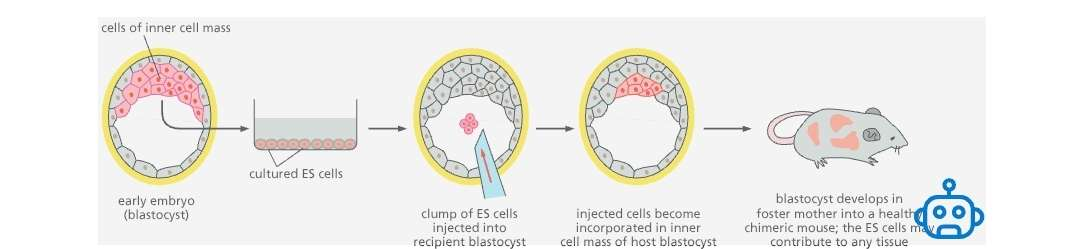
Human ES Cells: Similar to mouse ES cells, human ES cells can be derived from early embryos and human fetal germ cells.
Pluripotent: They can become virtually any cell type in the body but cannot form the placenta or other extra-embryonic tissues.
When introduced back into a blastocyst, ES cells can integrate into the developing embryo, contributing to all tissues in the body, including germ cells, which are essential for reproduction.Can be cultured indefinitely and can lead to various tissue regeneration therapies..
Location dependent: it will form based on where it is transplanted within the body, highlighting the need for precise methods of delivery to ensure successful integration and function of the differentiated cells.
As long as you put the blastocyst back in the same time, location, and position it will continue where you left off.
Issue Arise:
if put back at a different time point, often result in tumor cells
lack of function related to lack of proper extracellular signal
Because its at a different stage of development, so placing it in will not be able to catch up.
Pluripotent Stem Cell Potential
Pluripotent Cells:
Can give rise to nearly all cell types in the body but not extra-embryonic tissues (like the placenta).
Embryonic stem (ES) cells fall into this category.
ES cells are derived from the inner cell mass of the blastocyst, an early-stage embryo.
They can proliferate indefinitely in culture and retain their potential to differentiate into various cell types.
Grown human PSCs could provide cells for regenerating tissues (muscle, nerve, heart) and organ repair (e.g. insulin-secreting pancreatic cells).These cells, these can differentiate into any cell type.
Image