ADME
ADME stands for Absorption, Distribution, Metabolism, and Excretion, which are the four key processes that describe the pharmacokinetics of a drug in the body.
Linpinsk’s Rule of 5
Oral absorption is likely to be poor for a molecule if (Adv. Drug Del. Rev.
23:3 (1997)):
• there are more than 5 H-bond donors (sum of NH and OH groups)
• there are more than 10 H-bond acceptors (sum of N and O atoms)
• the molecular weight is >500
• the calculated log P (cLogP) is >5
Kinetic solubility refers to how quickly a drug dissolves, while thermodynamic solubility refers to how soluble a drug is at equilibrium
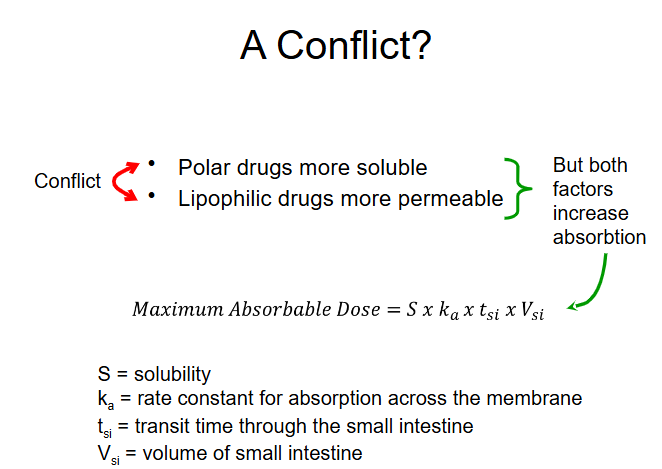
Absorption requires solubilisation
ionisation (pH), hydrophilicity, molecular shape
polar drugs usually more soluble
solid drugs needs to dissolve before they can be absorbed
rate of dissolution can limit rate of absorption
Transport across membranes
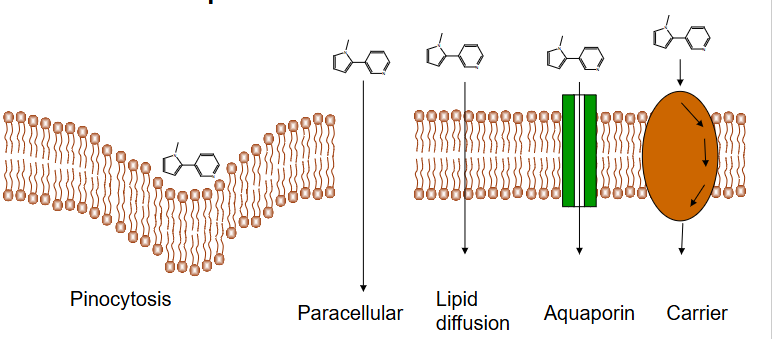
Paracellular Diffusion
Between cells - usually only small (Mr <350) polar drugs
Some membranes are more permeable than others
eg. nasal epithelium more leaky than GI tract epithelium
eg. very tight junctions in blood brain barrier
Passive diffusion through LiPID
Fick’s Law
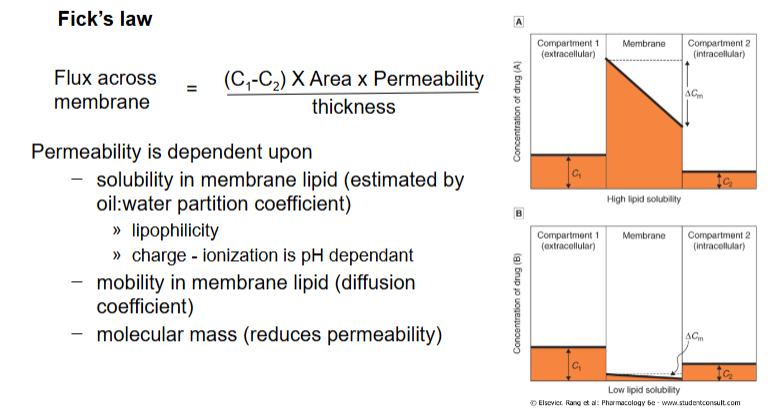
The concentration gradient, membrane area, thickness, and permeability are critical factors in drug flux across membranes.
The balance between polarity and lipophilicity is crucial for predicting drug absorptions.
pH and ionization significantly affect drug absorption, with the pH partition hypothesis explaining how charged and uncharged states influence membrane permeability
pH trapping
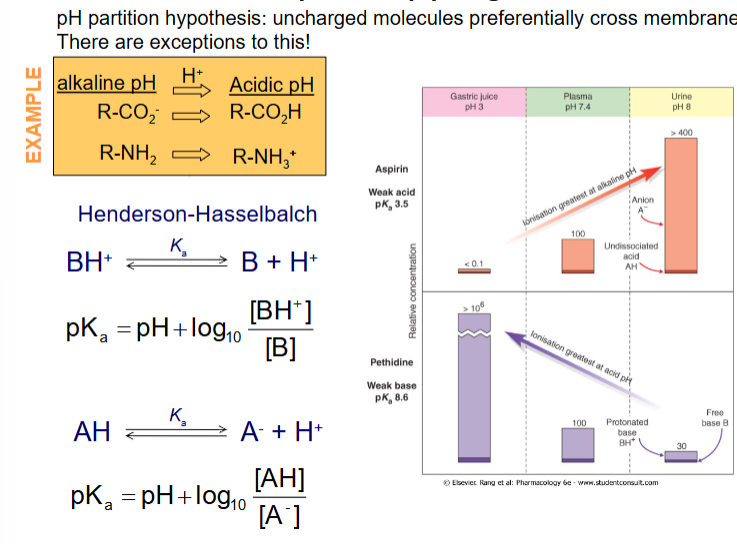
pH trapping through the pH partition hypothesis, which describes how drugs' charged and uncharged states affect their ability to cross membranes.
When a drug moves from one compartment to another with different pH levels, it can become trapped due to ionization changes.
The charged form of the drug cannot easily cross membranes, while the uncharged form can pass through more readily.
This concept is particularly important for drug absorption, as the pH differences between various body compartments (like the stomach and blood) can significantly influence where drugs accumulate and how effectively they are absorbed
Carrier-mediated transport
Carrier-mediated transport
Active