Coleridge. Textual Analysis- The Ancient Mariner (1798) (Lect. 39)
Composition
Written by Samuel Taylor Coleridge in the autumn and winter of 1797-98 while residing in Nether Stowey, Somerset.
Coleridge was engaged in varied literary pursuits and briefly served as a minister in Shrewsbury in December 1797, during which he read the poem publicly for the first time.
Inspiration
According to William Wordsworth, the idea for poem was conceived while he and Coleridge were on a walking tour . Wordsworth claims merit for proposing the idea. At the time he was reading A Voyage Round The World by Way of the Great South Sea (1726) by Captain George Shelvocke, which narrates a sea voyage in 1719 during which a sailor, Simon Hatley, shot a black albatross.
Wordsworth suggested a possible symbolic interpretation of the event for Coleridge's poem: "Suppose you represent him as having killed one of these birds on entering the south sea, and the tutelary spirits of these regions take upon them to avenge the crime."
Sources
Shelvocke’s narrative depicted the albatross as an evil omen, thus contrasting sharply with Coleridge's treatment of the albatross as a symbol of good fortune and spirituality.
Shelvocke's A Voyage Round The World narrates the killing of the albatross as follows:
"We all observed that we had not had the sight of one fish of any kind since we were come to the southward of the Straits of Le Maire, nor one sea-bird, except a disconsolate black albatross, who accompanied us for several days, hovering about us as if he lost himself, till Hatley, my second captain, imagining from his colour that it might be some ill-omen, after some fruitless attempts, at length shot the albatross, not doubting, perhaps, that we should have fair wind after it."
Here the blackbird is interpreted as an evil omen, while in Coleridge's poem, the white albatross is a good omen, shot arbitrarily by the mariner.
Influences from Exploration
The poem may have drawn inspiration from significant explorations, including James Cook's second voyage and journals written by William Wales, both of which Coleridge encountered during his educational background.
Coleridge may also have been influenced by accounts of James Cook's second voyage to the South Seas and the Pacific Ocean (1772-1775), in particular the journal kept by Cook's astronomer William Wales, who taught mathematics at Christ's Hospital school when Coleridge was there. Cook and Wales saw the Antarctic ice fields, which may have inspired the poem's passages set in the icy seas.
Imagery within the poem embodies the stark beauty and harsh realities of Antarctic ice fields, lending itself to the poem's atmosphere.
The Ancient Mariner
Medievalism and Gothic Themes
The poem inherently reflects a Romantic interest in Medieval culture, characterized by themes of gothic art, chivalry, and a deep connection to nature. Coleridge believed that gothic art could powerfully convey the essence of romantic poetry, invoking profound feelings of devotion and awe.
The growing interest in gothic themes also stimulated the Romantic revival of the Medieval culture. Coleridge believed gothic art to be the most direct reference to romantic poetry: "Gothic art is sublime. On entering a cathedral, I am filled with devotion and awe; I am lost to the actualities that surround me, and my whole being expands into the infinite; earth and air, nature and art, all swell up into eternity, and the only sensible impression left is, 'that I am nothing!'"
Key elements such as the ship, the albatross, and various sea creatures are laden with multi-layered symbolic meanings that promote universal themes of sin, redemption, and the human condition.
Coleridge's "Rime of the Ancient Mariner" was therefore influenced by medieval elements, such as gothic atmosphere, archaic terms, and symbolic journeys. Many elements in the poem have a symbolic meaning (the ship, the albatross, the sun, the moon, the sea and its creatures).
Poetry and Supernatural Events
One of Coleridge’s main objectives with his collection Lyrical Ballads was to illustrate supernatural occurrences in ways that resonate with relatable human experiences, bridging the gap between the real and the ethereal.
The poem is structured around symbolic journeys that mirror the emotional landscapes and societal experiences of humanity, encompassing themes of isolation, guilt, and ultimate redemption.
Coleridge's task for the Lyrical Ballads was to represent supernatural events in plausible ways: "In this idea originated the plan of the 'Lyrical Ballads'; in which it was agreed, that my endeavours should be directed to persons and characters supernatural, or at least romantic, yet so as to transfer from our inward nature a human interest and a semblance of truth sufficient to procure for these shadows of imagination that willing suspension of disbelief for the moment, which constitutes poetic faith."
Ballad Form
While the structure does not historically portray the Middle Ages with high accuracy, it reflects popular cultural themes of the time, engaging with folklore, myth, and a deep-seated fascination with the mystical.
Coleridge utilizes the ballad form, characterized by several quatrains with varied line lengths, following a rhythmic meter that enhances the lyrical quality of the poem. Examples illustrate alternating meters, inviting a musical quality that lingers in the reader's mind.
The ballad offered the Romantics an idea of the Middle Ages that was not historically realistic, but representative of current popular taste. The romantics believed that the elements presented in ballads, such as the supernatural and the mysterious, were typical of medieval culture. This view gave rise to the spread of romantic literary ballads.
Coleridge's use of the ballad form is usually regular: he divides the poem into seven parts. Most of the stanzas in the poem have four lines or quatrains; several have five or six lines. In the four-line stanzas, the second and fourth lines usually rhyme.
In the five- and six-line stanzas, the second or third line usually rhymes with the final line.
Meter: The meter alternates between iambic tetrameter (with four feet per line) and iambic trimeter (with three feet per line): this is known as ballad meter.
Following is an example (the first four lines of Part II) of a stanza with this pattern: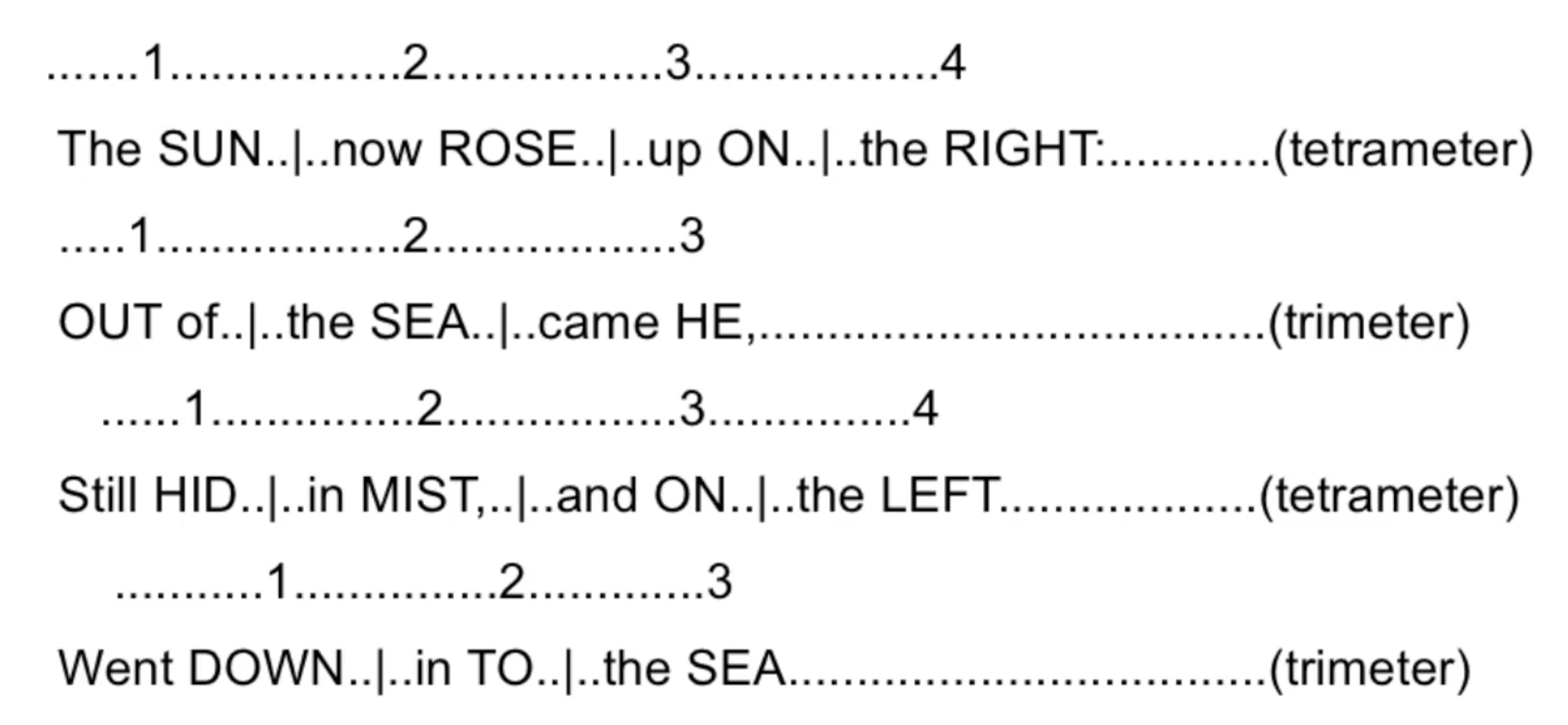
Early Reception
Initially, the poem received several critical responses; notable critic Robert Southey described it as a misplaced attempt at profundity, whereas Wordsworth pointed out flaws in character development.
Secondly, that he does not act, but is continually acted upon; thirdly, that the events having no necessary connection do not produce each other; and lastly, that the imagery is somewhat too laboriously accumulated." In time, however, the poem has come to be recognized as the true masterpiece in the Lyrical Ballads, and Wordsworth was obliged to admit "Yet the Poem contains many delicate touches of passion, and indeed the passion is every where true to nature, a great number of the stanzas present beautiful images, and are expressed with unusual felicity of language."
Over time, however, the poem garnered critical acclaim, solidifying its status as a significant work within Lyrical Ballads, praised for its emotional depth, complex imagery, and intricate narrative structure.
Textual Analysis (post it blu libro di inglese)
Characters
Ancient Mariner: An old sailor who narrates his haunting and surreal tale, possibly reflecting the human struggle against fate and nature.
Wedding Guest: Reluctantly listens to the Mariner’s account, embodying various layers of scepticism and curiosity typical of human nature.
Two Hundred Crewmen: The ill-fated companions of the Mariner, representing collective humanity’s journey through trials and tribulations.
Pilot: The kind-hearted boatman who offers help, symbolizing guidance and possible salvation.
Pilot’s Boy: A minor character who assists the Pilot, often embodying innocence amid despair.
Hermit: A representation of spiritual salvation, the Hermit absolves the Mariner, guiding him towards redemption.
Albatross: This mystical bird becomes a critical symbol in the narrative, as its death signifies immense misfortune and moral folly.
First Part (Lines 1-82)
Establishes a stark contrast between the Wedding Guest’s initial reluctance and burgeoning curiosity as he engages with the Mariner’s strange tale and dark history.
The Mariner's fateful action of killing the albatross is depicted as both random and ominous, emphasizing its transformation from a symbol of hope to one of doom.
Language used mirrors the forbidding conditions typical of icy explorations, painting a vivid picture of isolation and dread.
Stylistic Features
Coleridge employs a straightforward vocabulary and poignant repetition to evoke deep emotions. For instance:
Use of monosyllabic words like "snow" and "mist" translates to bleakness and starkness.”
Internal rhyme and alliteration are artfully employed, enhancing the poem's rhythmic appeal.
Anaphora and onomatopoeia craft vibrant visual and auditory imagery that immerses the reader.
Religious Interpretations
As Adam: The Mariner's grave act parallels Adam’s original sin, leading to similar consequences for his crew akin to humanity's fall.
As Christian Sinner: His act of slaying the albatross resonates with Christ’s crucifixion as a reflection of humanity's sinful nature, enhancing the theme of redemption and divine forgiveness.
Second Part (Lines 81-142)
The aftermath of the Mariner’s deed becomes evident, with the calm seas giving way to a stifling drought, showcasing the tangible consequences of moral failings.
The crew turns against the Mariner, marking him with the albatross, a potent symbol of guilt and public shaming in the face of tragedy.
Third Part (Lines 144-224)
The introduction of ghostly ships symbolizes death, contrasting sharply with the assumed promise of salvation, further immersing the Mariner in despair.
The manifestations of Death and Life-in-Death torment the Mariner, leading him through psychological and spiritual turmoil as he grapples with his actions.
Fourth Part (Lines 225-292)
The Mariner’s eventual reconnection with nature signals a turning point, as he unwittingly blesses the snakes, spurring his journey towards redemption and acceptance.
Fifth Part (Lines 293-410)
As the manifestations of grace emerge, the ghost ship transitions to reveal the influence of angelic powers, signifying hope amid despair, and elevating the Wedding Guest's fears further.
Sixth Part (Lines 411-514)
The finale presents a blend of renewal and continued penance, as spiritual forces navigate the ship while the deceased sailors look on accusatorily, embodying the tension between sin and redemption that permeates the narrative.
Seventh part (lines 515-626)
The Mariner is saved by a saintly hermit — a figure representing Christian redemption - who arrives from the shore with the pilot (who in turn represents, perhaps, the saving grace of a merciful God) and his assistant. As the ship sinks, the Mariner is taken onto the pilot's boat: when he speaks, however, the pilot screams and his assistant goes mad, since they are convinced that he is the devil.
The hermit, instead, listens to his story, the telling of which frees the Mariner of his suffering. This is his true redemption but also his true penance: to be obliged to tell his story over and over again to whoever he meets, and so teach "love and reverence to all things that God made and loveth" (marginal note). His narration to the Wedding-guest and to the reader - is just one of these innumerable retellings.