Emotion
Introduction to Emotion
- affect: emotional states can be long orr short in duration
- mood: long-lasting, diffuse affective state without a clear trigger
- physiological basis is poorly understood
- emotion: discrete, short duration affective srates that change in response to the environment, positive or negative reactions to particular situations
- purpose: survival and reproduction
- psychologists do not agree on what produces emotions
- 3 components:
1. physiological reaction 2. behavioral. response 3. feeling
Physiological Basis of Fear-Hormonal
- amygdala and other fear related brain regions control 2 pathways that produce stress hormones
- sympathetic adrenal medullary system (SAM system)
1. produces catecholamine stress hormones 2. fast
- hypothalamic-pituitary adrenal system (HPA axis)
1. produces glucocorticoid stress hormones 2. slower
- both systems produce fear related physiological responses
- SAM System
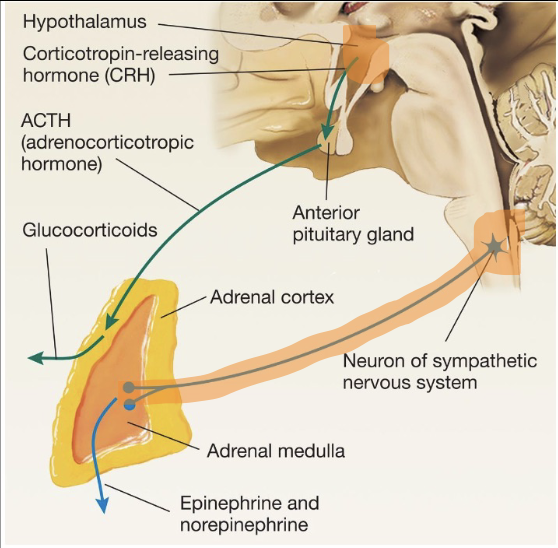
- Hypothalamus and hindbrain activate sympathetic nervous system neurons
- CNS neurons synapse directly on the adrenal medulla: inner region of the adrenal gland
- Adrenal medulla releases epinepherine and norepinephrine
- sympathetic nervous system activation
1. activates skeletal muscles bia increased heart rare and increased glucose metabolism 2. brain response and arousal
- HPA Axis
- Paraventricular nucleus (PVN) of the hypothalamus releases corticotropin releasing horomone (CRH) into the blood stream
- CRH targets the anterior pituitary gland
- anterior pituitary releases adrenocorticotropic hormone (ACTH) into the blood stream
- ACTH targets adrenal glands located on top of the kidneys
- Adrenal cortex: outside layers of the adrenal glands produce glucocorticoids
- gluticocorticoids (cortisol) and other corticosteroids:
1. increase glucose break down 2. increase blood pressure 3. decrease inflamatory response
- fight or flight response can last minutes or hours
- negative feedback restores homeostasis after stressors are gone
Physiological Basis of Fear-Neural
- the limbic system is the highly conserved emotional region of the brain
- includes the:
- hippocampus
- amygdala
- cingulate gyrus
- hypothalamus
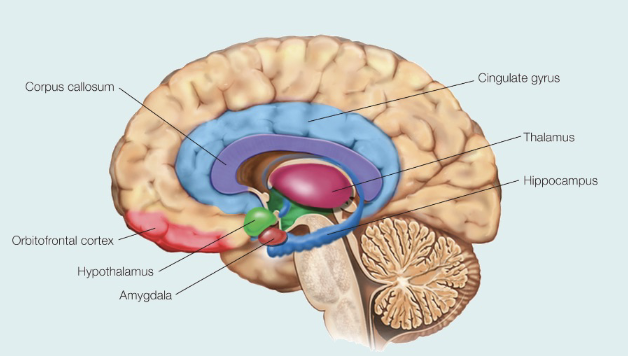
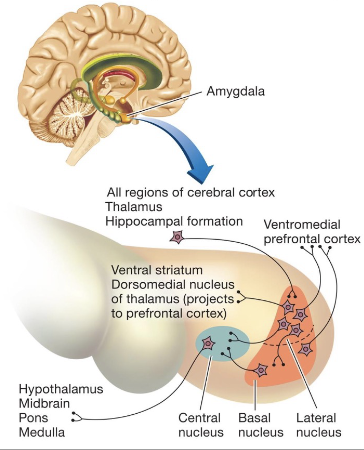
- amygdala: limbic system region within temporal lobes, responds ro environmental stimuli of biological significance
- integrates behavioral, autonomic and hormonal components of fear
- composed of 3 divisions:
- lateral nucleus
- basal nucleus
- central nucleus: most important region for expression of negative emotion
- neurons are activated by aversive/threatening stimuli
- innately aversive: height, large animals, specific sounds or odors
- learned via fear conditioning
Neural Basis of Fear and Learning
- emotions play a major role in learning
- implicit learning: non-declarative (fear conditioning)
- explicit learning: declarative, episodic, or instructed
- lateral amygdala undergoes physical changes to neurons when neutral stimulus repeatedly paired with unconditioned stimulus. and response
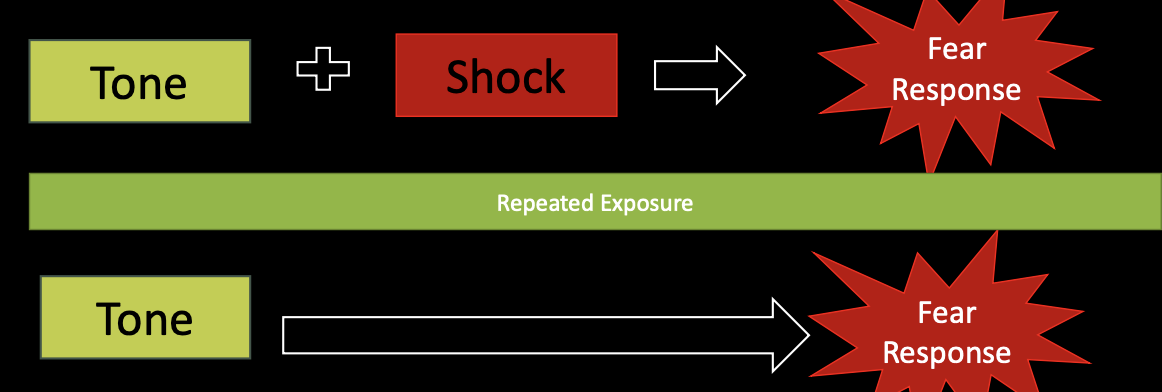
- contextual fear conditioning: aversive stimulus presented in one environment
- signaled fear conditioning: aversive stimulus presented with tone
- evidence: fear conditioning is amygdala. dependent
- amygdala. lesion impairs conditioning in animals
- patient SP with amygdala lesion
- reports knowing that cue precedes a chock (explicit)
- no physiological response to cue (implicit)
- extinction: emotional response is extinguished when conditioned stimulus nolinger paired with aversive stimulus
- ventromedial prefrontal cortex (vmPFC) inhibits production of conditioned response
- amygdala modulates encoding and consolidation in hippocampus
- emotion enhances explicit memories
- emotional episodic memories and instructed fear
- more easily encoded recalled and retained
- amygdala lesion impairs
- expression of instructed fear
- enhancement of emotional memory
- central AMY: expression of fear response
- Lateral AMY: learned conditioned response
- vmPFC: extinction of learned conditioned response
- hippocampus and amygdala: explicit fear learning
Neural Basis of Aggression
- aggression: species typical threar or attack behaviors
- linked to waiting→ access mates defend tertitory or offspring
- self defense
- aggressive behaviors:
- threat behavior
- defensive behavior
- submissive behaviors
- cortex: percoeves approaching animal
- limbic system: integrates innate and learned responses
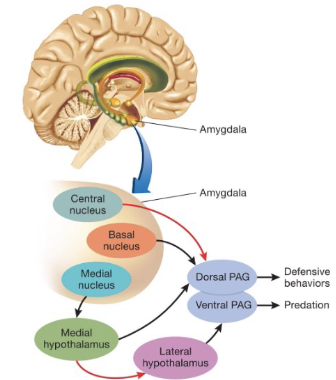
- hypothalamus and amygdala promote sympathetic response and control PAG
- Periaqueductal gray matter (PAG): midbrain rehion surrounding cerebral aqueduct
- stimulation drives aggressive attack or predation behaviors
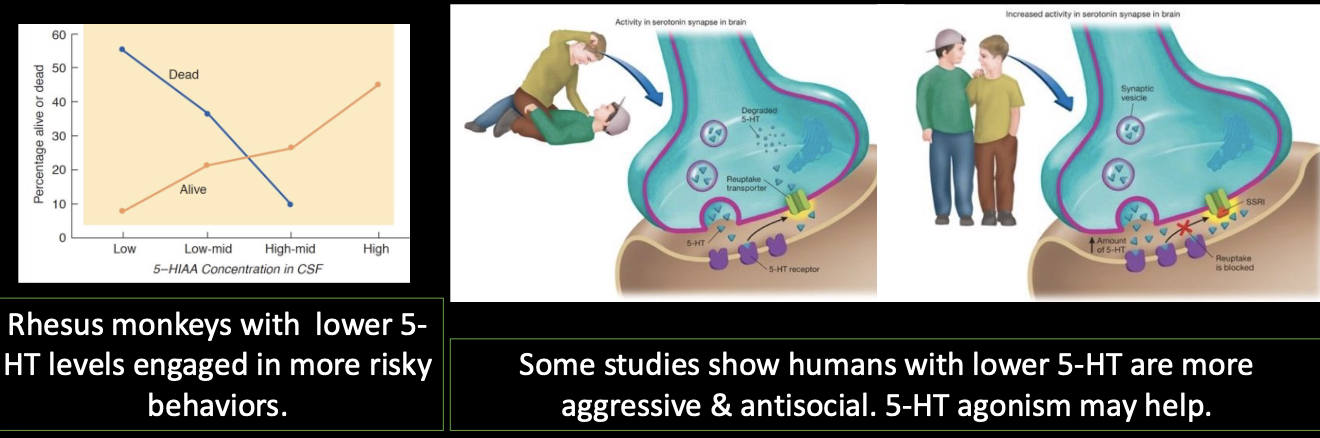
- serotonin inhibits risk taking behaviors including aggression
- antagonism increases aggressive attack
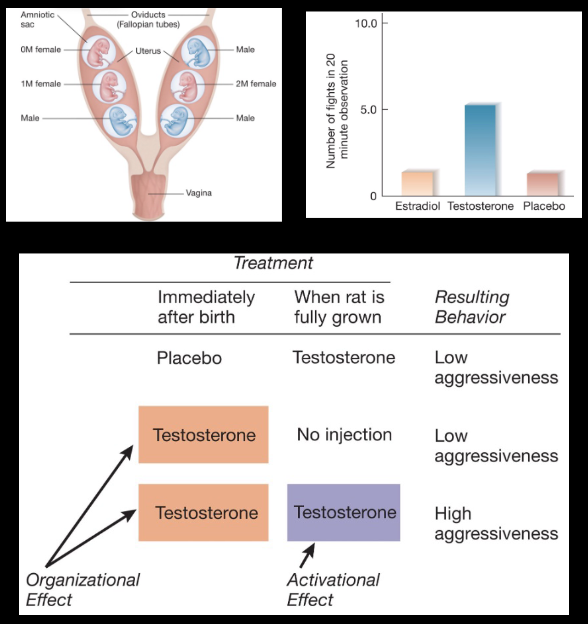
- testosterone: androgen gonadal hormone
- omcrerses aggressive behavior in females and males
- aggressiona nd T linked to reproductive behaviors
- incresed aggression in females with high T
- increased aggression in males with earlt T
- T during development→ aggression
- pubertal T→aggression
Neural Basis of Impulse Control
- impulsive violence may be causef by faulty emottional regulation
- ventromedial prefrontal cortex: controls emotional behavior
- integrates automatic emotional responses and complex behaviors
- drives. emotionally guided decisions
- controls emotional reactions
- serotonin: serotonergic inpitts to the prefrontal cortex (PFC) regulate impulsive behavior
- emotional and impulsive violent murderers have reduced serotonin transporters in the PFC and reduced brain activity in the PFC and increased activity in the AMY
- Development: PFC is not fully developed until adulthood
- adolescents can lack inhibition and impuls control
- moral deciision making requires vmPFC
Communication of Emotions
- production of facial expressions- automatic conserved among humans and animals
- recognition of facial expression is automatic, rapid and accurate
- verbal expression of emotion alre also universally produced and recognized
- emotional content of songs assessed on the 300-400ms
- lateralizatio: rihjt hemisphere more involves in the left in the comprehension of emotion
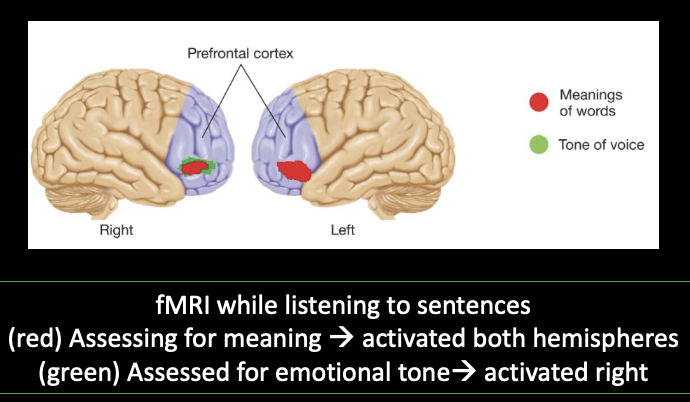
- amygdala activation required for recognition of fearful facial expression
- AMY inputs from:
- cortical regions→ sloe more accurate
- subcortical (thalamus) regions → fast
- affective blindsight: visual cortex damage but can mimic others facial expressions
- simulationist hypothesis: we percieve others expressions by imagining makin them or actually mimicking them
- right somatosensory corted activates in repsonse to facial expression
- disruption or famage imparis the recognition of emotion
- mirror neurons activated
- facial paralysis impairs recognition of expressions due to impaired production of own expressions?
- adinovisual mirrot neurons produce facial expressions in response to sounds
- 2 facial expression pathways: automatic and voluntary
- damage to voluntary1 vs involuntary2:
1. volitonal facieal paresis: damage to primary motor cortex
1. can produce spontaneous not instructed expressions 2. emotional facial paresis: damage to frontal lobe area
1. can produce voluntary non emotional facial expressions
- right hemispjere is more involved than the left in production of facial expression
- left side of the face is more expressive
- right hemisphere lesions impair expression of emotion
Cognitive Theories of Emotion
- theories of emotion generation explain the casual link between physiological reaction, behavioral reactions subjective experiential feeling
- James Lange theory
- emotion producing situation
- physiological response: autonomic system
- behavioral response: skeletal. and facial muscles
- cognition: brain interprets
- subjective emotional feeling
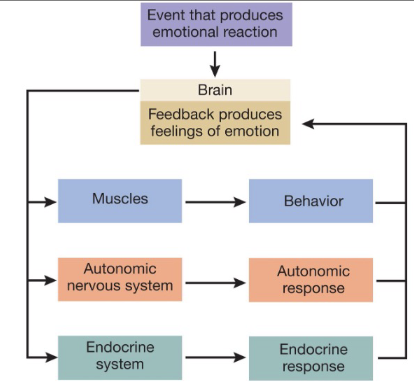
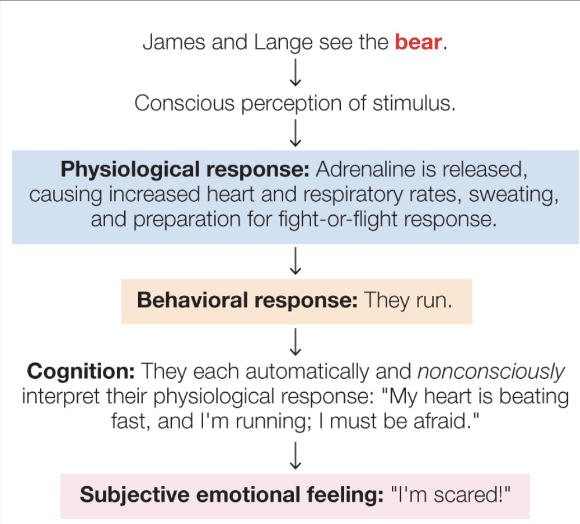
- evidence: difficulty to measure feelings of emotion
- spinal cord damage: higher (close to brain) injuries→ less feedback from muscles and less intense feelings of anger or fear
- botox paralysis facial muscles, reduces frowning→ significantly less negative mood compared to those with other cosmetic treatments
- making fearful angry and happy faces→ physiological responses associated with these emotions
- explanations:
- classical conditioning: learned association between facial response and emotional response
- inner: inborn ability via mirror neurons, somatosensory association regions
- cannon bard theory:
- emotion producing situation
- simultaneous: subjective emotional feeling and physiological responses (autonomic and behavioral)
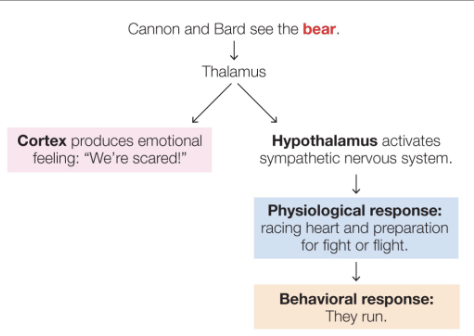
- evidence:
- severed cat brain→ separated cortex from brain stem
- emotional reactions occurred despite severed brain stem
- behavior was produces however did the cat feel subjective feelings of emotion?