Japan
Roots of Militarism and Nationalism
Reasons for Militarism and Nationalism:
● Japan was determined to be seen as equal to the western powers in order to do this it was determined to transform itself into a western style nation
● Japan’s belief in its destiny as the leader of Asia
● To obtain raw materials and markets from countries in East, while also stopping other countries form doing the same
● Need for strategic security
● Actions of the western power
● Support from the general population for militarism and expansionism
Nationalism and militarism was then linked to an imperialist foreign policy.
This began in the second half of the 19th century which started when it was forced to trade with the US through the treaty of Kanagawa (1854). Which also restored power to the emperor now called Meiji. This resulted in massive political reform eliminating feudal system, limited democracy, modernizing army and new navy.
Japan after 1900
First Sino-Japanese war (1894-95):
Japan with a population of 30 million easily defeated China with a population of 200 million and gained many territories establishing it as a world power with an empire. However, Germany, Russia and France were concerned with its growing power, so in what was known as the triple intervention they forced Japan to relinquish some of the land gained making the Japanese furious.
Anglo-Japanese Alliance:
Japan signed an alliance with Britain (1902) making it the first non-western country to sign an alliance with a western country.
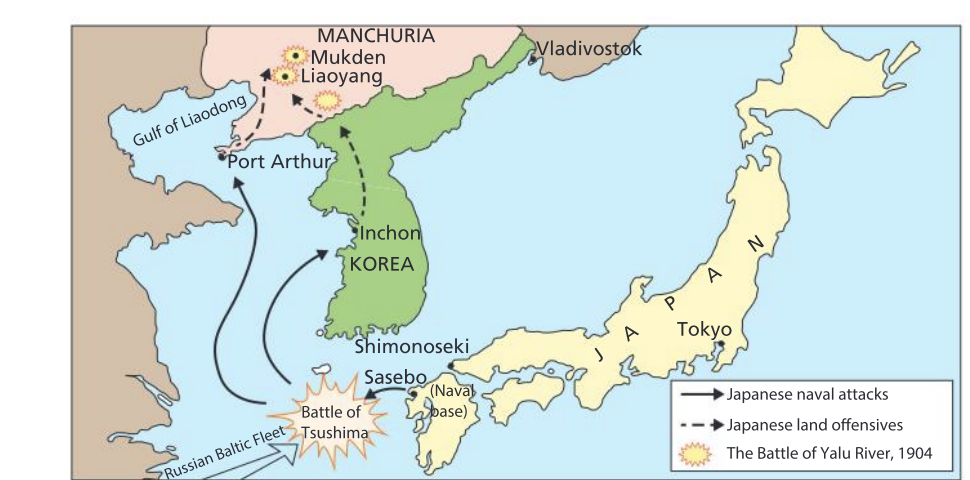
Russo-Japanese War (1904-1905):
Japan clashed against Russia over Manchuria and Korea. While it was a success for Japan it required a mobilization of 1/5 of the male working population (1 million solders) and costed 100,000 casualties plus an immense financial cost.
Ended with the treaty of Portsmouth which gave Korea and south of Manchuria to Japan, however; a lot of Japanese were disappointed as they had been led to expect much more. The war led to respect to Japan from both asian and western countries and also reinforced Japan’s own notion as being destined to lead Asia.
Reasons for entering WW1 on the side of the Allies:
Remain allies with Britain, shown by Anglo Japanese alliance of 1902
Ambitions with areas that Germany controlled
However doubt as they saw Germany as the most civilized individuals
Wanted Germany navy to get out of its waters
Increase and diversify its interest
World War 1:
Japan asked for german colonial territory in China from the Allies but wasn’t given so then declared war on Germany and seized those colonies. Japan issued the twenty one demands on China (1915) . These caused a sharp reaction from Britain, US and even within the Japanese government who believed that these action only would ruin Japanese reputation. As a result one fifth of the twenty one demands were withdrawn. Which China then agree however in the end Japan didn’t gain much
Role in WW1:
Seized German possessions in the Pacific (micronesia, Marshall)
Protected Allied shipping lanes
Took over German occupied Tsingtao
However never sent troops to Europe and never mobilized its economy
Net positive impact on Japan
Twenty one demands (1915):
21 Demands placed on China
Caused a sharp reaction from Britain, US and even within the Japanese government who believed that these action only would ruin Japanese reputation.
As a result one fifth of the twenty one demands were withdrawn.
The Han Yeh Ping company a iron and coal company became shared between the two countries even though it was Chinese
Shandong Province became part of China
Economic influence and priviliges in South Manchuria and Eastern Inner Mongolia
Impacts of WW1:
Exports quadrupled between 1913 and 1918
Heavy industries grew significantly
Shift from debt to creditor status
However cause rapid inflation and led to Rice Riots
Agreements in WW1:
Modified twenty one demands (1915) Russo-Japanese treaty of friendship which pledge mutual consultation on China (1916)
Lansing–Ishii Agreement which gave Chinese sovereignty but admitted that Japan had special interests, horrified China (1917)
Gained territories such as Shandong peninsula and pacific islands north of equator in Treaty of Versailles
However couldn’t passed the race equality clause which made it seem like weaker compared to western states and Shandong was unresolved
Japan in the 1920s
Japan in the 1920s resorted to a foreign policy of internationalism in the 1920s keeping good relations with the USA and furthering economic advancements in China.
Taisho democracy referred to a series of reforms during the Emperor Taisho’s reign. Where all men adult men where allowed to vote, society became more open and media had more influence. He was then succeeded by Hirohito
Washington Naval Conference:
Four power pact was treaty between Treaty between Britain, France US, and Japan to respect status quo, ended British Japanese alliance
Five Power Naval Treaty imposed ratio on naval tonnage of 5:5:3:1.75:1.75 for US, UK, Japan, Italy and France respectively in order to stop naval race, however wasn’t all encompassing and regulation wasn’t strict
Nine power Nine Power Pact Agreement that stated that all powers invested in China would have equal rights with it, with the US especially weary Japanese aggression in China
Japanese Problems:
Fragile democracy:
The democracy was fragile there were, financial scandals, election law violations, and fear of left wing radicalism
Peace Preservation law clamping down on anybody against the governmental structure especially aimed at the communist party.
Universal suffrage bill was introduced in 1925 which increase electoral population from 3 million to 12 million (only men).
Opposition to internationalism:
Conservative groups and also in the army saw Shidehara’s internationalism as a betrayal of Japanese interests.
Continuing to advocate for an aggressive policy in China.
USA exemplified this problem by passing a bill limiting immigration and excluding Asiatics from the quota.
Economic Crisis:
Japan’s economic boom only lasted till 1921 with europeans taking back and reviving lost markets.
Large disparity between rural and urban areas, with farmers suffering due to the falling of the price of rice.
Creating insatisfaction with the government as they sided with big companies and land lords, brutally suppressing protests from farmers and workers.
Dependency on global trade imported 100% of aluminium and 85% of iron and steel.
Japan in the 1930s
Kodo-Ha:
Political faction in Japanese army
The more radical of the two
Saw the USSR as its enemy
imperial way faction
Emphasized national spirit over material force.
Tusei-Ha:
Political faction in the Japanese
Was less radical and tried to work within the framework
Wanted to have good relations with the USSR
control faction
May 15 incident (1932)
Naval officers killed PM Inukai over naval treaty opposition
Ultranationalists groups were behind it but got light sentences
Emboldened the military
February 26 incident (1936)
1500 troops from the imperial Japanese army tried to have a coup d’etat
Organized by young Japanese officers linked to Kodo Ha
Great Depression Impact:
Silk market crashed as it heavily relied on US
Unemployment rose significantly during the great depression
Families had to resort to selling their daughters
Brought army and politicians against each other
The economic depression resulted in many in Japanese people losing faith in democracy
Increased nationalistic fervor and respect for the emperor
Led to crash of the silk market
Japanese Expansion in China
Northern Expedition:
Followed the united front between GMD and CCP
Zhang Xuelian Chinese warlord and supporter of Japan had to flee Beijing
This threatened Japanese interests so he was assasinated by Kwantung army and they stopped the Nothern expedition in Jinan
Tried to unite China, was stopped by the Kwantung army in Jinan
Political Instability:
While Japan became a strong country after Perry’s forcible opening, China did not
China turned to a semi-colonial country following the opium wars, officially being an independent power but in reality being in the mercy of others.
The Xinhai revolution in 1911 toppled the Qing dynasty however the country remained weak and divided.
The rivarly between the KMT and CCP caused further instability
Military impunity:
Mukden incident staging allowed for full scale invasion, also kept on pushing even though the government said they needed to go back
Japanese government wanted Zhang to retreat to Manchuria, instead the army decided to assassinate him
Marco Polo bridge incident used as pretext for invasion
Mukden Incident (1931):
Was a way to declare war on China
Kwantung blows up railway in Mukden against Japanese government wishes
Lytton report by the League of Nations found Japan guilty
Lytton Report:
Found the Japanese incident culpable for the Mukden incident condemning Japan
In response Japan quits the league of nations at the same time as Adolf Hitler and Bennito Mussolini
Manchukuo:
Name for the Japanese occupied Manchuria from 1932 till 1945
Believed that Asia should be ruled by Asians and take European colonies
Wanted to have full control of railway
Kwantung Army:
Army of Japan
Acted independetly and against the wishes of emperor
However the diplomats didn’t want the international community to know this which made them seem untrustworthy when the army broke the diplomats promise
Japanese Violence on China:
Bombing of Shanghai (1932)
Rape of Nanjing
GMD:
Chinese nationalist party lead by Jiang
CCP:
Chinese communist party rivals of GMD led by Mao
Rape of Nanjing (1937):
150,000 pow + 50000 male citizens killed
20,000 to 80,000 women were raped and sexually assaulted, later mutlitating their bodies
Brutality used as a tactic to attempt to break morale
Believed they were superior people compared to the Chinese
Marco Polo Bridge incident (1937):
Official start of second Sino Japanese war, wasn’t engineered as the mukden incident
Chinese units fired at Japanese troops and Japanese troops attacked
Justified their invasion by saying they were liberating from colonialism
Government was powerless to stop the army
Lead up to Pearl Harbour
USA:
Pursue isolationism
Did not recognize Japan’s claim but did nothing more
Roosevelt tried to do more but was limited by the neutrality acts
However because Japan wanted to fully conquer east Asia and the fact they were scared that Jiang would ally with the US
Embargoes on planes and aviation and stopping of credit to japan implement in 1939
When Japan moved south in to attack soviet in July 1941 USA froze all japanese assets, thus creating Japanese threat which relied on this
More support was given to Jiang and his nationalist forces after the Neutrality act was not applied to China under Roosevelt's presidential power 19 (1938)
Oil loans worth 25 million dollars (1940)
Later on sends 100 P-40 planes among other resources (1941)
Reasons forPearl Harbour:
Had economic concerns due to the embargoes (losing 94% of oil supplies) didn’t think they could fight a prolonged war
Had been trying to negotiate with the US for some time but couldn’t get to agree with them
More colonies -> more ppl to sell too
Chinese war became drain on resource
Believed that if they attacked Pearl Harbour they could buy time
Thought themselves as the protectorate of Asia
Histiography:
Left wing argued that WW2 started with the manchurian incident 1931 while right wing say started with pearl harbour, orthodox historians say that the great pacific war began in 1937 with Marco Polo bridge incident
Right wingers also argued that independence movements wouldn’t have been successful if they hadn’t invaded Asia
Michiko Hasegawa asserts that Japan went to war because of oil embargo while Saburo Ienaga argues that it is Japanese imperialism
Boyle says that Roosevelt wanted Japan to attack on pearl harbour
Also historians argued after Hirohito’s death that he was agressive and wanted Japanese expansion if he really didn’t want it he could have stopped it