Week 3: Qualitative Research Methods
Introduction to Qualitative Research
Qualitative research involves collecting and analyzing non-numerical data.
Humphrey et al.'s research (2022, 2023) explored values, life goals, social attitudes, behaviors, and stressors of young Australians through a qualitative approach.
The study employed a phenomenological approach to understand participants' lived experiences and their perceptions of the social world.
Basic Qualitative Designs
Five major types of research design:
Narrative: storytelling, narratives about themselves or events around them, persons perspectives changes over time eg- effects of corporal punishment in schools
Phenomenological: exploring phenomenons, strong philosophical underpinnings, life exp of a concept experienced by indiv eg- whats it like for a mother to live with a child dying of cancer
Grounded theory: adopted to devp theories/hypotheses rooted in data, adapted to variety of areas of research, employed to interviews, biograph data, media, convos, focuses on emergence, sys process, data collection and analysis occur at same time, theory building is cont.
Ethnographical: observational, intensive and indepth obs qual approach, prolonged obs from a groups everyday life, behav, values and interactions among members of group are studied, culture, beliefs, values, rituals eg- living in indigenous community to study their culture and edu practices
Case study: studying single or small number of cases, not used to test hypothesis, in depth analysis
Qualitative Data Collection
Data in qualitative research differs from quantitative research.
Common data collection techniques:
Qual interviewing: structured and semi-structured, closed and open-ended ques
Focus group: collective interview, ensure not dominated by few part, used at early stage of research to identify sig issues, encourage eval of research findings of issue by population most impacted, opinions, beliefs, feelings and exp highlight, examine issue from a group perspective
Part obs: closely immersed in group of culture, researcher is observer by total or complete part, total or complete obs, part as an observer, v complex, focus on culture, grounded theory analysis mostly used
Qualitative Data Analysis
Qualitative data analysis requires different techniques than quantitative data analysis.
Typical steps:
Transcription: oral or vid turned into written, written is verbatim, indicate how words said, tune into recorded interaction, rough transcription, add fine deets to the trans
Qual data coding: identify segments of meaning in your data, label w code like color code or use softwares, inductive i.e data led coding where codes are devp directly from data, terms and phrases used as codes, deductive i.e theory led coding where pre-defined list of codes created, related to theory testing or identifying codes, blended coding also done, easily accessible, structured, transparent, valid
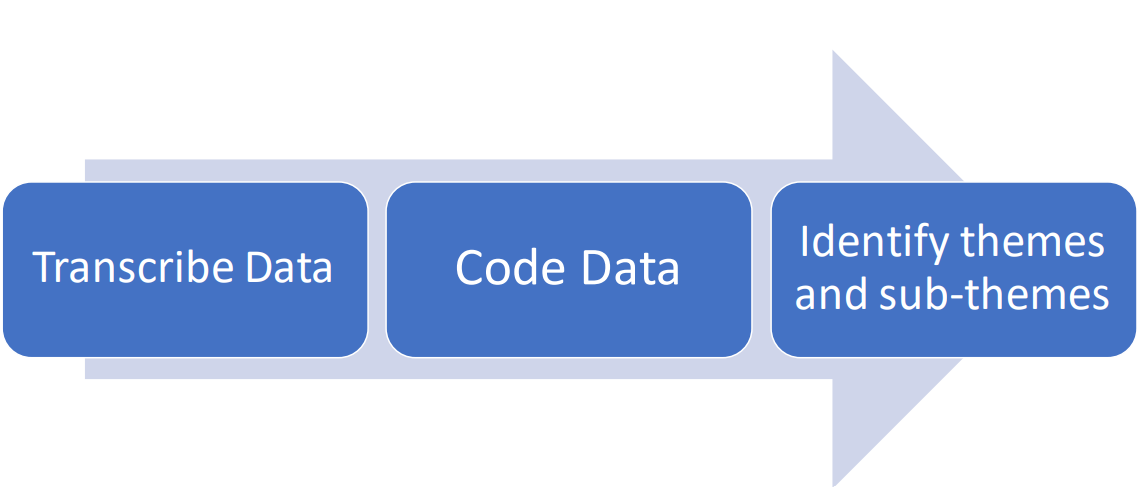
Thematic analysis: examined to identify broad themes, themes consist of several codes, data familiarisation, initial coding gen, search for themes, review, define and label, report, can also be transcribe, code, identify themes and sub themes, meaning can be implicit or explicit
Eg for TA from tut: biopsychosocial factors and matching words to them, subjectivity in perception, first code then theme
Thematic Analysis: Humphrey et al. (2023) audio recorded and transcribed interviews, then used thematic analysis inductively. They read interviews to familiarize themselves with the data, identified and merged overlapping codes, identified broad themes, reviewed and refined these themes, and named/defined the final themes. Identified themes included the importance of personal relationships, happiness and material success (values/life goals), and uncertainty about the future (psychological stress).
Mixed Methods Research
Mixed methods studies combine qualitative and quantitative research.
Both quant and qual
Theory gen and hypothesis testing
Equal emphasis
Analysis incl stats and qual data analysis
Final report incl themes w stat data
DESIGNS
Convergent parallel MM: qual and quant collected and analysed at the same time
Explanatory sequential MM: collect quant first, qual used to explain quant
Exploratory sequential MM: collect qual first, qual helps develop quant survey
STRENGTHS
Narratives, words used to add meaning to numbers and vice versa
Strength of one method to overcome weakness in another method
Broader and complex RQ
Complete knowledge
Increased generalizability
Form interventions
WEAKNESSES
Expensive
Time consuming
Single researcher harder
Has to be knowledgeable to carry out both
Difficult to interpret conflicting results
Evaluating Qualitative Research
Qualitative research is evaluated using different criteria than quantitative research.
Quantitative research emphasizes generalizability, validity, and reliability.
Qualitative research emphasizes credibility, transferability, dependability, and confirmability.
Credibility
Definition: Confidence that the results accurately represent participants' true and believable views, reflecting the reality of their experiences.
Similar to validity in quantitative research, focusing on accuracy and trustworthiness.
Signs of credibility:
Prolonged engagement: Lengthy contact with respondents/settings/data to identify patterns, establish rapport, and ensure participants feel comfortable sharing information.
Time sampling: Collecting data at multiple points in time or across different settings for a more comprehensive understanding.
Triangulation: Comparing multiple data methods, sources, and investigators to cross-check results.
Multiple data methods (e.g., interviews, observation, artifacts).
Multiple data sources (different people, time points, settings).
Multiple investigators (researcher agreement in coding/analysis).
Triangulation of theory (integrating multiple theoretical perspectives).
Peer examination/debriefing: Discussing research process/findings with researchers experienced in qualitative research to identify biases, errors, or alternative interpretations and promote reflexivity.
Member checking: Returning data/findings to participants to confirm accuracy of the researcher's interpretation.
Negative case analysis: Exploring cases where participant experiences differ significantly to understand the reasons behind the differences and their influence on study conclusions.
Interviewing Technique
Are the questions participants are asked logically aligned with the phenomenon being studied, the research aims, and the overall research design? Are the questions flexible enough to be repeated, reframed, or expanded upon as needed to clarify participants' responses? as it creates space for follow-up questions
Researcher Authority
The researcher should have relevant expertise in the subject area, as well as a solid understanding of the theoretical knowledge and qualitative research methods.
Transferability
Definition: Extent to which results can be generalized to other contexts or settings, representing experiences of a specific population.
Similar to external validity.
Signs of transferability:
Similarity of sample to population: Ensuring the sample represents population under investigation.
Time sampling: Data represents multiple time points, enhancing generalizability.
Dense description of the sample: Detailed information about the sample and data collection to assess representativeness and time sampling.
Dependability
Definition: Whether study procedures could be replicated by other researchers in similar settings, demonstrating a clear decision-making process.
Similar to reliability.
Signs of dependability:
Dense description of research methods: Detailed explanation of all procedures (data collection, analysis, etc.).
Dependability Audit: Independent researcher reviews study and analysis procedures to verify replicability.
Stepwise Replication: Multiple teams independently follow procedures and compare results.
Code-Recode Procedures: The researcher codes data, waits (at least two weeks), and recodes without referring to the original attempt; results should be similar if procedures are clear.
Confirmability
Definition: Alignment between data and results (researcher interpretations and conclusions), ensuring data supports the findings.
Signs of confirmability:
Dense description of data and use of quotes: Researchers offer detailed data descriptions and participant quotes to support their conclusions, enabling readers to assess alignment.
Confirmability Audit: Independent researcher reviews research and data to evaluate alignment of conclusions with data, including raw data, summaries, codes, themes, and collection materials.