Big Bang and the Formation of Elements
- A chemical element is the building block of matter, it is composed of a single kind of atom.
- Nucleosynthesis is the process of creating new atomic nuclei from preexisting nucleons (protons and neutrons).
There are three kinds of nucleosyntheses: big bang, stellar, supernova
Big Bang Theory
- Georges Lemaitre is the proponent of the Big Bang Theory.
The evidences of the Big Bang are the: red shift, cosmic microwave background radiation
- Edwin Hubble suggested that the universe is expanding and he also discovered the red shift
- The red shift is caused by the stretching of light waves as they travel through expanding space. As the universe expands, the distance between galaxies increases and the light waves from those galaxies also get stretched out
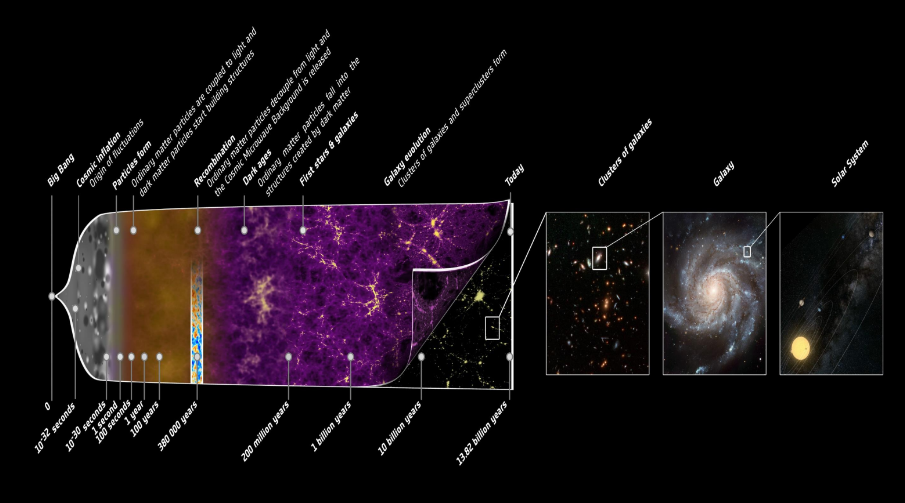
- Big Bang nucleosynthesis happened in the first few minutes after the Big Bang.
Quarks and leptons, to protons and neutrons, then the first elements
- quarks are elementary particles that are the building blocks of protons and neutrons, which in turn are the building blocks of atomic nuclei.
- leptons are elementary particles that do not interact with the strong nuclear force, which is responsible for holding atomic nuclei together.
- both the quarks and leptons combine to form protons and neutrons.
- due to relatively high temperatures, quarks and leptons were moving so fast that a number of collisions among them happened but were not able to combine
- as the temperature of the universe decreases, quarks and leptons have finally combined together for the conditions of the universe have become right for these two to combine and form stable blocks of matter.
- the first elements in the universe are hydrogen (75%), helium (25%), and a few traces of lithium and beryllium.
The formation process of Helium-4
- George Gamow - his fame as a physicist began with his theory that explained the radioactive alpha particle decay of atomic nuclei.
- According to Gamow, the formation process of Helium-4 may take 3 steps.
1. Two separate interactions of a neutron and a proton which each create a deuteron 2. Two interaction of two deuterons results in an ejected neutron and the formation of a Helium-3 atom (an isotope of helium-4 consisting of two protons and one neutron) * The reason why the resulting helium-3 atom has only 1 neutron instead of 2 is because one of the neutrons in the two deuterons ejected because it carries away excess energy. 3. The interaction of helium-3 and the deuteron will result in the formation of helium-4 with 2 protons and 2 neutrons and an ejected proton. * Deuterons are a type of nucleus that contains one proton and one neutron, bound together by a strong nuclear force.
Hydrogen Formation
- Hydrogen came from a young, yellow star
- Successive nuclear reactions caused the young, yellow star to turn into a red giant
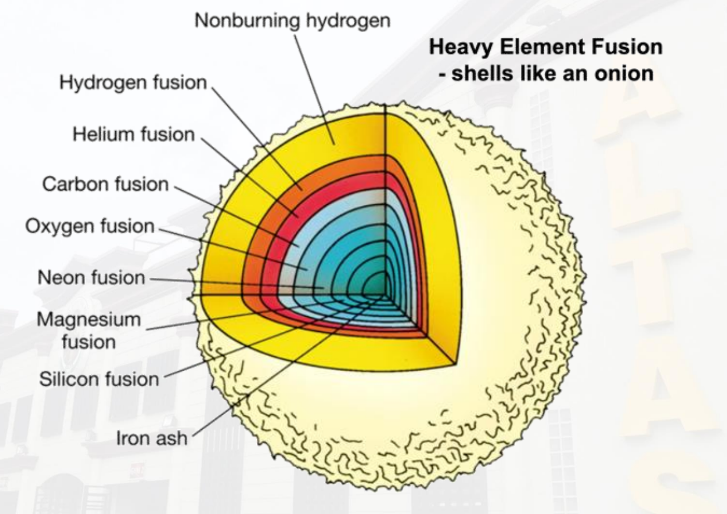
- The successive nuclear reactions take place in a region or a layer called the fusion shells
- The temperature was still high such that the electrons have high kinetic energy
- high kinetic energy makes it difficult for electrons to combine with protons in order to form hydrogen atoms.
- Over time, the temperature decreases which consequently decreased the kinetic energies of the electrons. As a result, electrons bind to protons, thus forming Hydrogen atoms.
- the decrease in temperature and energy causes the universe to have a stable environment for hydrogen atoms to be formed.
- For a Hydrogen atom to become stable, it gradually clumped with another Hydrogen atom.
- Hydrogen atoms are unstable on their own for this element only has one electron and one proton in its nucleus, which makes it highly reactive and prone to chemical bonds.
- Hydrogen molecules together with helium atoms clump together to form molecular dense clouds.
- Gravitational attraction increase due to gravity is the reason why hydrogen and helium atoms come together which then forms this molecular cloud.
Stellar Formation and Stellar Evolution
- Dense clouds are the main ingredient for the formation of stars
- Stellar nucleosynthesis is the process by which elements are created within stars by combining the protons and neutrons together from the nuclei of lighter elements
- Stellar evolution traces the formation of the other elements
- A protostar is also the beginning of the main stages of hydrostatic stellar evolution, where stellar nucleosynthesis occurs.
- Nuclear fusion is a nuclear reaction in which extremely tiny nuclei fuse together to create a relatively large nuclei and it leads to the release of huge amount of energy
- In the proton-proton chain, deuterium is produced by the weak interaction on quark transformation which converts one of the protons in a neutron
- reactions in the proton-proton chain takes billion of years for a specific proton to be involved in a successful proton-proton fusion
- helium core is created due to the nuclear reactions that happened in the hydrogen shell fusion
- The carbon-nitrogen-oxygen cycle is a 6 sequence reaction process where Carbon-12 is used as a catalyst that facilitates the production of Helium-4
- The triple alpha process is the fusion of 3 alpha particles in order to form carbon
- The triple alpha process involves the reaction of 3 helium
- Helium burning creates another core which is made of Carbon and some percentage of Oxygen by triple alpha process.
- helium fused together forms beryllium, then helium fused with beryllium forms carbon
- When carbon reaches a certain temperature, it allows carbon fusion
- Carbon fusion produced neon within a carbon fusion shell
- Neon concentrated at the core results in neon fusion which produces oxygen
- Oxygen being concentrated at the core produces silicon
- Silicon fusion produces nickel
- Nickel decay results in iron
- The reason why iron is the last element formed during stellar evolution is that it’s the remaining stable element based on its mass
Stellar Explosion
- As the RED GIANT is exhausted the nuclear fuel of light elements, its core started to collapse that eventually led to the explosion of the star
- A violent explosion called SUPER NOVA releases a huge amount of nuclear energy and produced NUCLEAR CAPTURE & RADIOACTIVE DECAY, and other elements heavier than IRON
- Neutron capture reactions were either as fast as a fraction of a second or as slow as a few million years. This process occurred as a seed nucleus captured neutrons, forming a heavier isotope of the element that was either stable or radioactive (unstable)
- stable isotopes continued to capture neutrons and formed other heavier isotopes of seed nuclei.
- unstable or radioactive isotope underwent beta decay, producing an isotope of a new element
- S-Process is when neutron capture occurred so slowly that beta decay of the product isotope happened before it captured another neutron.
- R-Process is neutron capture occurred very fast that the seed nucleus turned into a relatively heavier nucleus before beta decay took place.