W9: Colour Vision
Key Concepts in Color Vision
Inducing Patterns
Patterns, such as horizontal lines, can alter perception of colours that are physically identical.
Example: VISION appears different from COLOUR due to patterned context.
Inspect closely the differences in vertical bars in both words.
S-cones Stimulation
The significant colour shift occurs because of inducing patterns that selectively stimulate S-cones, such as purple and lime lights.
The receptive-field organization has spatially antagonistic centre and surround, driven by S-cones.
Cell Response
The colour shift is explained by a receptive-field organization with a spatially antagonistic center & surround, both driven by S-cones
when nearby & more distal inducing lights differ in S-cone stimulation (purple & lime lines), the cell has a large response; on the other hand
the cell response is weak with the uniform yellow chromatic surround because the receptive field center and surround are almost equally excited & therefore counterbalanced
Spatial Frequency Dependence
Colour shifts depend on spatial frequency, affecting how colours are perceived.
Learning Outcomes in Colour Vision
Understand the Physical and Physiological Factors
Physical: properties of light and surface interactions.
Physiological: factors like lens and macular pigment.
Colour Mixing Types
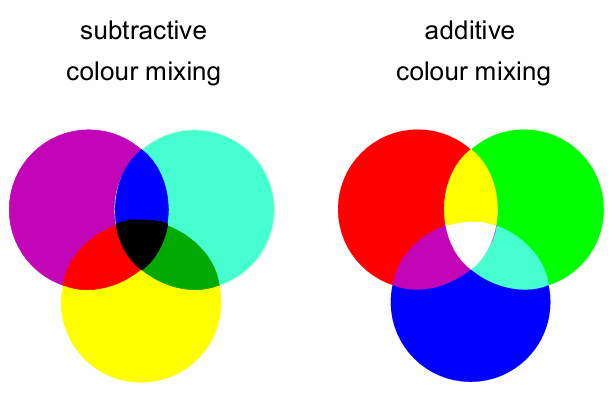
Additive Mixing: Combining light of different colours; primary colours are Red, Green, and Blue (RGB).
Subtractive Mixing: Combining pigments; primary colours are Yellow, Magenta, and Cyan (YMC).
Colour Matching & Perception
Study factors influencing colour perception and matching.
Define what colour vision entails and how it functions.
Historical Perspective on Colour
Pre-17th Century Understanding
White light was viewed as the purest form of light.
Monochromatic light was seen as a modification of white light.
Isaac Newton's Contribution
Demonstrated that white light is a heterogeneous mix of various wavelengths.
Proposed that no single wavelength corresponds to white light, stating: "The rays are not coloured."
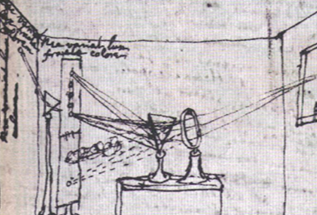
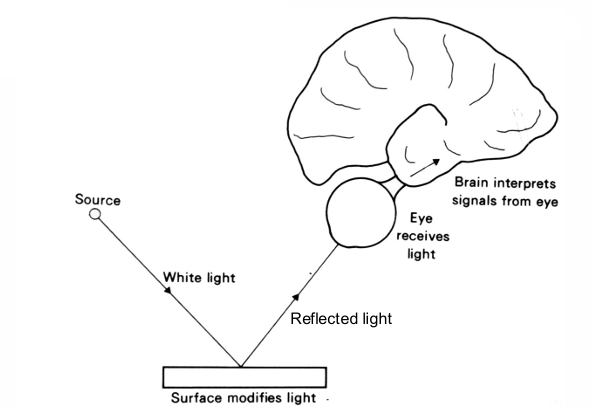
What is Colour:
colour is related to light emission (photon energy)
properties of sources but “the rays are not coloured”
Colour is related to light reflection properties of objects
the ripest tomato is not red without an observer.
brain uses natural daylight to interpret colours.
Colour is constructed within ourselves:
a subjective experience
wavelengths themselves are not coloured
wavelength is associated with colour.
Nature of Colour and Wavelength
Link between Physical Stimulus and Perception
The study of colour vision has a goal to establish the link between the wavelength composition of light - the physical stimulus - and colour – the perception
Colour can be experienced through fundamental sensations:
Unique hues: Red, Green, Blue, Yellow
Achromatic colours: Black, Grey, White
Additional colours: Orange, Purple, Pink, Brown.
Electromagnetic spectrum
Light behaves both as a wave (reflection, refraction) and as a particle (absorption).
Wavelength specified in nanometers (nm) or frequency (Hz).
frequency is inversely proportional to wavelength (Hz = v /
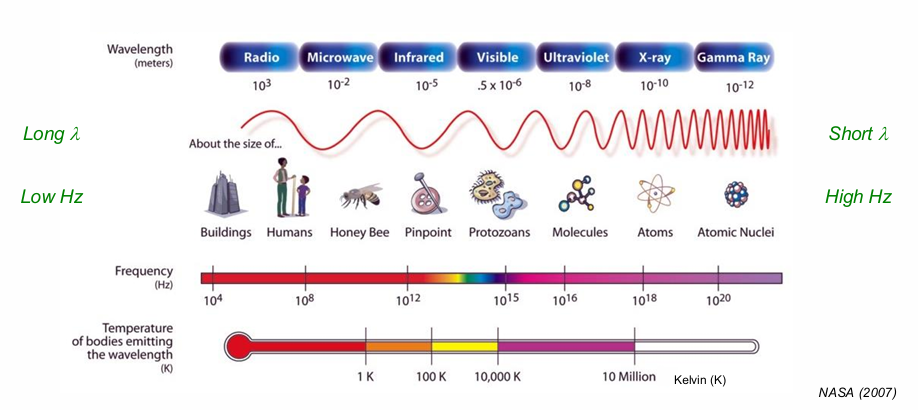
Visible Spectrum
light is visible electromagnetic radiation we see (~380 nm to ~750 nm)
spectral sensitivities are continuous
other wavelengths are either not transmitted through the atmosphere and the eye or are not absorbed by retinal photopigment.
Colour Perception Factors
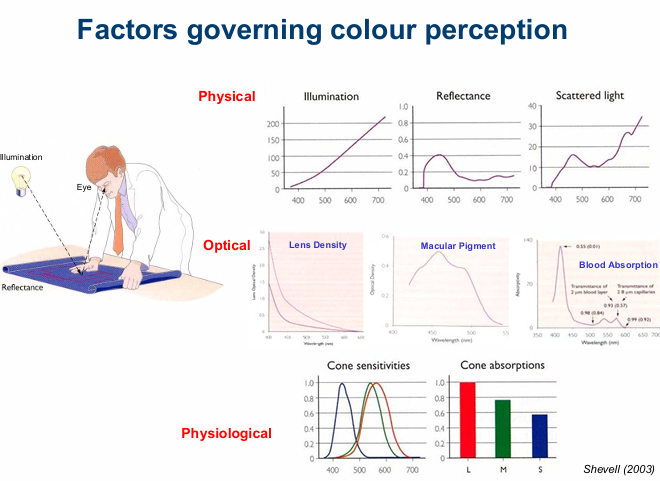
The wavelength composition of the light at the cornea (colour signal) depends on the spectral distribution of the ambient illumination (the light) and the surface reflectance (the object environment).
“An object’s perceived colour depends upon both its spectral reflecting properties and the light wavelengths illuminating it.”
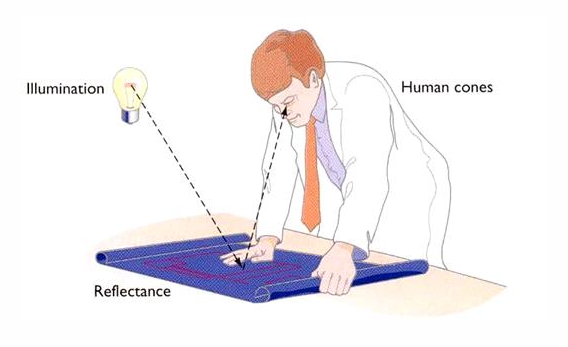
Light Sources
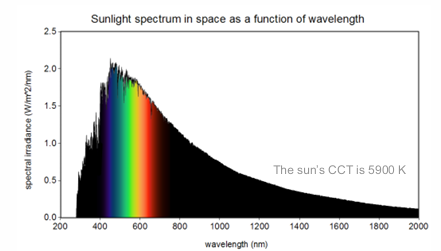
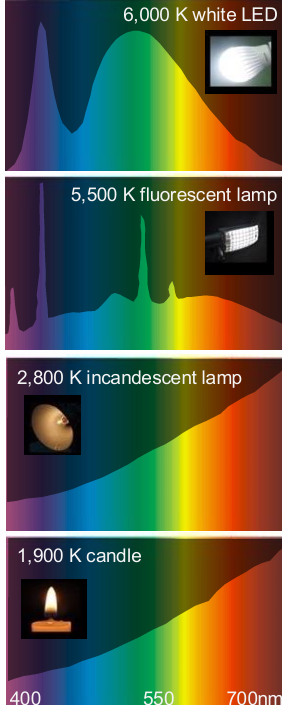
most natural light sources emit light at many wavelengths = broadband light.
interference filters selectively transmit (& attenuate) selected portions of the light source to produce “narrow band” sources.
Artificial (manufactured) light sources can have narrow spectrums (e.g., LEDs, lasers)
Colour temperature
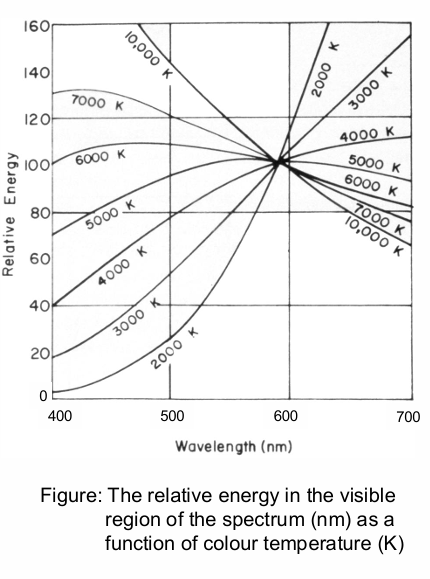
colour temperature (Kelvin, K) is the temperature at which a (theoretical) blackbody radiator would emit radiation of the same colour as the source.
As source temperature rises, radiant energy emitted by the body (source) extends over an increasingly wide band of wavelengths.
800K - Red = hot
2000K - yellow-white
10,000K - blue-white
influence on melanopsin → tune lights to body reaction (increase concentration and focus)
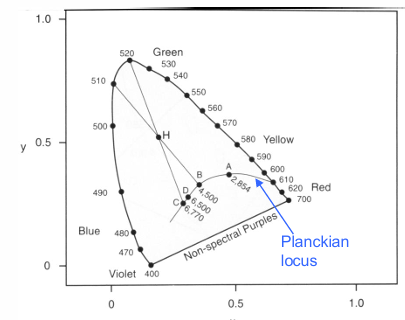
Standard illuminates:
A - 2854K Incandescent lamp
B - 4874K sunlight
C - 6774K overcast sky northern hemisphere
D - 6504K Daylight
Within the 1931CIE diagram the standard illuminates fall on an arc called the Planckian locus
Spectral Reflectance
Perceived surface colour depends on the object spectral reflectance
different objects reflect different amounts of the various wavelengths of the incident light.
an objects surface reflectance profile describes the fraction of incident light a surface reflects at each wavelength.
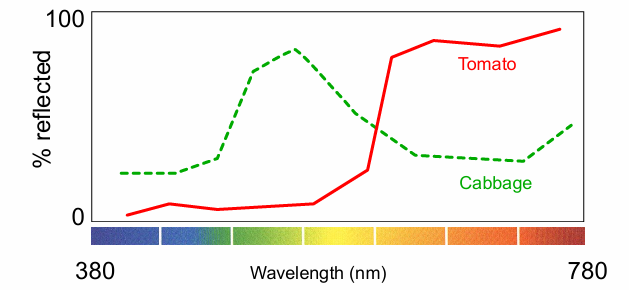
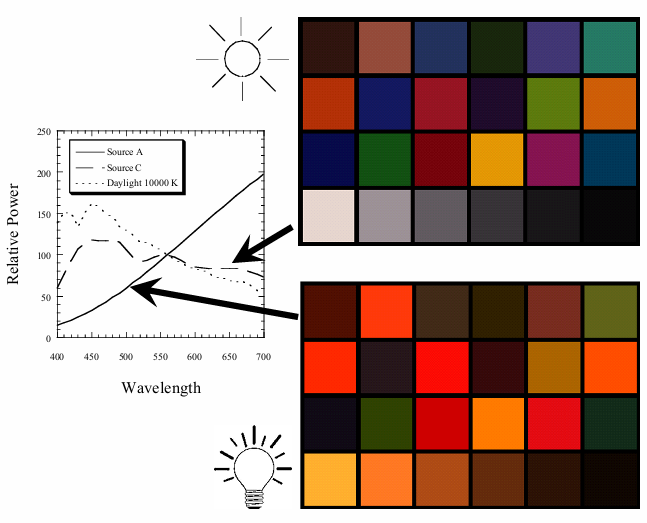
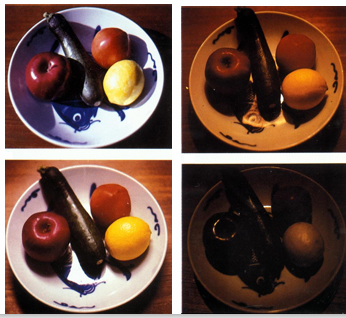
Chart 1: Lower row = achromatic colours.
importance in photography
chart 2: viewed under a tungsten lamp (lower colour temperature = lots of long wavelength energy causing achromatic to look orange).
Optical and Retinal Factors
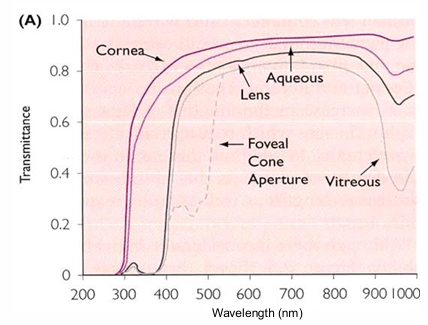
Absorption of light in the ocular media
IR and UV absorption changes the spectral composition of the stimulus
Lens yellows with age = decreased transmission of short-wavelength light
Macular pigment = absorbs short wavelength light
blood vessels = absorbs short wavelength light
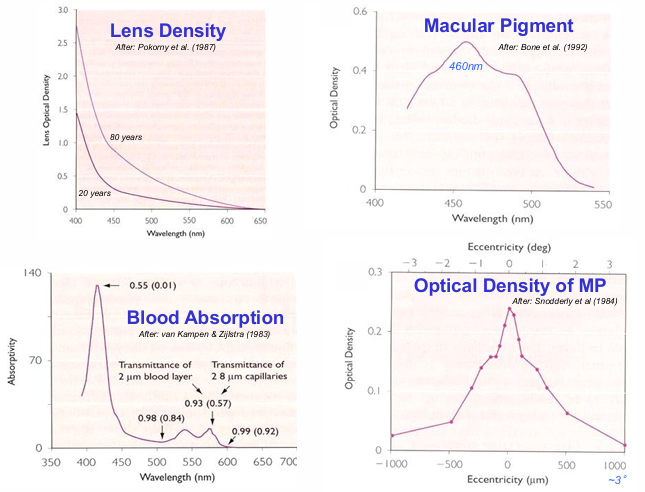
Lens density: as lens density increases, most of short wavelengths are effected, with slight changes in higher wavelengths.
not only are blue wavelengths being absorbed, but other wavelengths going through the middle wavelength regions of the spectrum
Blood absorption: most absorption at short wavelengths ~420nm
create shadows on the eyes.
Macular pigment: ~450nm.
macular pigments can absorb vitamins that can change density (carotenoids) for the BCMO1 gene only.
Optical density: 3 degrees either side of fovea.
FACTORS GOVERNING COLOUR PERCEPTION
Producing Colour: Additive & Subtractive colour mixing
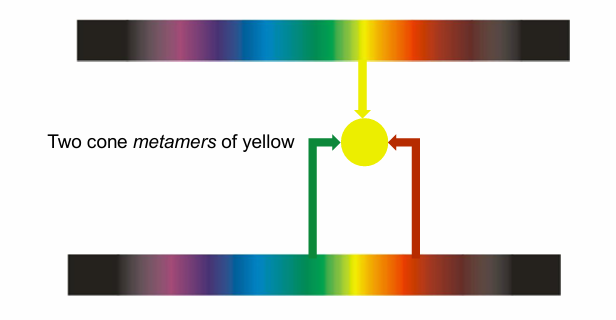
colour is physics and physiology; lights that are physically different can appear identical.
many metameric matches that can produce an identical colour.
can use this to understand different combination and for identification of colour deficiencies.
the laws of additive and subtractive colour mixing are consistent with human colour vision being a trichromatic three variable system.
Primaries
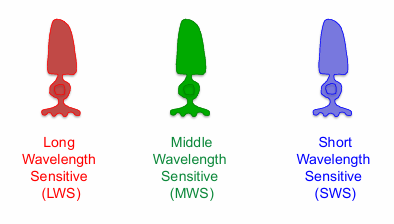
colour vision is trichromatic - 3 variable system
Red, green, blue
subserved by 3 cone photoreceptors (L, M, S) with maximal sensitivity in different regions of the visible spectrum.
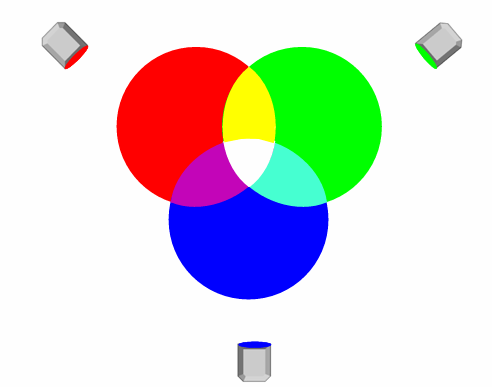
Colour Mixing Techniques
Additive Colour Mixing
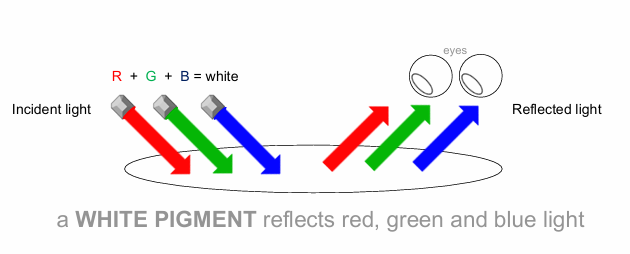
The law of colour mixing that apply to projected lights are called additive.
Subtractive Colour Mixing
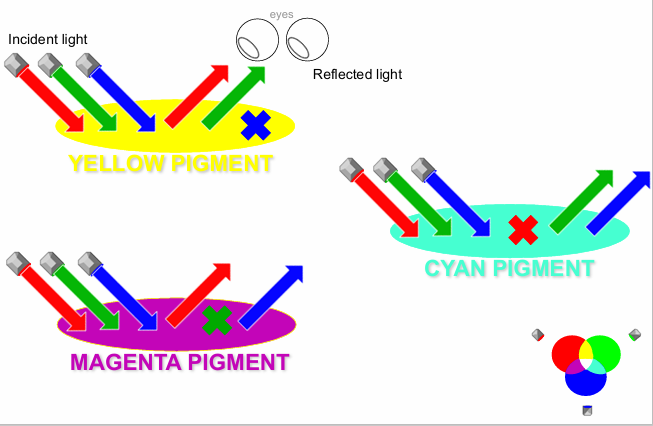
The laws of colour mixing that apply to pigments and paints are called SUBTRACTIVE because they depend on what is absorbed or subtracted from the reflected light by the pigment.
primaries: yellow, magenta, cyan
begin with white light and then take away (subtract colours)
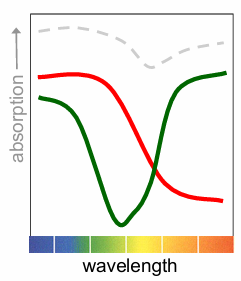
colour appearance governed by absorption properties.
by using 3 suitably chosen primary pigments, the laws of subtractive colour mixing can be used to create new colours.
important in manufacturing of fabrics, paints, materials and surfaces.
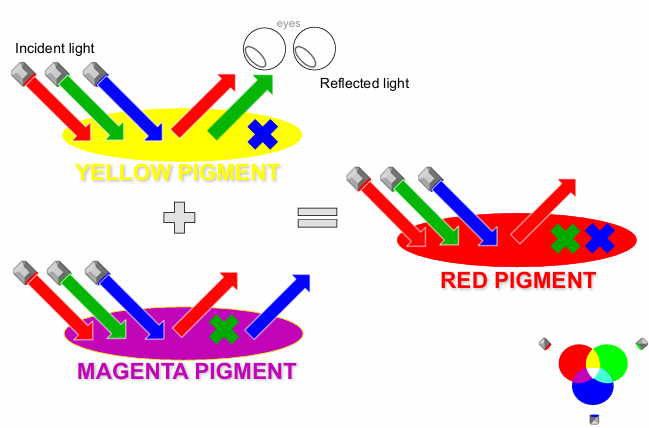
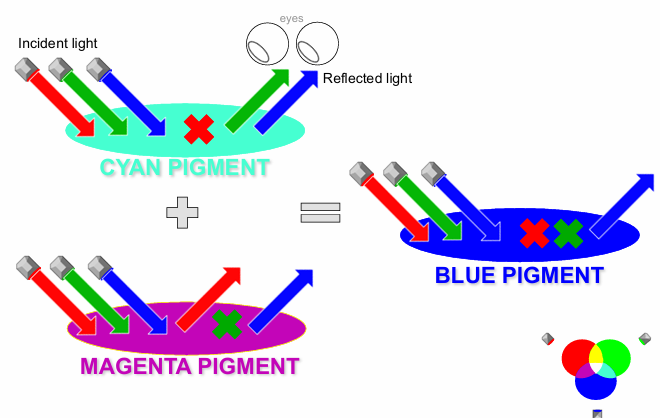
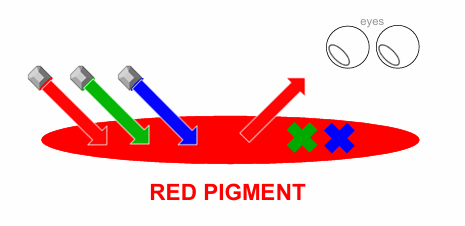
why is a red pigment red?
A red pigment subtracts (absorbs) green and blue and reflects red.
this applies to green and blue.
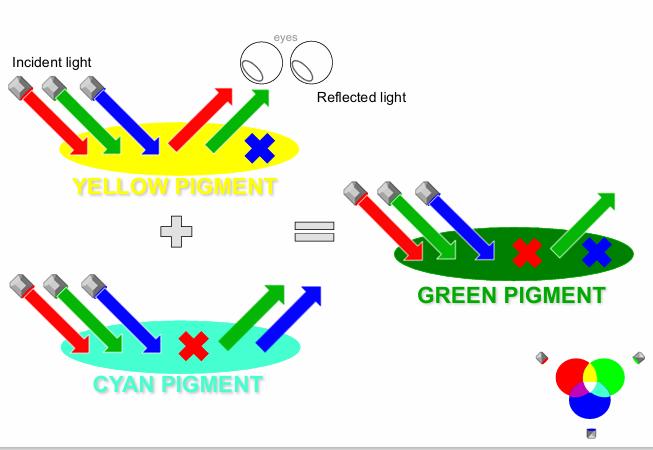
combining primaries.
when green & red pigments are mixed, the pigment absorbs most of the light & the middle wavelengths are reflected resulting in a dark yellow.
with additive = new colour is brighter
with subtractive = colours become darker
Additivity with colour displays
colour display screens are comprised of many small dots (pixels) that generate light & are mixed together by the eye & appear uniform
3 primaries (RGB) produce additive colour mixtures.
adjust proportion of the red, green & blue pixels to generate a colour gamut.
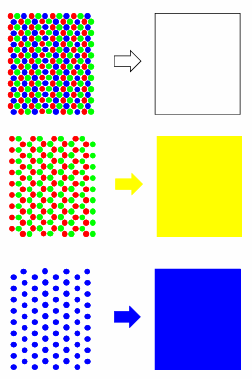
Can all colours be generated on your TV screen? What are the implications of this?
spectral radiometer used to measure the intensity of light across different wavelengths, allowing us to evaluate the colour accuracy and range displayed on the screen.
TV can only create colours that occur within this triangle.
doesn’t have the intensity range.
Implications: pseudorepresentation of environment, cameras have the same limitations (narrow spectrum)
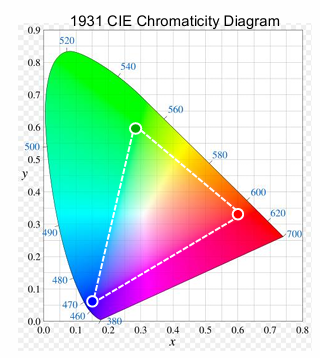
Closer to middle = more desaturated.
near the edge = more colours / more saturated.
Factors influencing colour matches
observational conditions:
surround, field size and location, choice of primaries, luminance levels.
every is a dichromatic when small stimulus is restricted to central retina as there are no S cones.
Depending on the field size and change in position on retina, relative density of rods and cones changes
colour vision reduced in periphery (less cones)
narrow vs broad band primaries
different observers:
colour defects, range of colour matching abilities among normals.
some people are very good colour discrimination whereas others are not as good.
rod intrusion:
occurs at retinal illuminances <1000 Td. Can alter the appearance of metamers (as does different illuminants).
dichromats become trichromats under dim light levels as rods provide the third photoreceptor class.
can alter the appearance of metamers.
melanopsin photoreceptors:
contribute to colour vision at photopic light levels.
colour constancy - brain figures out what the illuminant is and counteracts changes so that a constant, stable colour is perceived
apple in morning looks red in morning, but in the middle of the day with more short wavelength light the apple will still appear red.
melanopsin photoreceptors provide a colour signal that is opposite to the colour temperature.
physiological mechanisms:
preretinal filters, photopigment optical density, individual differences in photopigment spectra, retinal homogeneity, photopigment bleaching, small field tritanopia.
e.g., diamond grading - maintain constant colour vision even though stimulus on retina changes.
after cataract surgery, people perception of white changes. Takes about a ~month for the brain to realise the lens has changed and their white points return to normal.
regeneration of rods / cones - spectral sensitivity changes (colour vision at beach vs inside a room)
homogeneity - photopigment density changes across retina.
Illumination level
no cone-mediated colour vision at very low illuminances.
Rods mediate salient and diverse colour percept’s that are unrelated to photopic colour name.
colour signals strengthen as illumination increases.
colours appear brighter & more vivid on a sunny day; duller on an overcast day
an object’s colour tends to remain constant (colour constancy) even when the illumination spectrum & thus the reflected light changes.
Bezold-Brucke Effect
Perceived hue can change as photopic light level increases
Wavelengths >500nm; longer wavelengths (e.g., reds) appear yellower
Wavelengths <500nm; short wavelengths (e.g., violets) appear bluer
There are 2 (478nm & 578nm) & possibly 3 (503nm) invariant hues
Unique white settings are stable with variations in light level, indicating that white has a non-polarizing (equal) effect on colour processing.
Helmholtz - Kohlrausch Effect
When a coloured light is compared to a white light of equal luminance, the coloured light will typically appear brighter & fluorescent
implication for Abney’s Law
this represents a non-additivity of brightness
Context
Aperture colour: light presented in isolation that remains unaffected by the viewing context
early visual processing
surface colour: denotes that a colour belongs to an object - chromatic variations within background context alter perceived chromatic contrast & hue.
cortical processing
Chromatic Induction:
Appearance of a light depends on the other light in view. That is, the light reaching the eye is the same, but the appearance is different because of the context
Change in appearance caused by a surrounding light is induction
physics is constant, but difference in how brain interprets.
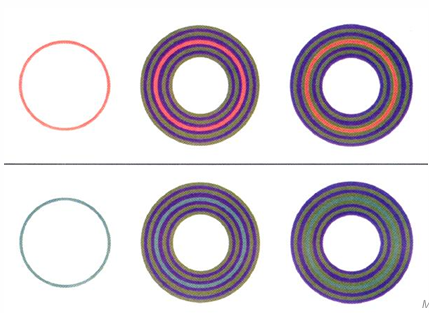
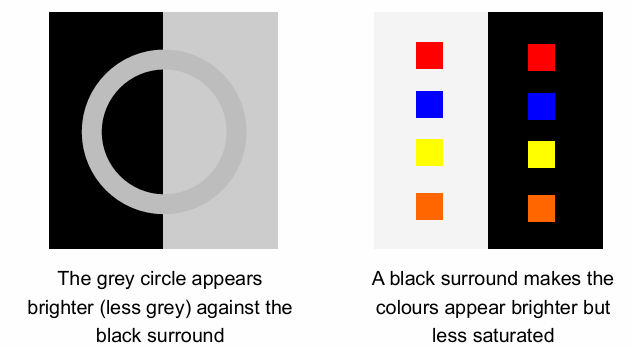
Effect of surround luminance
appearance of identically coloured patches can change when surrounded by a different luminance.
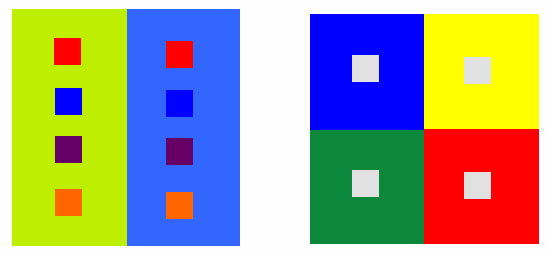
Effect of Surround hue
Colour appearance depends on the background chromaticity
Simultaneous colour contrast (below) is an example of induction for entirely coloured contexts (i.e., there are no achromatic lights)
Both the saturation & hue can appear to alter
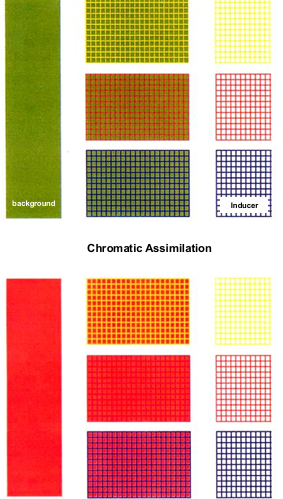
Chromatic Assimilation & contrast
chromatic assimilation: appearance of a light shift towards the colour of the inducing light
achromatic assimilation: a background colour overlaid with a black pattern appear darker; when overlaid with a white pattern it appears lighter.
Chromatic contrast: appearance of a light shifts away from the colour of the inducing light.
What is colour vision
8% of men have a colour deficiencies.
colour vision definition: the ability to distinguish two lights regardless of their radiances.
if a patient doesn’t have colour vision and the radiance of the two lights are adjusted, there will be one point (even though they are physically different) where they appear to be the same brightness.
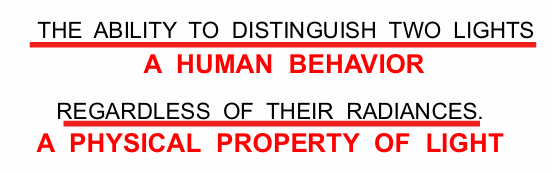
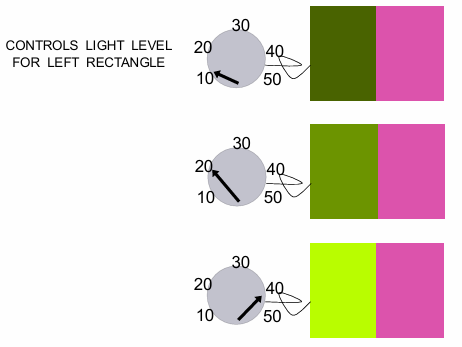
to determine what type of colour vision - must carefully select the two light colours.
for a person with only one photoreceptor, there would be a point when the dial is moved, where the photon catch of one light and the photon catch of the other light would be the equivalent for their photoreceptor, and at this point they would say there is only one light.
Assessment of colour vision
colour matching or discrimination
these are the normal limits of physical light differences that cannot be seen.
that is, physically different lights can be perceptually identical (where red and green appear yellow)
physically different lights that are seen as identical to each other are metamers.
colour appearance is the colour we experience
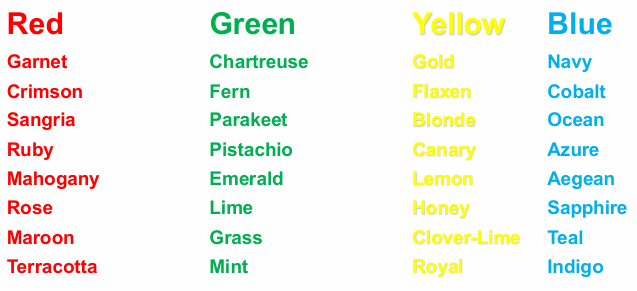
colour appearance is not involved in matching or discrimination
“Is there a difference between 2 lights?” → yes or no
Colour vision in the real world
Colour matching and discrimination: differences in light that humans cannot see
different physical lights that look alike (metamers)
If a person with normal CV cannot see a difference, neither will a person with abnormal CV
If a person with abnormal CV can see it, so can a person with normal CV
If a person with normal CV can see it, a person with abnormal CV may not see it (depending on the type of CV deficiency
colour appearance: colours we “see” (hue, saturation, brightness)
what lights look like.
Questions to ask yourself?
What physical factors can affect colour perception?
How can optical and retinal factors modify colour vision?
In what way can colour matches change with surrounding luminance and hue?
Define colour vision.
Describe the two paradigms used to assess colour vision