4. Morphology
Leap from limited set of meaningless elements (phonemes) to open class of meaningful elements
New level of analysis:
Study of internal structure of words, segmenting them into morphemes → Smallest units of language that carry meaning (transcribed in curly brackets)
Example sound sequence /in/ in inbox (morpheme 1), independent (morpheme 2), inch (no morpheme)
→ same thing at one level, can have different function at other level
Classification of morphemes
→ Come in different types, defined by distribution
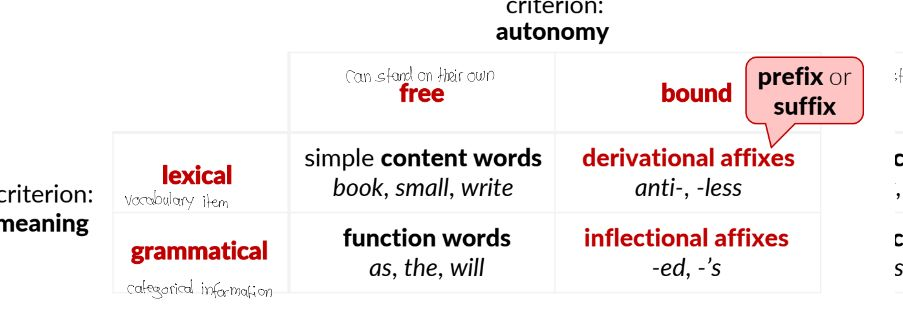
Lexical vs. grammatical in semantic terms:
Content words → lexical meaning: concepts in extralinguistic reality
function words → grammatical meaning: relations between linguistic expressions
→ Lexical and grammatical elements can both be contained in one-word forms
Lexical vs. grammatical in structural terms
vocabulary: not a closed system, entirely optional with endless options
grammar: e.g. markers for singular/plural from closed system of discrete values (grammatical category) → One of them is obligatory, choice can have implications for other choices
→ Arbritrary feature whether grammatical or lexical
Comparison other languages: In Bantu physical properties grammatically relevant, in Japanese number not a grammatical category
Lexical vs. grammatical in morphology
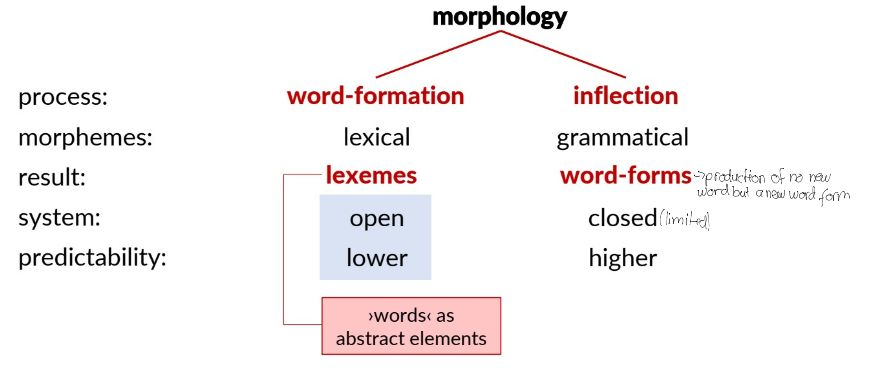
→ Morphemes as abstract elements of langue, physically realised by morphs: sequences of sounds in which speakers recognise meaningful elements
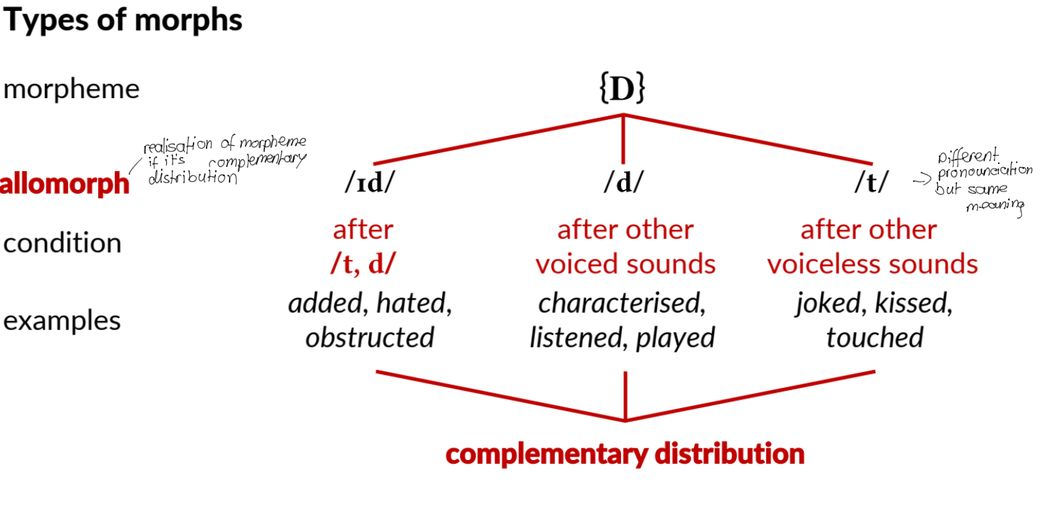
→ Some cases: morpheme realised by morphs of different subtypes (e.g. plural S)
plural marker S three variants whose choce is phonologically conditioned (dependent on sound in environment)
Complementary distribution (uses do not overlap)
Variants of 1 morpheme distributed like that = allomorphs
Morphological processes
minimum number of morphemes in word-form is one
maximum number of morphemes theoretically unlimited
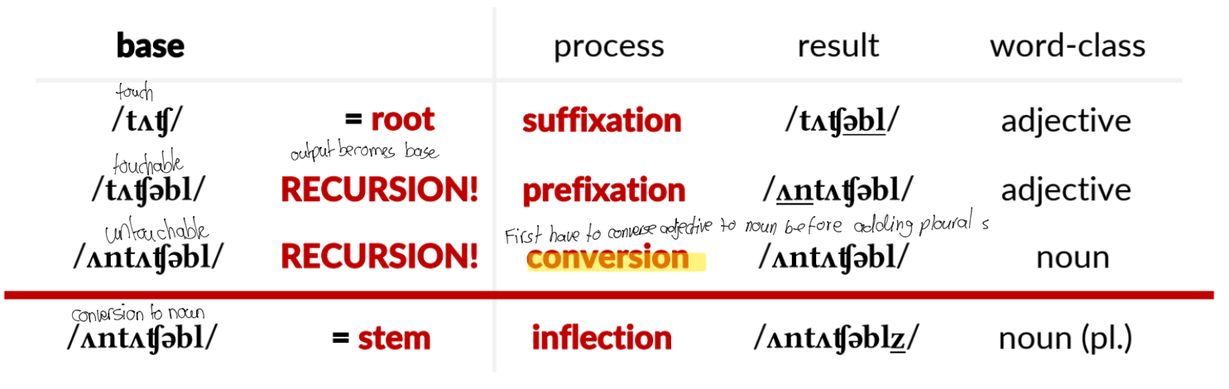
Word-formation is recursive → Repeatedly applicable → Output of one morphological process can become base of another
Parts of morphological processes:
suffixation
prefixation
recursion (outpt becomes base)
conversion (word class change)
inflection
root
free lexical morpheme that remains when all affixes have been removed
not further analysable
stem of a word form
part that remains when all inflectional affixes have been removed (-sles, - ed, -en, -ing, ‘s, -er, -est, …) (tense, number, gender, case, person)
can be simple (one lexical morpheme) or complex (more than one)
always a free from (word of the language) → Works mostly in english but not always (e.g. fungus - fungi)
Lexical Morphology
Word-formation
→ Language provides speakers with productive patterns for creating new words based on already existing ones
→ Word formation allows language to keep pace with extralinguistic changes, contributes to economy of language:
speaker's perspective: building on already existing vocabulary less of a burden on memory
hearer's perspective: words based on familiar patterns can always be understood
Three most productive strategies of English word-formation work with morphemes:
1. Derivation (affixation)
Prefixation (bound + free) e.g. co-author, intolerable, …
→ usuall class maintaining
Suffixation (free + bound) e.g. free - freedom, child - childish, duck- duckling)
→ typically but not always class-changing
—>Both types very common in European languages
(in other languages aldo infixation and circumfixation possible)
2. Compounding (free + free)
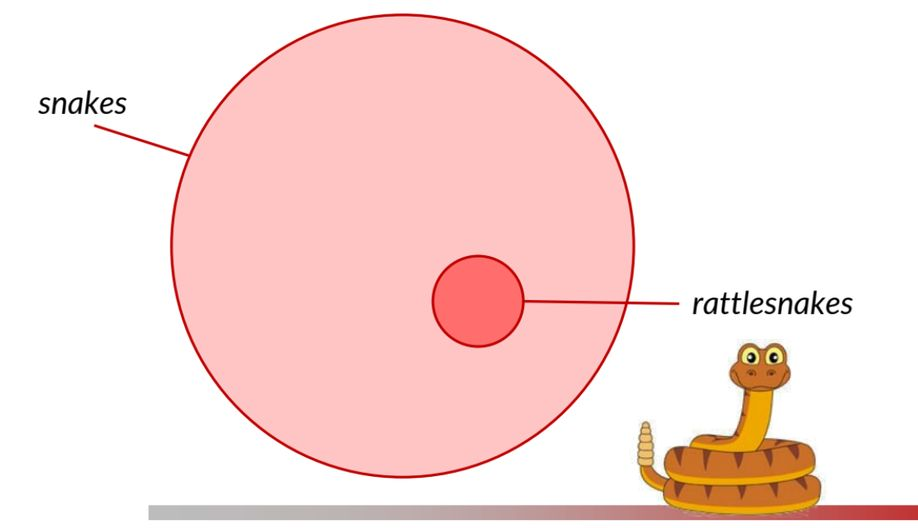
- Endocentric compounding (within → Snakes - Rattlesnakes)
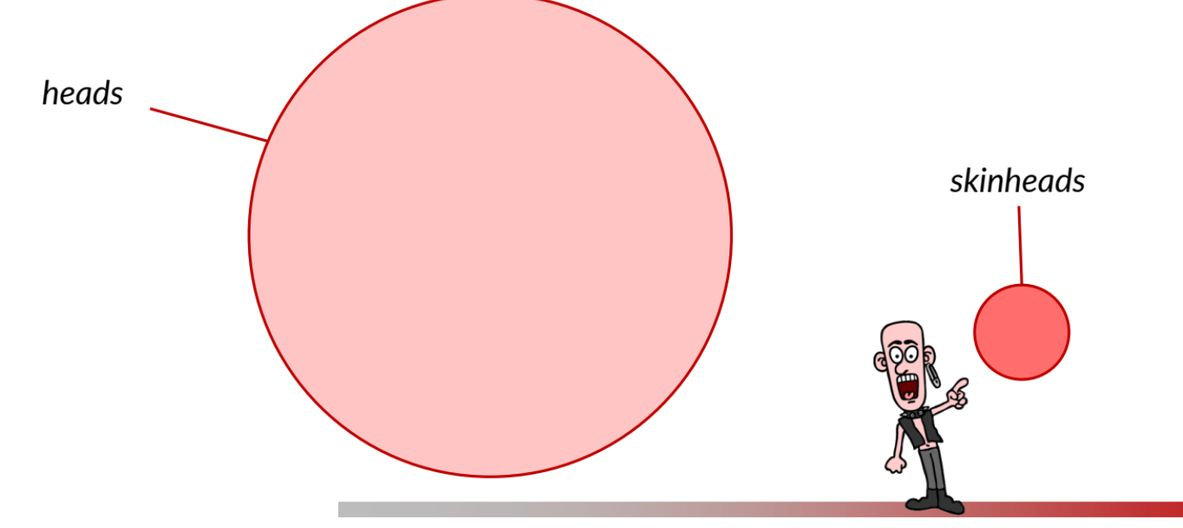
- Exocentric compounding (heads - skinheads, Barfuß → not a type of foot bus someone is it)
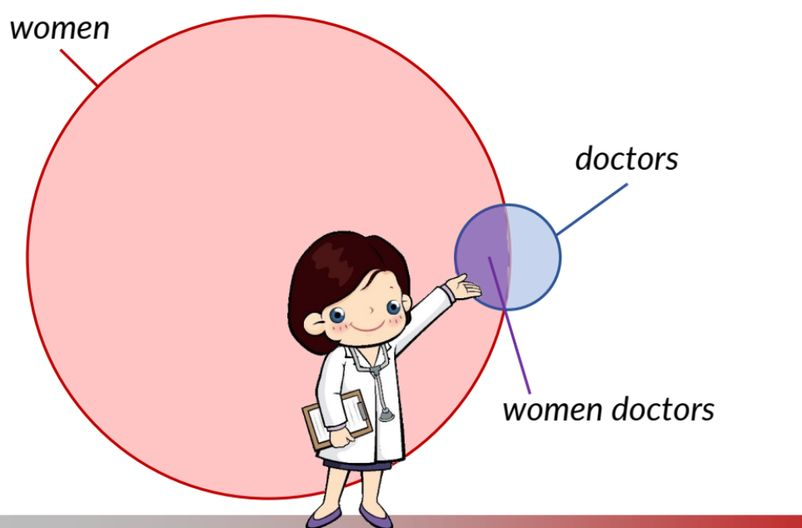
- Appositional compounding (Intersection, woman doctor, she-goat, … )
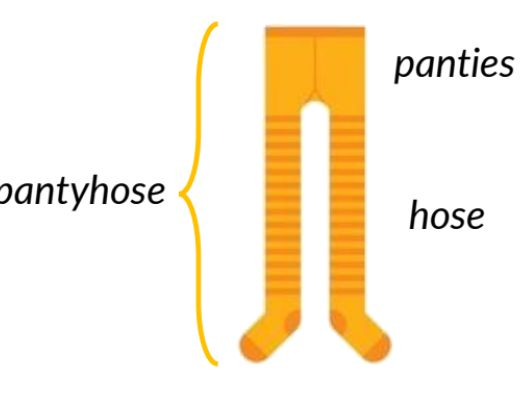
- Copulative compounding (not often, pantyhose = panties + hose)
- Neoclassical compounding (e.g. aristocrat, biology,…)
special in consisting of an initial combining form and a final combining form → two bound elements (aristocrat)
pattern of combining bound bases imported from classical languages
→ Compunding widespread in all languages (some use linking elements in compunding (Les-e-saal)(speed-o-meter))
Compounding vs univerbation
Compunding = productive word-formation pattern, level of langue - univerbation = unsystematic, level of parole (e.g. anything)
Compounding or derivation or neither?
Morphological status can change through time e.g. cniht (boy) + had (condition) (→ Compunding) = knight + hood (→ Suffixation) but hood no longer used independently
3. Conversion (zero derivation)
noun → verb
verb → noun
adjective → verb
adjective → noun
particle → verb
→ Very productive in English, world-class not marked by morphology
→ Any form compatible with any of open word-class
Coinage:
coinage (eponymy) = process when name of individual person, place or brand is converted into normal lexeme
Non-morphemic patterns of word-formation
→ Sometimes speakers disregard morphemic structure of existing words and operate with meaningless sounds
→ Less predictable, more like “what sounds good”
→ less common, associated with stylistic levels or semantic domains
4. Backformation
Reversal of what speakers assume was earlier process of derivation (e.g. to baby-sit <- baby-sitter)
creates new word by restoring base that never existed
difficult to diagnose, speakers cannot be expected to know which word was formed first
5. Clipping
cutting away sounds or letters at beginning/end or both (e.g. app, gym, fridge)
can be phonologically modified (bycicle, bike)
does not respect morpheme boundaries of original word, results become morpheme in its own right
often at first less formal but can eventually become neutral term
6. Blending
Playful fusion of two words (combining first sounds of one with last sounds of other words) e.g. brunch
mostly Iconicity: similarity between form and meaning
Splinters extracted from popular blens can become productive morphemes (work+alcoholic → workaholic, foodaholic, …)
7. Acronymy
Abbreviation pronounced as words e.g. Lol, Aids, asap
8. Alpahbetism
Abbreviation pronounced letter by letter e.g. USA, FBI
9. Word-manufacture
invention of new word without any base in existing vocabulary
tho also not entirely free
has to follow basic phonotactic rules to be pronounceable
will be influenced by associations andd sound-symbolism