Hobbes Chapter 13
Thomas Hobbes (1588-1679)
Born in Westport, England
Educated at Oxford
Travelled Europe, saw the emergence of a “new science” (Descartes et al)
Leviathan (1651)
Hobbes really hated learning Scholastic and Aristotelian philosophy
Leviathan (1651)
Has four parts
Chapter 10: “The power of a man (to take it universally), is his present means, to obtain some future apparent Good.”
Chapter 13
Just like Locke, this starts with the fundamental equality of everyone.
Why? The ability to kill someone. There is no natural hierarchy, there’s no stability.
We are equal insofar as we are all vulnerable; even the strongest and smartest can be undone by an opposing force.
The fundamental equality also extends to our intellectual abilities and capacities.
Most people are smart today because they can follow rules, but that’s hard to come by naturally.
Most people learn by doing, and most people experience the same things in life (in the state of nature).
Most people feel unequal, but that’s just their vanity; almost everyone thinks they’re smarter than the average person, which is ironic.
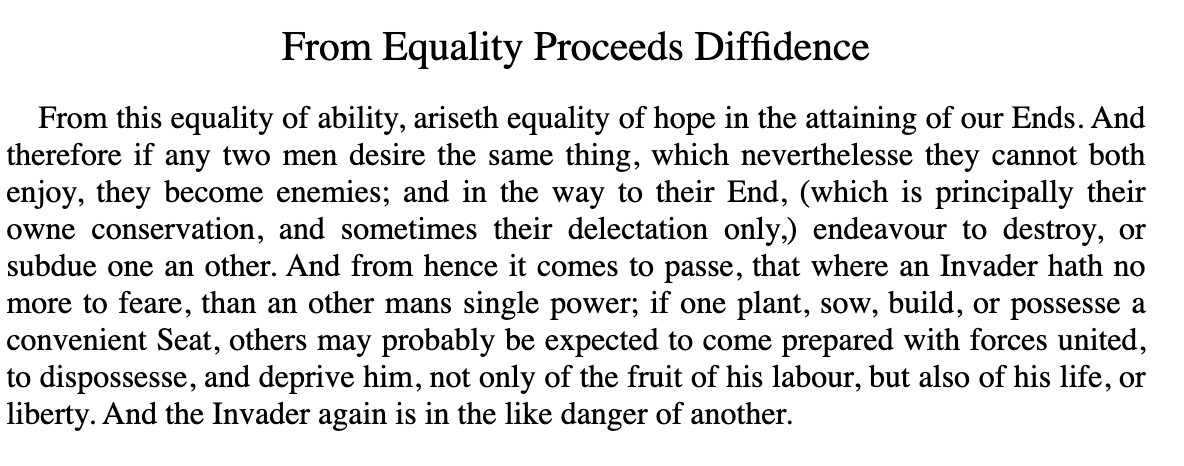
Or equality leads us to distrust other people.
Violence is instrumentally rational under conditions of insecurity, particularly when in competition and lacking sufficient power compared to others, you must utilize your own power to destroy or subdue your rivals.
The state of nature = the state of war
Diffidence (mistrust) leads to war
First, because there is no common, stronger power to stop someone from attacking you, you must anticipate violence and be ready to inflict violence of your own on someone else.
You need a way to prepare yourself
You have to keep expanding your power; you cannot survive those ambitious attempts against you
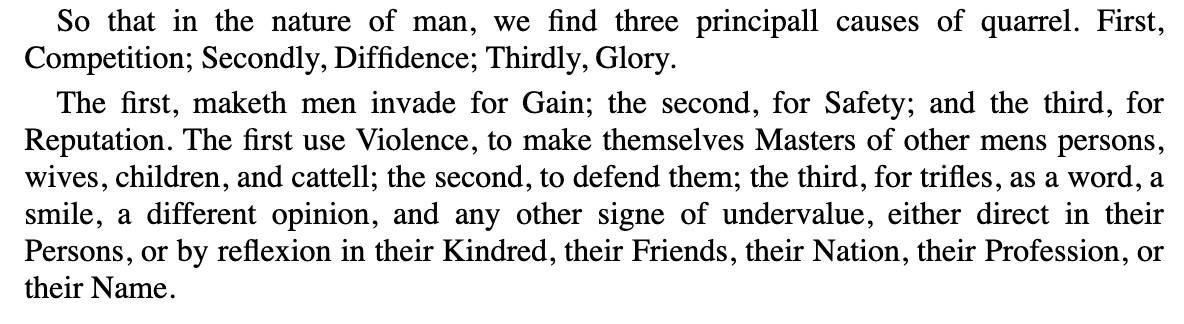
Mistrust leads to war because
No power stops someone from taking your stuff (scarcity and competition)
There might just be people ready to fight you (diffidence or mistrust)
Even if you don’t want power, you’re going to have to go get it (glory)
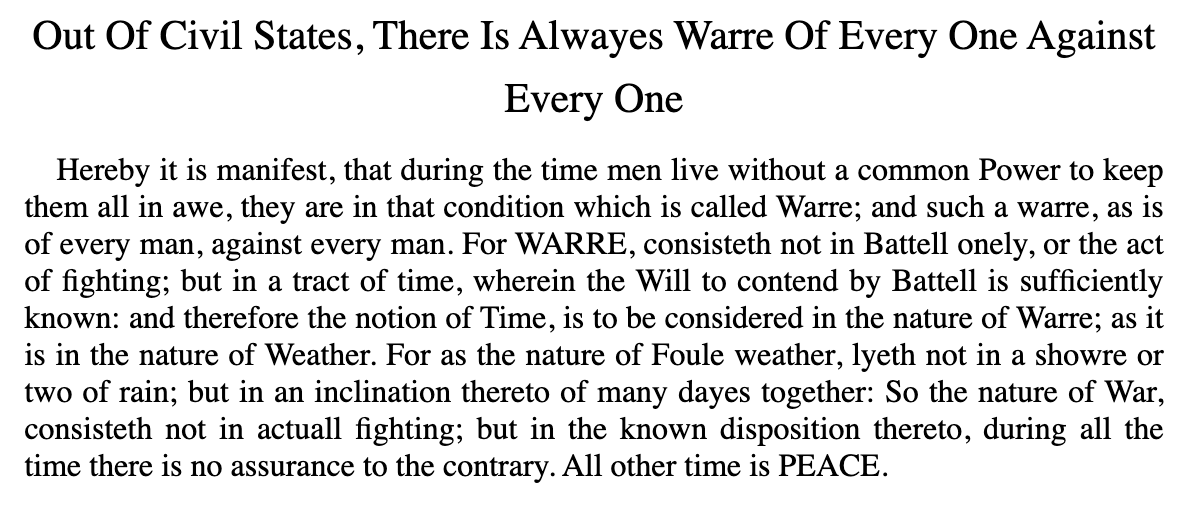
“Awe”, this is actually gear laced reverence; something is awful because it is something that makes you respect it because it is so fearful.
War is a “tract of time”; it’s an uneasiness. You are constantly in this state. It’s like bad weather; you see the conditions leading up to it, during, and afterward.
Peace is just when we aren’t fighting, when war isn’t on the horizon, when we have the assurance that we aren’t going to be fighting.
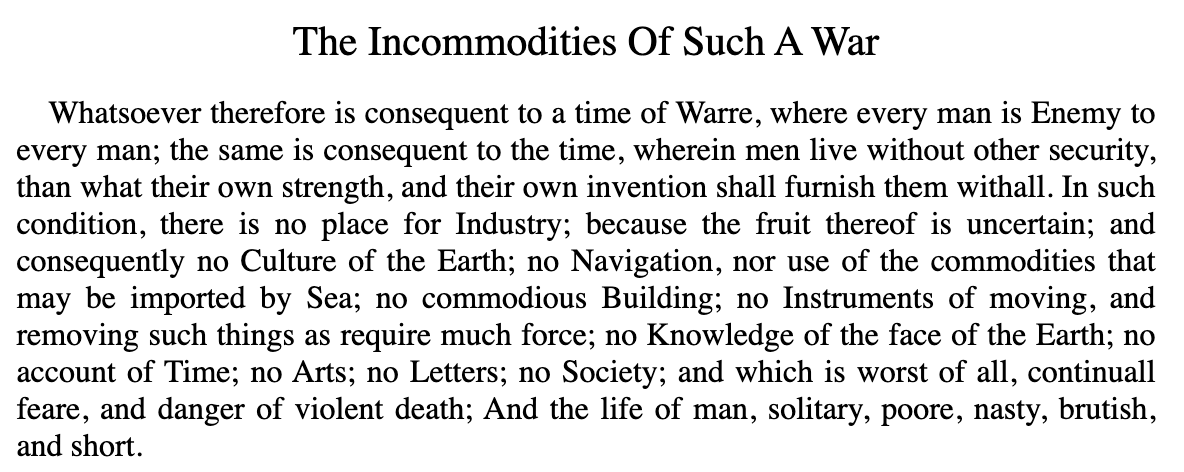
When there is no assurance/security beyond your own strength and invention, there is uncertainty of any fruit of your labor and, therefore, war.
Civilization requires stability across time: famously, Hobbes says that life in the state of nature is “solitary, poor, brutish, and short.”
Why do you still lock your door at night?
Phenomenological proof that you agree with Hobbes: even in society, you still believe that human beings are as he describes them.
There is no sin, Hobbes says, because there are no laws that determine what is right or wrong.
There is no “law os nature” in the Lockean sense
There is only power to do what you must to describe
There is no private property, there is no “mine and thine” in the state of nature
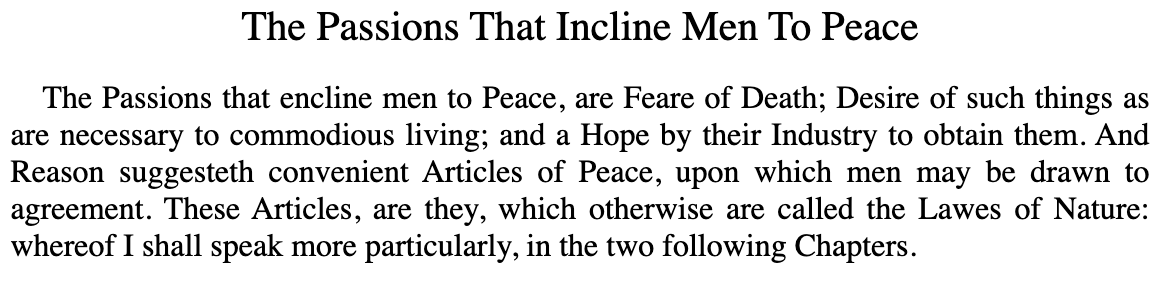
Fear of violent death brings us to peace.