Endocrine System
The Endocrine System is responsible for controlling the body by producing and releasing hormones that regulate long-term metabolic activity.
maintain homeostasis in the blood
growth and development
regulate cellular metabolism and energy balance
reproduction and sexual development
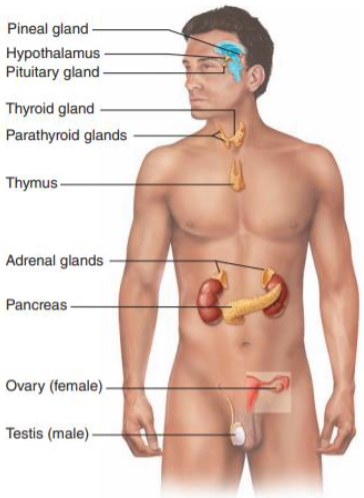
Glands and Hormones
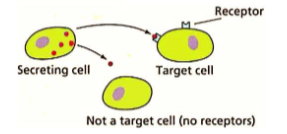
Endocrine glands release hormones directly into the bloodstream for chemical signaling of Target Cells. Hormones are chemical messengers made of amino acids or steroids that alter cellular activity - increase or decrease the rate of metabolic processes.
Hormone Feedback and Regulation
Negative Feedback: inhibitory (slow down) and stabilizing and adjusts to maintain homeostasis has opposing hormones
Positive Feedback: stimulation (speed up) and stabilizing and amplifies the effect of stimuli
Glands are activated by different stimuli.
Neural: nerve fibers stimulate hormone release - sympathetic nervous system stimulates the adrenal medulla to release epinephrine and norepinephrine.
Humoral: changing blood levels stimulates hormone release - release of PTH (Parathyroid) prompted by decrease of Ca² levels.
Hormonal: hormones stimulate other organs - hypothalamic hormones stimulate the anterior pituitary gland.
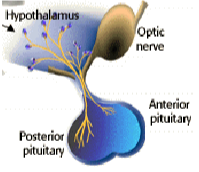
Pituitary Gland: “master gland” - controls and regulates other glands
G.O.A.T F.L.A.P
Anterior-
Growth (GH) - total body growth
Prolactin (PRL) - stimulates production of breast milk
Adrenocorticotrophic (ACTH) - stimulates adrenal cortex ~ release hormones
Thyroid-stimulating (TSH) - stimultaes thyroid gland ~ release hormones
Follicle-stimulating (FSH) - stimulates ovaries/testes ~ release hormones or produce gamates
Luteinizing (LH) - stimulates ovaries/testes ~ release hormones or produce gamates
Posterior-
Oxytocin - stimulates uterine contractions and milk ejection
Antidiuretic (ADH) - stimulates kidney to reabsorb water - prevents urine formation. Urine volume decreases, blood volume inceases and bp increases
Thyroid Gland: base of the throat
Thyroxine (T3) & Triiodothyronine (T4) - stimulates body metabolism ~ regulates energy production and body heat, blood pressure, tissue growth, stimulated by TSH
Calcitonin - lowers blood Ca levels (from high blood Ca) by removing Ca from blood and depositing in bone, targets osteoblasts
Parathyroid Gland: 4 tiny masses of glandular tissue, posterior surface of thyroid
Parathyroid (PTH) - increases blood Ca levels (from low blood Ca) by removing Ca from bone and depositong into blood, targets osteoclasts to break down bones
Adrenal Glands: above each kidney, outer region (adrenal cortex), inner region (adrenal medulla)
Adrenal Cortex-
Mineralocorticoids - regulate Na+/K+ reabsorption in kidneys ~ regulate blood volume, and blood pressure
Glucocorticoids - allows body to withstand long-term stress, releasing glucose into blood, decrease inflammatory response ~ stimulated by ACTH
Gonadocorticoids - small amounts of estrogen or testosterone (androgens) - contributes to onset of puberty
Adrenal Medulla-
Catecholamines - activates sympatheic ANS, increase fight or flight response
Pancreas: close to the stomach, abdominal cavity, mixed gland
Insulin - high blood sugar level ~ stimulates glucose uptake from blood into cells to be oxidized for energy, converted into glycogen or fat, released by beta cells
Glucagon - low blood sugar level ~ stimulates liver to release sugars stolen in glycogen, targets liver, glucagon is released by alpha cells
Gonads: ovaries and testes - stimulated by FSH and LH
Estrogen - maturation of reproductive organs, 2nd sex characteristics
Progesterone (Ovaries) - works with estrogen for breast development, menstrual cycle
Testosterone (Testes) - promotes the development of male reproductive organs, 2nd sex characteristics, necessary for sperm production
Thymus Gland: active in childhood and atrophies as we age
Thymosin - maturation of T cells (lymphocytes) ~ important in immunity
Pineal Gland: roof of the 3rd ventricle of the brain
Melatonin - affects biological rhythms and reproductive behaviors
Extra Credit -
Exophthalmos: eyes are protruding (poking out)
Tetany: tingling noted around mouth and feet
Diaphoretic: sweating
Polydipsia: extreme thirst
Hypernatremia: the level of sodium is too high
Hypokalemia: the amount of potassium in the blood is too low
Hyperglycemia: high blood glucose
Glucosuria: urine contains sugars (glucose, lactose, fructose, or galactose)