Dynamics: Force, Newton's Laws, Friction, and Drag Notes
Concept of Force and System Representation
Force Definition: A force is a vector push or pull possessing both magnitude and direction.
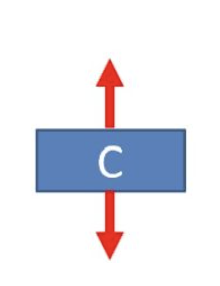
Free-Body Diagram (FBD): A technique representing a system as an isolated single point, showing only external forces acting on it. Internal forces within the system cancel out and are ignored.
Standard Force: A reproducible reference force used to define units of force, such as the restoring force exerted by a stretched spring.
Newton's First Law of Motion: Inertia
Statement: A body at rest remains at rest, or, if in motion, remains in motion at a constant velocity unless acted on by a net external force. (FRICTION)
Ex. Much less friction on an ice rink
If an object is moving at constant velocity, it is moving in an inertial frame
Inertia is not a force!
Inertia: The tendency of a body to remain at rest or to maintain constant velocity.
Mass (): Quantity of matter in an object (). Mass is an intrinsic property that remains constant regardless of location.
If an object moves with a constant velocity, there are no forces acting on it (Just N and g)
For there to be a force, it must be accelerating
Newton's Second Law of Motion: Dynamics & Weight
Statement: Acceleration () is directly proportional to and in the direction of the net external force (), and inversely proportional to the mass () of the system:
v is proportional to F
v is inversely proportional to F/M
SI Unit of Force: The newton (), defined as:
Weight (): The gravitational force exerted on a mass by the nearest large body:
On Earth, g = 9.80, giving a mass a weight of .
Unlike mass, weight changes depending on local gravitational field strength.
Newton's Third Law of Motion: Symmetry in Forces
Statement: Whenever one body exerts a force on a second body, the first body experiences a force equal in magnitude and opposite in direction to the force it exerts.
Interaction Pairs: Action and reaction forces act on different systems; therefore, they do not cancel each other out within a single system's free-body diagram.
Normal Force, Tension, and Inclined Planes
Normal Force (): The supporting contact force directed perpendicular to the surface of contact.
Tension (): The pulling force transmitted along a flexible connector (rope, cable, tendon) parallel to its length. For a perpendicular force applied at the midpoint of a flexible connector:
Incline Resolution:

Component of weight parallel to incline:
Component of weight perpendicular to incline:
Normal force on incline (no perpendicular motion):
Acceleration down a frictionless incline:
Friction and Drag Forces
Static Friction (): The force that prevents a stationary object from starting to move when a force is applied to it:
Kinetic Friction (): Kinetic friction is the force that resists an object's motion while it is already moving or sliding across a surface:
Coefficients of friction depend on contact materials, where .
For an object sliding down an incline at constant speed ():
Drag Force (): Opposing frictional force exerted by fluids (liquids/gases) on moving objects. For large objects at high speeds: where is the drag coefficient, is fluid density, is frontal area, and is velocity.