Russo - Japanese War (1904 - 1905)
Background
Russian Empire
Initial
Economic System
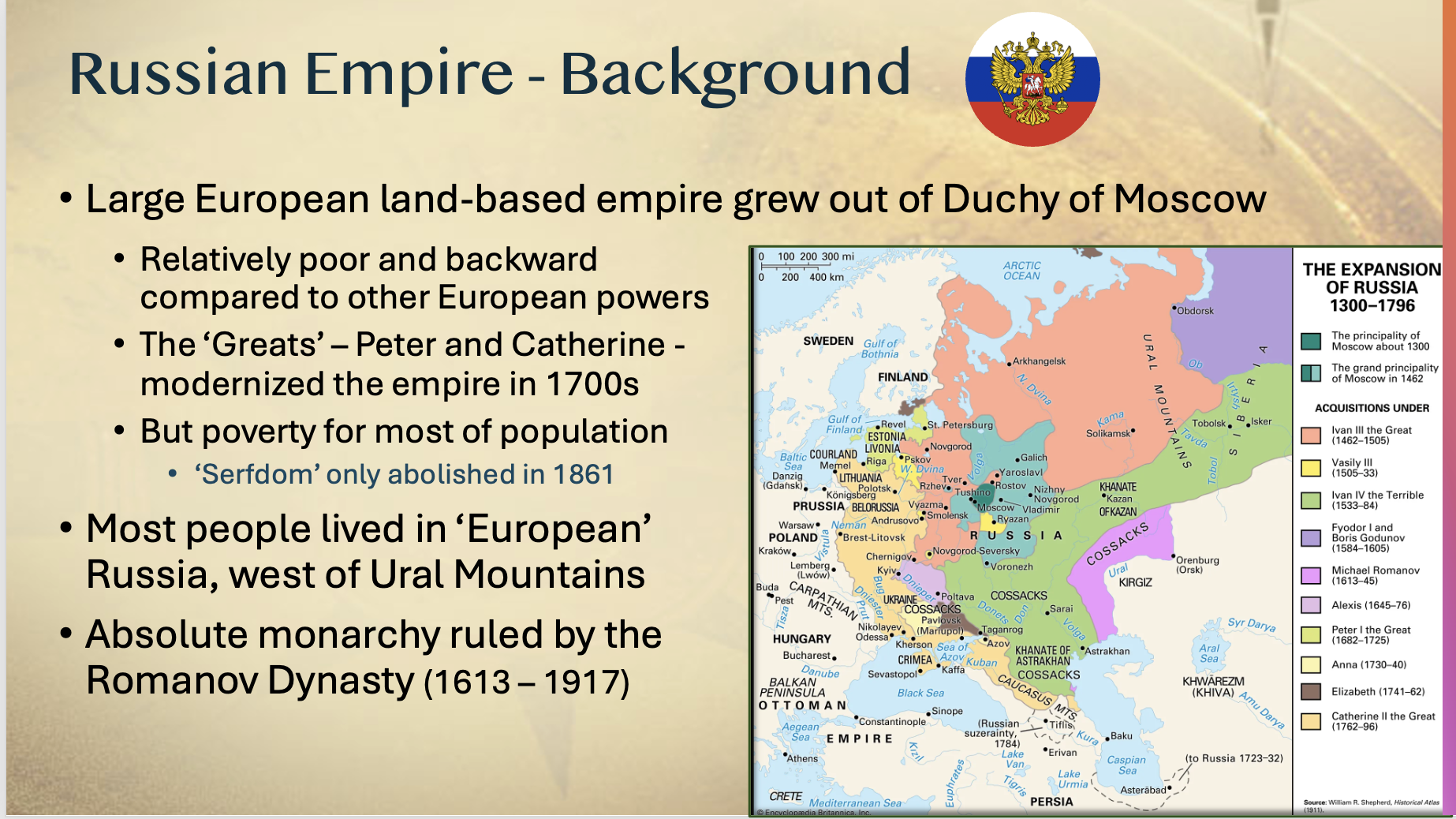
the majority of citizens were land based peasants
Russia kept their feudal system until 1861
peasants were required to live and work on land for nobles, basically as slaves
Political System
Absolute Monarchy - monarch has the ultimate authority to run the state through a divine right (basically a dictatorship)
Monarch was called “Tsar” (or Czar)
fun fact: the roots of Czar have to do with Ceasar, as Russia viewed itself as the third rome (similar to Kaiser being German for Ceasar)
from 1613 - 1917, Russia was ruled by the Romanov Dynasty
Changes and Improvements
Political Reforms
Russia joined the modernization and enlightenment system in the 1700s under the ‘Greats’ - Peter and Catherine (including speaking French in the court!),
Territorial Gains
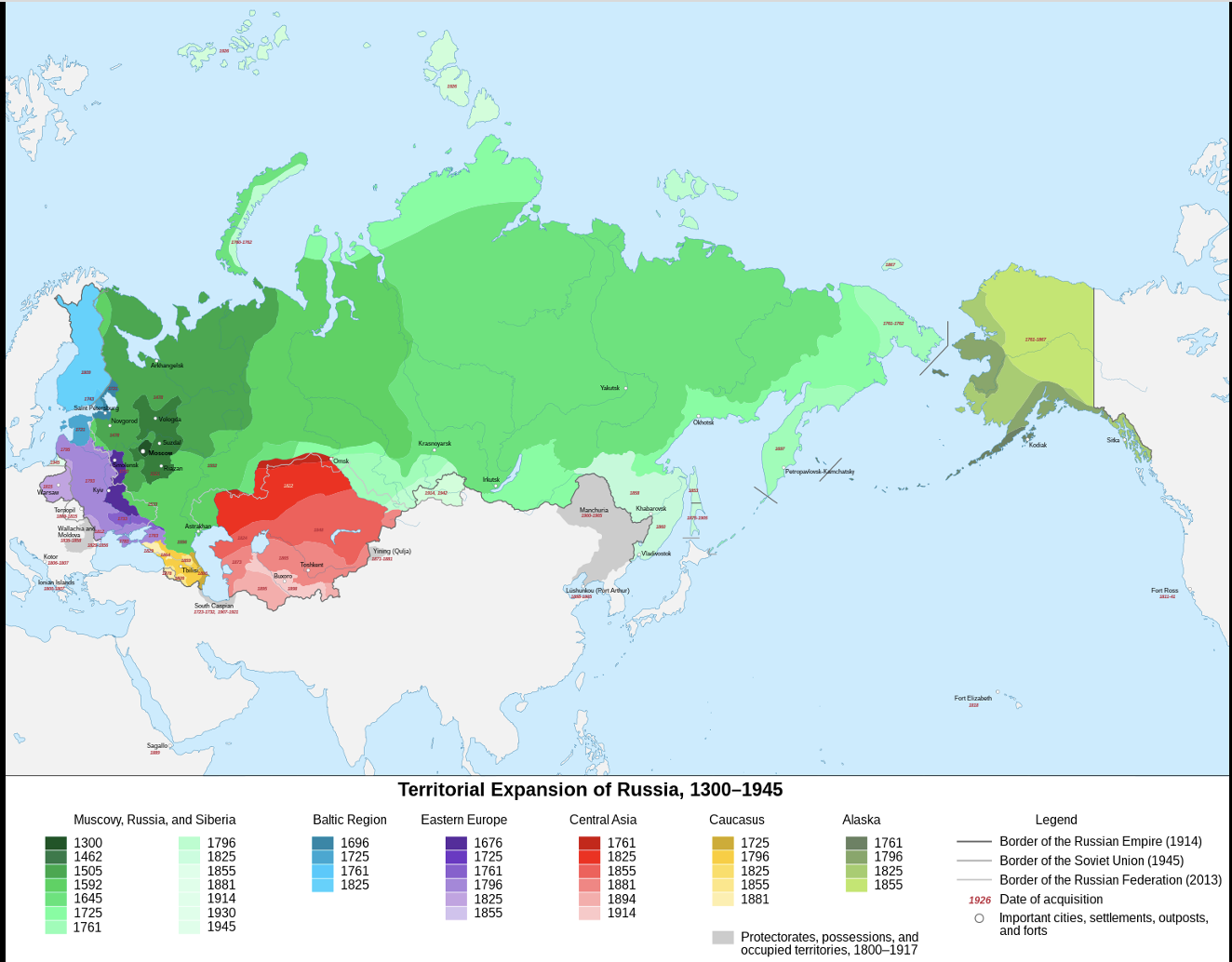
The two ‘Greats’ also greatly expanded the Russian empire’s territory, until they expanded as far East as Alaska and as far west as Germany, covering Siberia and Central Asia
Territorial disputes in China
Moving into China (1600s)
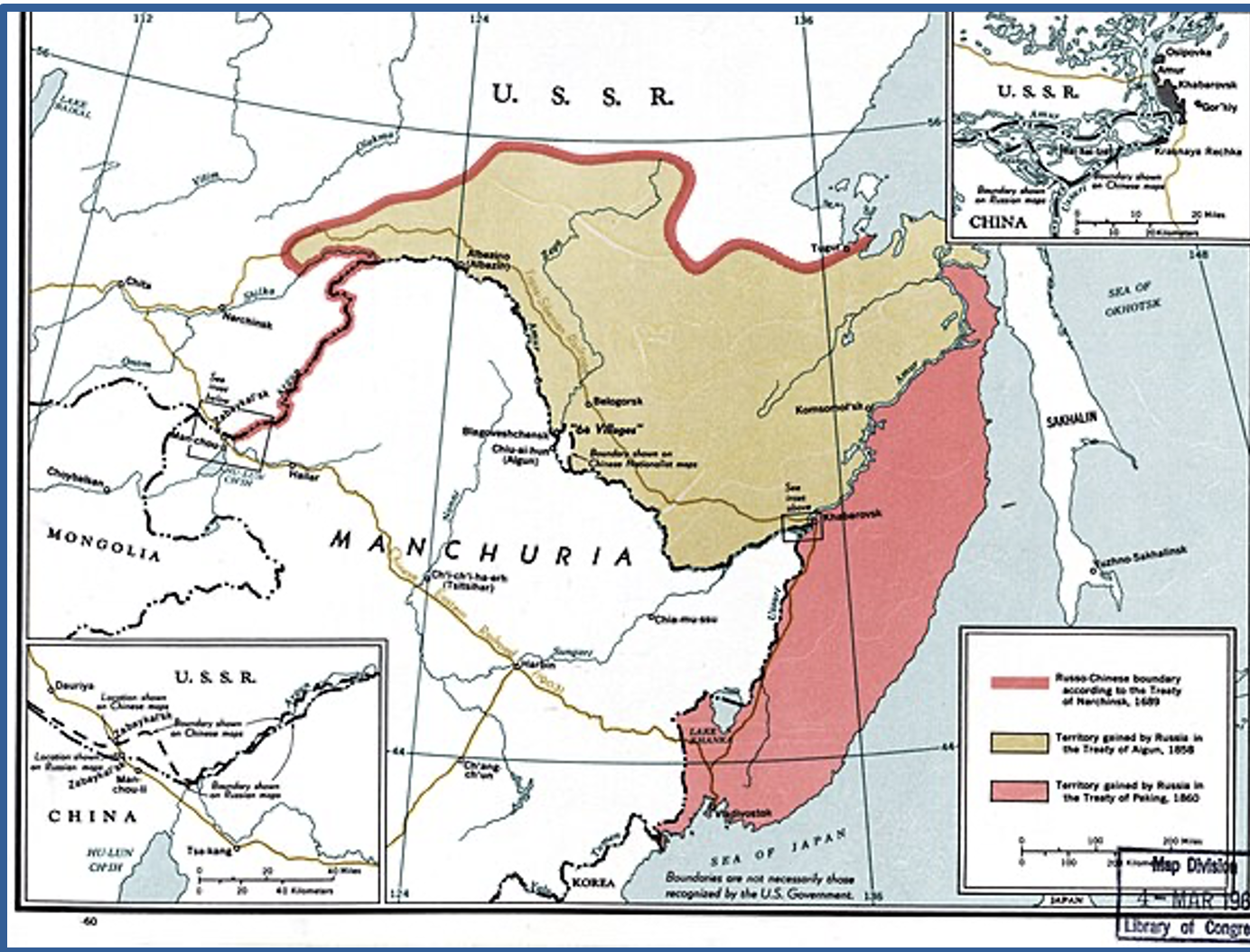
in 1600, Russian settlers start moving into Chinese territories at the Amur River, leading to territorial disputes
They signed a treaty with Kangxi called the Treaty of Nerchinsk (1689), but due to translation issues the border between Russia and China is still unclear.
Russia’s “Unequal Treaties“ with China (1800s)
1858 - the Qing Dynasty is fighting in and sorely losing the second opium war AND the Taiping Rebellion
Russia steps in and offer to help China get rid of British and French presence
Russia steps into and offers to help get Britain and France out of China with the concession of the red land (Treaty of Aigun 1858, and Convention of Peking 1860) - signs away coastal Manchuria - now the modern Russian city Vladivostok
Russian really wants to build a Trans-Siberian Railway to unify their empire, and also get a warm water port (their current port freezes up in the winter, even in Vladivostok, which is further South) - they only have a warm water port in the black sea, but the navy fleet can’t get out to the Mediterranean sea unless they have permission from the Ottoman empire. They can’t get defeat Constantinople due to backing from the British and French empire — gaining territory in China would allow them to build a railway and have access to warm water ports like Port Arthur
Japan
prior to 1853, Japan was isolated for 250 years
When Tokugawa Ieyasu defeated all the samurai, he expelled all foreigners save a small amount of Dutch merchants
Feudal rule 1603 - 1868 founder and first shōgun of the Tokugawa shogunate of Japan(shogun is a military dictator that acts on behalf of the (powerless) emperor)
Japan is ruled by upper class of Samurai, with regions ruled by semi independent rulers called daiymyos
would only trade with Korea, China, Rukus (Okinawa), and Dutch merchants
Forced open by US fleet under Commodore Matthew Perry in 1853 (forced to trade due to lessons learnt from British influence in China)
Meiji Restoration
After Japan is forced open, the simmering discontent grows - exposing the weakness of bakufu (Tokugawa Government) to resist Western powers, and increasing worry about invents in China
the Daimyos rise up and overthrow the Shogun and restore the power of the emperor
In about 30 years, they modernize themselves completely
send out students and ambassadors to study in Europe and the US
they study different models and take inspiration, Germany military, British constitutional monarchy
industrialize rapidly from a feudal society (where Samurai are paid in rice) to an industrial powerhouse)
1870s - Samurai Status and privilege banned (but unofficial status continued, such as advantages with setting up coporations)
1889 - Parliamentary gov’t established
Growing Modernization
Japan needed markets and resources to feed their growing industrializing society
Viewed Korea as vital to its interests (viewed Korea as a ‘dagger to Japan’, because people would use korea as a bridge to fight Japan or vice versa - and they also wanted Korea for its coal, iron, and markets)
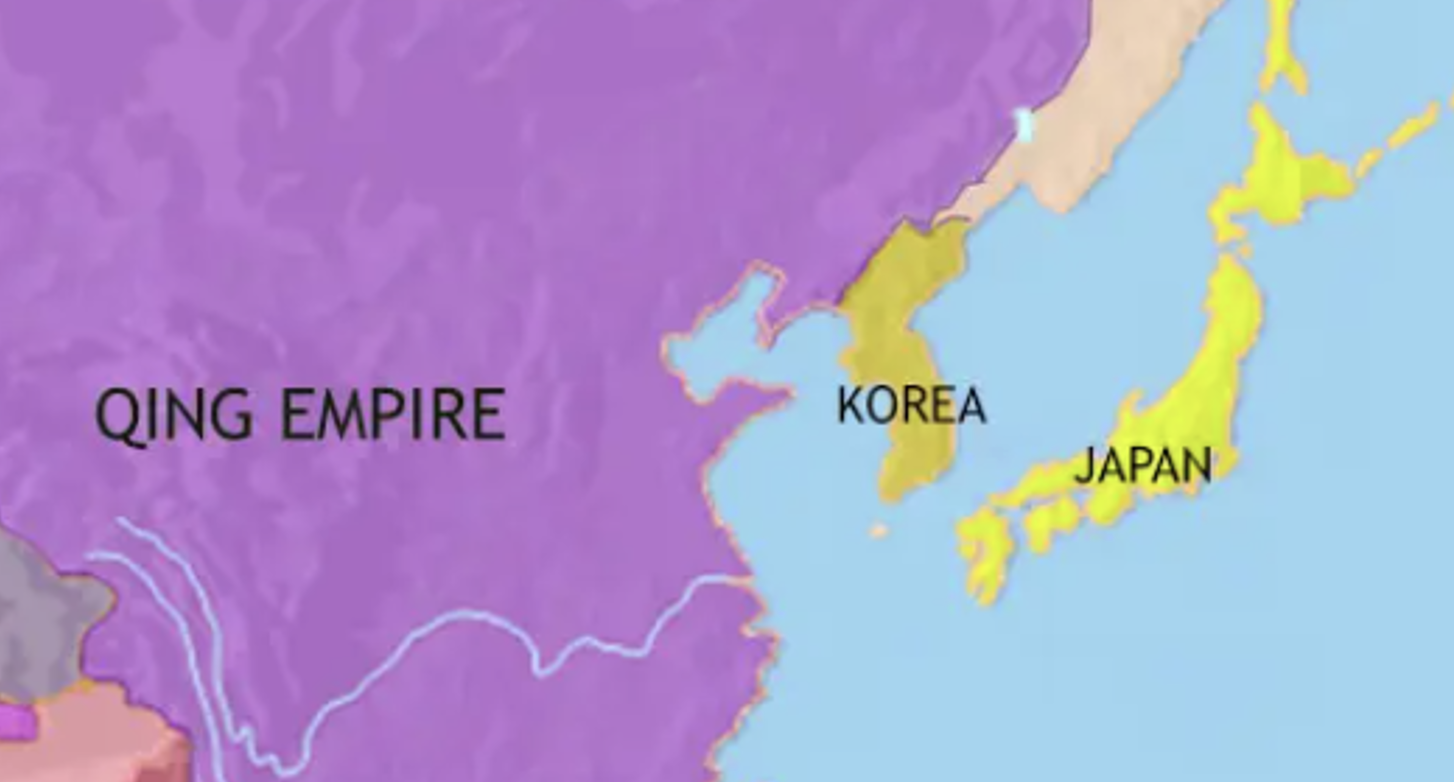
t However, Korea was a tributary state to China, and it refused to establish relations w/ new Meiji government and only recognized the old shogunate. (they only recognized the Qing Empire’s Emperor, not Japan’s Emperor)
1876 - following the Ganghwado Incident, Japan forced Korean ships to fire on Japan, and then threatened to declare war on Korea or have Korea open up to trade
Sino - Japanese War (1894 - 1895)
Build up
growing reformer faction in Korea started looking to Japan, and Japan started to encourage a Coup d’etat (1885) - China sent in troops
Another coup happens in 1894 - China sends in troops again, and Japan takes this as an opportunity to go to war with China
War fought mostly in Korea & Manchuria, and China was defeated convincingly and badly
Treaty of Shimonoseki
China signs the treaty of Shimonoseki
1) Give up Taiwan, the Pescadores islands, and Liaodong Peninsula
2) Pay a reparation indemnity of 200 million taels
3) Recognize Korea as a fully independent state
4) Give Japan most favored Nation Status (same status as UK, USA, France)
5) Opened up the Yangtze river to Japan and 4 ports (Chongqing, Hangzhou, Shashi, Suzhou)
China’s humiliation contributed to growing revolutionary movement within China against the Qing (led by people like 孙中山)
Upset Western powers
Triple Intervention
Russia, France, and Germany forced Japan to return the Liaodong peninsula to China in exchange for an additional indemnity (under the threat of further military intervention)
Queen Victoria
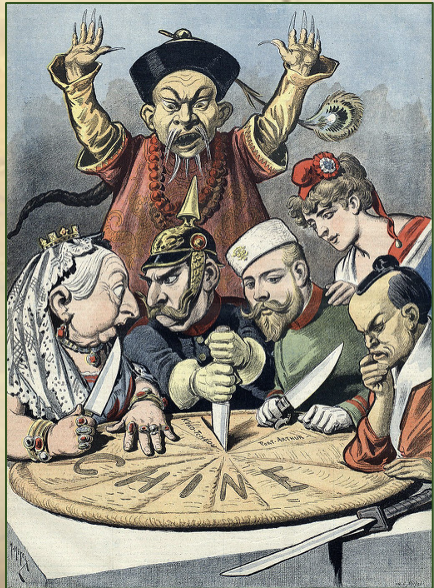
Queen Victoria (at that time, the longest serving monarch of Britain)
German (with the iconic pickel helmet)
Tsar Nicholas
France
Japan (looking on with interest)
3 Western Power “carving up the cake of China”
Russia - port arthur and manchuria
Britain - Weihaiwei
France - Shashi
Germany - Jiaozhou (Shandong)
Japan is furious, as many of the territories it won were given to the Western powers
in return with helping China pay back the indemnity to Japan, Russia would be allowed to build the Trans Siberian railway all the way to Vladivostok and Port Arthur
Summer 1897 - guarded by a lot of Russian Troops
China would lease the Liaodong Peninsula to Russia for 25 years
Despite legal obligation, Russia left troops in China after the 8 nation alliance defeated the Boxer Rebellion
Russo - Japanese War
Tensions in Europe
Cousin of Kaiser Wilhelm II (Germany) and King George V (UK)
Visited Japan in 1890 as Crown prince, and survived an assassination attack by Japanese policeman, leading to longstanding dislike of Japan
He travelled overland from Vladivostok —> St. Petersburg, and toured the Trans Siberian Railway - he thought he knew Asia well
under influence of cousin Wilhelm II of Germany, who wanted to push the British empire aside and overpower their cousin King George V.
Germany had the strong navy, Russia had the strong standing army)
Nicholas gets egged on by Wilhelm to confront the “Yellow Peril” of Japan and display outright racism
Germany is surrounded by Russia on the East, France on the west, and it felt surrounded by an alliance, so he wanted to undermine Russia’s alliance with France. Additionally, Germany used to be predominantly Prussia, and they and the germanic states had a war with France (Franco-Prussian war), taking some of its territory and uniting with other states to form Germany (besides Austria)
Germany was late to the “colonial party”
Boxer Rebellion (1899 - 1901)
Boxer Uprising
Russia, Japan, and 6 others send in troops as part of a 8-nation colaition (八国联军) to end the boxer uprising, and sends over 100,000 troops to “protect” its railway in Manchuria, but didn’t remove them afterwards as promised
Japan and Russia were the dominant powers in Korea and Manchuria, creating potential for conflict
Anglo - Japan Treaty of 1902, If Britain or Japan were at war against two powers, the other would join the war
Japan’s Goals
1)Check Russian expansion in Asia
2)Prevent France from helping Russia in possible war (as they would lead to UK joining the war, which France didn’t want)
3)Treaty gave Japan new prestige as int’l power
Britain’s Goals
1)Check Russian expansion in Asia
2)Protect trade interests in China & Korea
3)Free up Royal Navy for growing naval arms race against Germany
Tsar Nicholas kind of Racist and calls the Japanese people “Yellow Monkeys” (also he was attacked by Japanese terrorists when he was a kid and he still got headaches from the lingering injuries
Post Boxer Rebellion Negotiations
Japan’s initial proposal:
Russia control of Manchuria if they could get free rein in Korea (spheres of influence)
Russia’s counterproposal:
only wanted to recognize control of Korea only south of the 39th parallel (so that they could gain more)
Kaiser Wilhelm pushes Nicholas to stand firm and confront the “Yellow Peril”, leading to drawn out negotiations
Japan is convinced Russia is stalling to send more troops along the Trans-Siberian Railway to fight against it