Key Concepts: ORA, Nonzero Target, and Alpine Method
Difference between refractive and corneal astigmatism
The anterior cornea is the first, important influence on vision, but not the only one. Astigmatism can be measured both by corneal shape and by subjective vision, leading to common differences between refractive and corneal astigmatism observed in patients and reported in the literature.
ORA and the nonzero target: why they matter
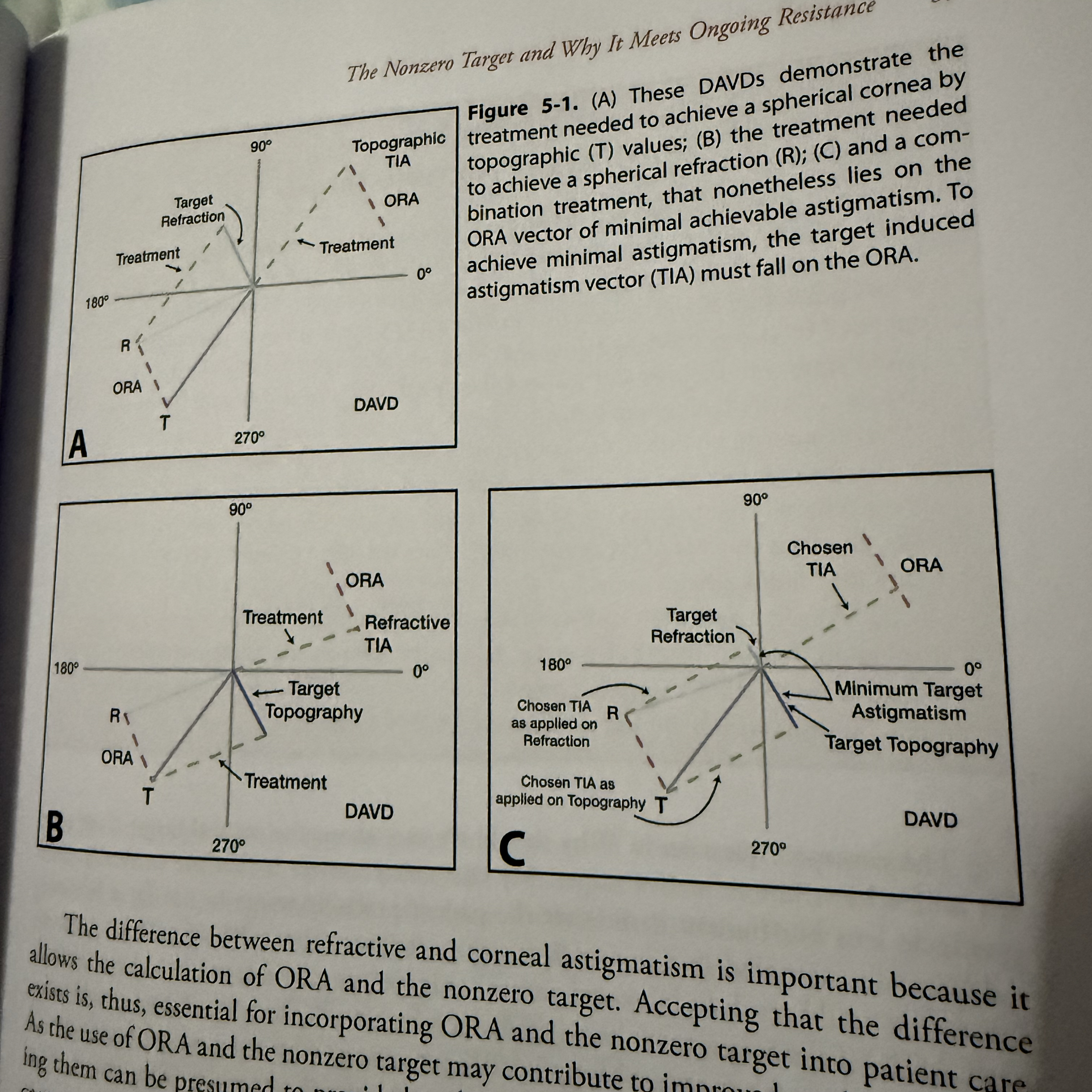
Accepting that refractive and corneal astigmatism can differ is essential because it allows calculation of ORA (ocular residual astigmatism) and the nonzero target. Ignoring ORA or assuming it doesn’t matter tends to yield poorer surgical planning and outcomes. ORA contributes to improving results when incorporated into planning.
The ALPIN method and vector analysis
The ALPIN method provides a vector-based framework for astigmatism analysis and treatment planning. It is foundational for standardized laser-based astigmatism correction analyses. In vector terms, ORA is the vector between preoperative topography T and preoperative refraction R:
A nonzero ORA implies a nonzero target in either topography or refraction; the ALPIN method enables calculation of ORA and the laser settings needed to eliminate 100% of either component or any combination where topographic and refractive targets sum to 100% (see below).
The ALPIN framework has been adopted as a standard for reporting astigmatism results by major journals, and in 2006 the ANSIA group acknowledged vector analysis as essential for evaluating astigmatism treatments.
Optimal treatment philosophy
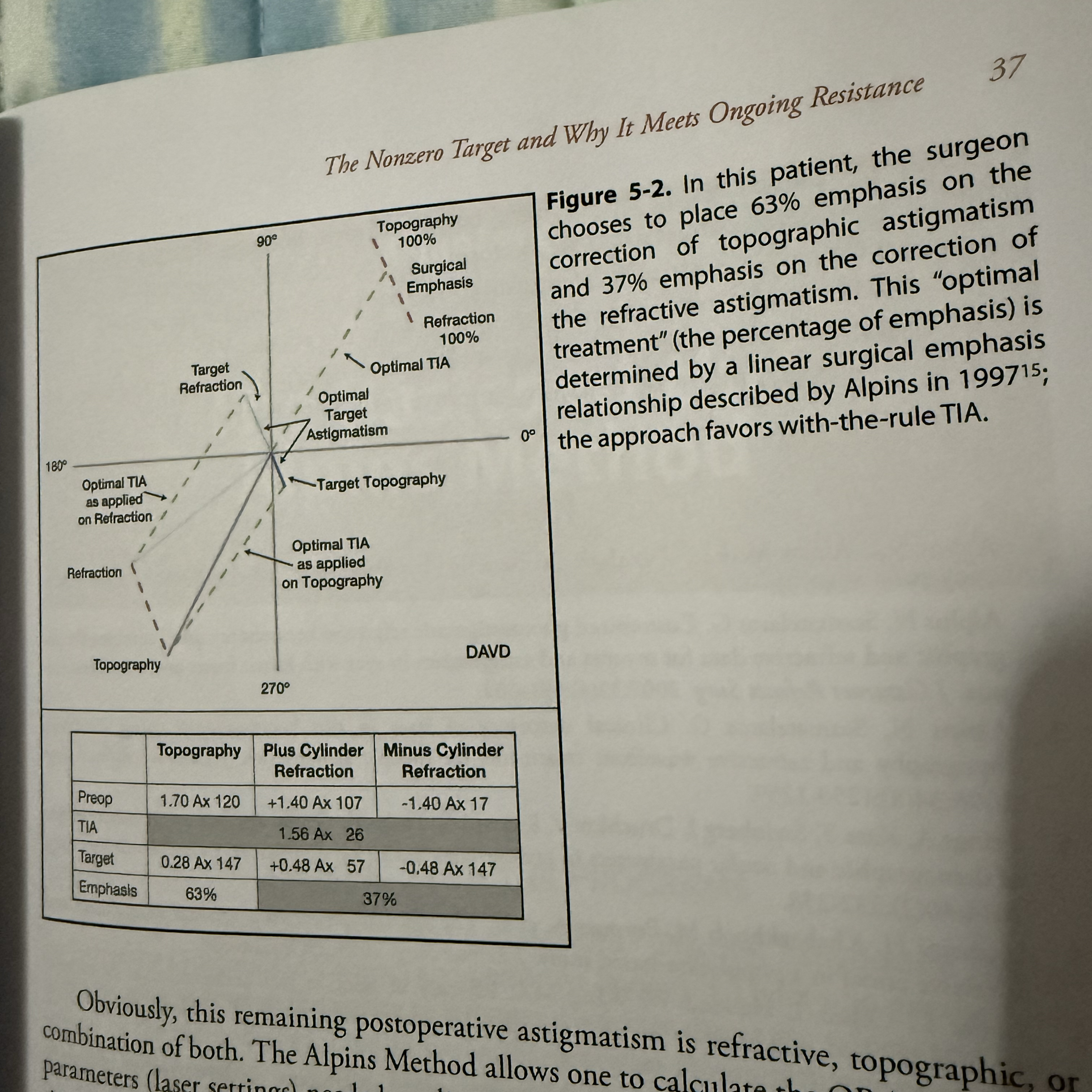
A nonzero target exists in any patient with ORA ≠ 0. The goal is to optimize treatment by considering both topographic and refractive astigmatism. The framework expresses the idea that the remaining post-operative astigmatism is minimized when the chosen targets remove 100% of one component (or a combination) while leaving the minimum possible residual, which equals the magnitude of ORA:
The maximum correction occurs when the remaining astigmatism equals ORA.
In practice, the optimal treatment emphasizes reducing topographic astigmatism, recognizing that the cornea is tissue, not a spectacle lens, and that patient comfort and lifetime use matter. In some patients, about seven percent have an ORA large enough to increase corneal astigmatism if treatment is based solely on refraction, underscoring the need to consider ORA in planning.
Practical planning guidelines
For patients with significant ORA and a potentially unfavorable corneal (e.g., against-the-rule) orientation, surgeons often apply a near 60/40 refraction-to-topography split (
this allocation is a common rule of thumb in practice.
Understanding the nonzero target and distinguishing between refractive and corneal targets before surgery enable two essential tasks: (1) optimize the treatment to the individual parameters, and (2) enable valid analysis by knowing where the targets lie. Precise goals allow assessment of success, identification of errors, and necessary adjustments for future procedures.
Implications for evaluation and last-minute review
The difference between refractive and corneal astigmatism is real and clinically important.
ORA and the nonzero target must be considered in planning to improve outcomes.
The ALPIN method provides a practical, vector-based framework for calculating ORA and for determining laser settings to minimize residual astigmatism.
In practice, allocate treatment emphasis to reduce topographic astigmatism when appropriate, while monitoring potential adverse orientations and ORA magnitude (ORA ≥ 1 diopter may influence plan).
A nonzero target guides both the surgical plan and the post-operative analysis, enabling better prediction of results and iterative improvements.