Chapter 2: Control and Coordination
Central Nervous System (CNS)
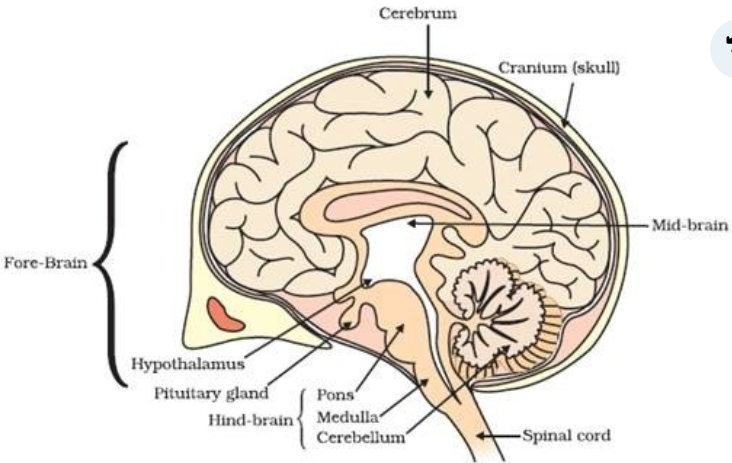
Brain (Protected by cranium and cerebrospinal fluid)
Forebrain
Cerebrum → Controls thinking, reasoning, memory, sensory processing, and voluntary actions
Hypothalamus → Regulates body temperature, hunger, thirst, sleep-wake cycles, and hormone secretion via the pituitary gland
Midbrain → Coordinates auditory and visual reflexes, including involuntary head and pupil movements
Hindbrain
Cerebellum → Maintains posture, equilibrium, balance, and precision of voluntary actions
Pons → Acts as a signal relay bridge and regulates respiratory rate
Medulla Oblongata → Governs non-voluntary life processes (heartbeat, blood pressure, swallowing, salivation, vomiting)
Spinal Cord (Protected by vertebral column)
Acts as the primary integration center for rapid spinal reflexes
Conducts nerve impulses bidirectionally between the brain and peripheral organs
Peripheral Nervous System (PNS)
Anatomical Classification (By Origin)
Cranial Nerves (12 Pairs) → Arise directly from the brain; innervate head and facial regions
Spinal Nerves (31 Pairs) → Arise along the spinal cord; innervate the trunk, torso, and limbs
Functional Classification
Somatic Nervous System (SNS) → Relays CNS impulses to voluntary skeletal muscles
Autonomic Nervous System (ANS) → Relays CNS impulses to involuntary organs and glands
Sympathetic System → "Fight or Flight" mode (increases heart rate, dilates pupils, inhibits digestion)
Parasympathetic System → "Rest and Digest" mode (decreases heart rate, constricts pupils, stimulates digestion)
Reflex Action & Reflex Arc (Flowchart)
Flowchart Pathway:
Stimulus (e.g., heat or pain)
↓
Receptor (Sensory receptor in the skin or sense organ)
↓
Sensory Neuron (Carries nerve impulses toward the spinal cord)
↓
Relay Neuron (Interneuron) (Processes impulse within spinal cord gray matter)
↓
Motor Neuron (Carries impulse from spinal cord to effector)
↓
Effector (Muscle or gland executes action)
↓
Response (e.g., immediate muscle contraction withdrawing hand)
Stimulus, Receptors, and Responses
Stimulus
An environmental change (physical or chemical, external or internal) that elicits a physiological or behavioural reaction in an organism.
Examples: light, heat, cold, sound, touch, pressure, and chemical odors.
Receptors
Specialized cells, tissues, or sense organs that detect specific environmental stimuli and convert them into electrical nerve impulses.
Types of Receptors
Photoreceptors (Eyes) → Detect light stimuli; responsible for visual perception.
Phonoreceptors (Inner ears) → Detect sound vibrations; aid in hearing and maintaining physical balance.
Olfactory Receptors (Nasal epithelium) → Detect chemical odor molecules; responsible for the sense of smell.
Gustatory Receptors (Taste buds on tongue) → Detect dissolved chemical compounds; responsible for the sense of taste.
Thermoreceptors / Tangoreceptors (Skin) → Detect changes in temperature (heat/cold) and tactile stimuli (touch and pressure).
Response
The physical or chemical reaction manifested by an effector organ (muscles or glands) in reaction to an integrated stimulus.
Types of responses include voluntary actions (consciously controlled), involuntary actions (autonomously controlled), and reflex actions (rapid, automated protective mechanisms).
Neuron (Nerve Cell)
Structural and Functional Unit
The core microscopic unit of the nervous system specialized for receiving, conducting, and transmitting electrical impulses.
Key Structural Components
Dendrites → Branched cytoplasmic projections that receive signals from other neurons or receptors and convert them into electrical impulses.
Cyton (Cell Body / Soma) → Contains a prominent nucleus and granular cytoplasm; processes incoming signals from the dendrites.
Axon → A single, elongated conducting fiber that carries the electrical impulse away from the cyton toward nerve endings.
Myelin Sheath → An insulating lipid-rich sheath covering the axon that accelerates nerve impulse transmission.
Nerve Endings (Axon Terminals) → Fine terminal arborizations with synaptic knobs that interface with the next neuron or an effector.
Transmission of Nerve Impulses & Synapse
Synapse → A sub-microscopic functional gap separating the terminal branches of an axon of one neuron from the dendrite of the adjacent neuron.
Mechanism of Transmission:
The electrical impulse travels along the axon to reach the axon terminal.
The arrival of the impulse triggers the release of chemical substances called neurotransmitters into the synaptic gap.
Neurotransmitters diffuse across the synapse and bind with specific receptors on the dendrites of the receiving neuron.
This chemical interaction generates a new electrical impulse in the next neuron, ensuring unidirectional signal flow.
Plant Hormones (Phytohormones)
Naturally occurring chemical compounds synthesized by plants that control growth, physiological processes, and environmental responses at minimal concentrations.
Growth Promoters
Auxins
Synthesized primarily at the actively growing tips of shoots and roots.
Promote cell elongation, apical dominance, root formation, and phototropic bending towards light.
Gibberellins
Synthesized in germinating seeds, developing buds, and young leaves.
Facilitate internodal stem elongation, promote seed germination, and break seed/bud dormancy.
Cytokinins
Concentrated in regions undergoing rapid cell division (such as developing fruits and seeds).
Induce active cell division (cytokinesis), delay leaf senescence (aging), and promote the opening of stomata.
Growth Inhibitors
Abscisic Acid (ABA)
Acts as a stress hormone in plants.
Inhibits growth, promotes stomatal closure during water stress, and causes wilting and dropping of leaves (abscission).
Ethylene
A naturally occurring gaseous hormone.
Promotes fruit ripening, induces cell expansion in width, and accelerates flower and leaf senescence.
Human Endocrine System (Animal Hormones)
A biological system composed of ductless endocrine glands that secrete chemical messengers (hormones) directly into the bloodstream to act upon distant target organs.
Major Endocrine Glands, Hormones, and Functions
Pituitary Gland ("Master Gland", located at the base of the brain)
Secretes Growth Hormone (GH): Coordinates physical growth, bone elongation, and body development.
Disorders: Childhood deficiency leads to Dwarfism; overproduction causes Gigantism.
Thyroid Gland (Located in the neck region, attached to the windpipe)
Secretes Thyroxine: Regulates carbohydrate, lipid, and protein metabolism for optimal physical and mental development.
Requirement: Dietary iodine is necessary for thyroxine synthesis; deficiency leads to thyroid swelling, termed Goitre.
Pancreas (Located inferior to the stomach)
Secretes Insulin and Glucagon from endocrine tissue (Islets of Langerhans).
Function of Insulin: Regulates and reduces blood glucose levels by enabling cellular uptake of glucose.
Disorder: Insufficient insulin production causes Diabetes mellitus, marked by elevated blood sugar levels.
Adrenal Glands (Located atop each kidney)
Secretes Adrenaline (Epinephrine): Prepares the body for emergencies ("fight or flight" responses).
Effects: Increases heart rate, boosts breathing rate, dilates pupils, and diverts blood circulation to skeletal muscles.
Testes (Male gonads situated within the scrotum)
Secrete Testosterone: Governs the development of male secondary sexual characteristics (deep voice, facial hair) and initiates sperm production.
Ovaries (Female gonads situated in the lower abdominal cavity)
Secrete Estrogen: Governs female secondary sexual characteristics and initiates the menstrual cycle.
Secrete Progesterone: Maintains the endometrial lining of the uterus and supports pregnancy.
Feedback Mechanism
A self-regulating physiological loop that controls the timing and quantity of hormone release.
Example: Rising blood glucose levels trigger pancreatic cells to release insulin. As blood sugar drops back to normal limits, insulin release is shut down, preventing excess reduction of blood sugar.