Week 2/2-2/8
Lecture 2/3
Sylvatic - living in the wild or forests
Simian - relating to monkeys or apes
Bushmeat - meat huned from wild animals
P = probability of infection of a new host species/time
Decreases with high phylogenetic distance
Factors
More interactions
Proximity
Types of transmission
Type of animal
Relatedness
Related intrinsic properties of the pathogen
High encounters
Disease emergence causes
Access to healthcare
Religion
Access to water & better infrastructure
Air quality
Immune suppression, immunocompromised
Stages in Disease Emergence
Pre-emergence
Localized emergence
Some spillover events lead to indefinitely sustained human-human outbreaks
Microbial Threats
Newly recognized agents
Mutation of zoonotic agents that cause human disease
Resurgence of endemic diseases
Factors contributing to emergence or re-emergence
Demographic change
Exposed to new environmental sources
Infectious agents
Insects
Animals
Breakdowns of sanitary and other public health measures in overcrowded cities
Economic development
Climate changes
Changing human behaviors
Child-care
Sexual and drug use behaviors
Patterns of outdoor recreation
Social inequality
Stages
Agent only in animals → none
Primary infection → only from animals
Limited outbreak → from animals or humans
Long outbreak → from animals or humans
Exclusive human agent → only from humans
Resistance of the vectors of vector-borne infectious diseases to pesticides
Tropical vs. Temperate
Tropical
More diseases spread by insects
More animal reservoir diseases
More stage 2 or 3 diseases
Temperate
More long-term immunity
More stage 5 disease
Lecture 2/5
Co-evolution - reciprocal evolutionary change between species
Co-speciation - host and pathogen specialty together
Host jumping
Co-evolution
Evolution - change in the inherited traits of a population of organisms from one generation to the next
Co-evolution - reciprocal, adaptive genetic changes between interacting species
The Red Queen Hypothesis
“Evolutionary arms-race” - a lot of effort is required simply not to lose ground. Moving ahead is even more difficult.
Pathogen is constantly exerting selective pressure against host
Host immune system is exerting selective pressure against pathogen
“Co-evolutionary arms race” to keep in the same place
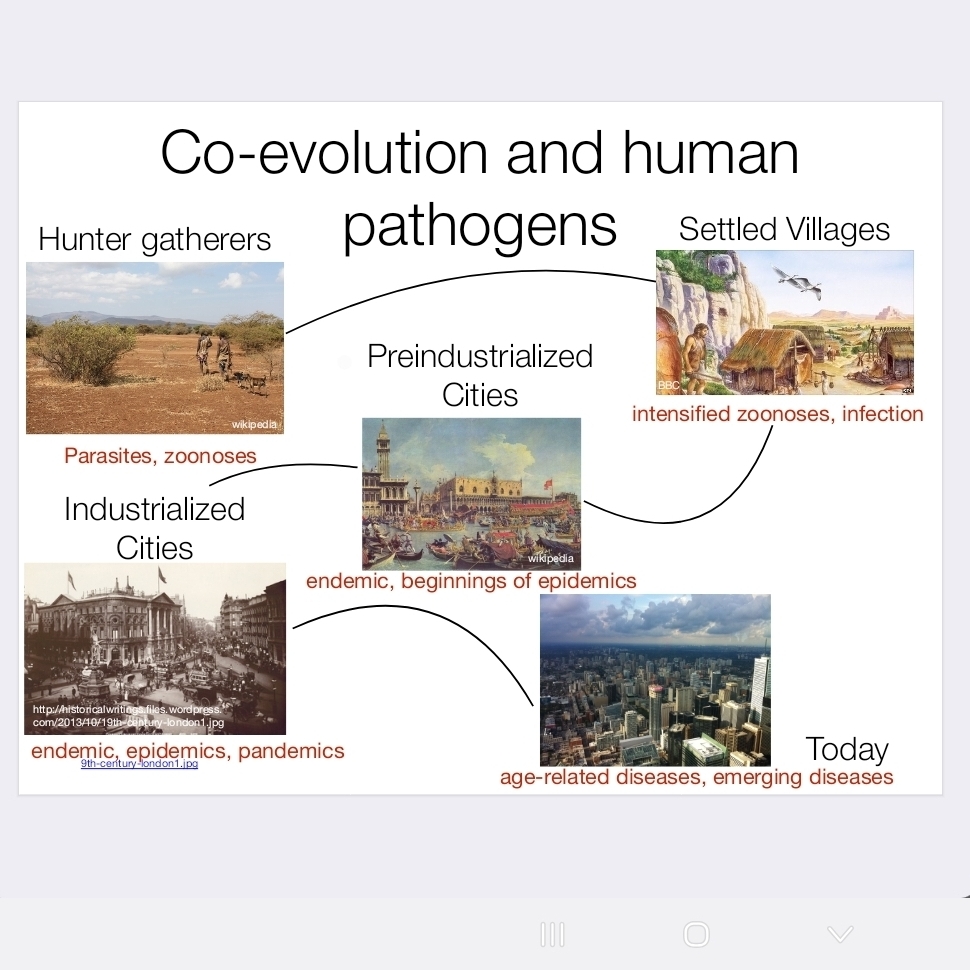
Co-evolution and human pathogens
Hunter gatherers → settled villages (intensified zoonoses, infection) → pre industrialized cities (endemic, beginnings of epidemics) → industrialized cities (endemic, epidemics, pandemics) → TODAY (age-related diseases, emerging diseases)
Sick Cell Anemia
Moon shaped red blood cells
Low O2 tension
Less Capillary blockage
Heme oxygenase-1 (HO-1) is induced
making carbon monoxide
confers protection against cerebral malaria
Sickle Cell Anemia & Malaria
Point mutation
SS, Ss ss
African and mediterranean groups
Anopheles gambiae mosquito
150 mosquito bites per year
100% infection rate in kids
25% greater survivability = SS.
Humans have adapted to malaria in endemic areas
Human populations adapting to selective pressure
Koch’s Postulates
The microorganism must be found in abundance of suffering organisms, but should not be found in healthy organisms
The microorganism must be isolated from a diseased organism and grown in pure culture
The cultured microorganism should cause disease → healthy organism
The microorganism must be relsolated from the inoculated, diseased experimental host
How do we measure co-evolution?
Compare evolutionary history of organisms using observable characteristics:
Morphology
DNA sequences
Protein sequences
Look for similar patterns of speciation or co-speciation
Build phylogenetic trees
Different ways to scale branch lengths
Additive tree - genetic distance can be added up
Ultrametric tree - all terminal branches terminate in the present → used to express time as well as genetic distance → molecular clock
Viruses: fasted pathogens around
Pathogens tend to evolve faster than their hosts
Difference most extreme in viruses: often evolve many order of magnitude faster
Thus virus phylogenies can be used to look at ecological and evolutionary processes
Co-evolution
Reciprocal, adaptive genetic changes between interacting species
Can look for signature of co-evolution using shared phylogenetic histories
Co-evolution vs. co-speciation
Cospeciation - joint speciation of two or more lineages
Coevolution - reciprocal adaptation between associated species
Pathogen counter-strategies
Rapid proliferation
e.g. measles, small pox, common cold
Herpes simples virus hides in sensory neurons
Antigen-switching
Trypanosomes, gonorrhea
Attachment of host proteins or host mimicry
Coating with host proteins e.g. enveloped viruses (herpes, retroviruses, flaviviruses)
Molecular mimicry - pathogen proteins resembling the host
Why do pathogens tend to become less virulent over time? Herd immunity, vaccines, mutations no longer powerful
What is the best way for a pathogen to increase lifespan and fecundity (produce offspring) Kill the immune system and still be transmissible