Psychosis
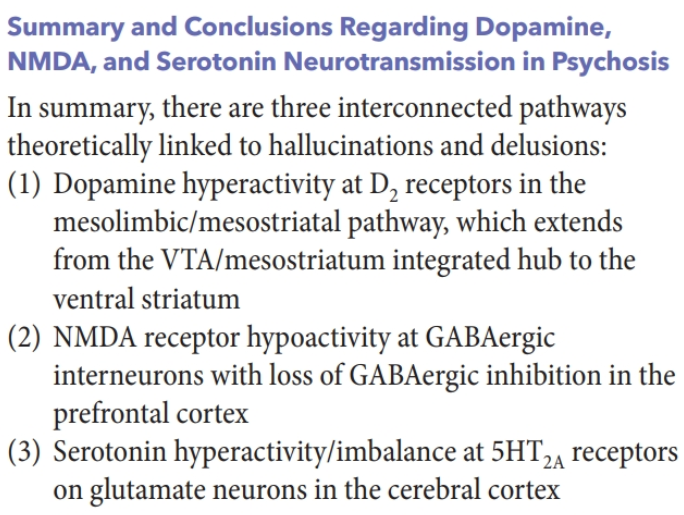
If one had asked any mental health clinician or researcher over the past 50 years what neurotransmitter was linked to psychosis, the resounding answer would have been DA, and specifically DA hyperactivity at D2 DA receptors in the mesolimbic pathway
The mesolimbic DA pathway projects from DA cell bodies in the VTA of the brainstem (i.e., mesencephalon) to the nucleus accumbens in the ventral striatum, which is part of the limbic system (thus, mesolimbic)
The glutamate theory of psychosis proposes that the NMDA (N-methyl-D-aspartate) subtype of glutamate receptor is hypofunctional at critical synapses in the prefrontal cortex. could be d/t alz/dementia/stroke, any neurodegen situation.
The serotonin theory of psychosis proposes that hyperactivity/imbalance of serotonin (5-hydroxytryptamine, 5HT) activity, particularly at serotonin 5HT2A receptors, can result in psychosis.
psychosis may be caused by an imbalance in excitatory 5HT2A receptor stimulation of those glutamate pyramidal neurons discussed above, which directly innervate VTA/ mesostriatal integrated hub dopamine neurons and visual cortex neurons
Schizophrenia is the prototypical psychotic disorder since it is the most common and best known and expresses prototypical psychotic symptoms. by definition is a disturbance that must last for 6 months or longer, including at least one month of positive symptoms (i.e., delusions, hallucinations, disorganized speech, grossly disorganized or catatonic behavior) or negative symptoms
What causes schizophrenia: nature (i.e., genetics) or nurture (i.e., the environment or epigenetics)? Is schizophrenia neurodevelopmental or neurodegenerative? The modern answer indeed may be “yes” in part to all of these
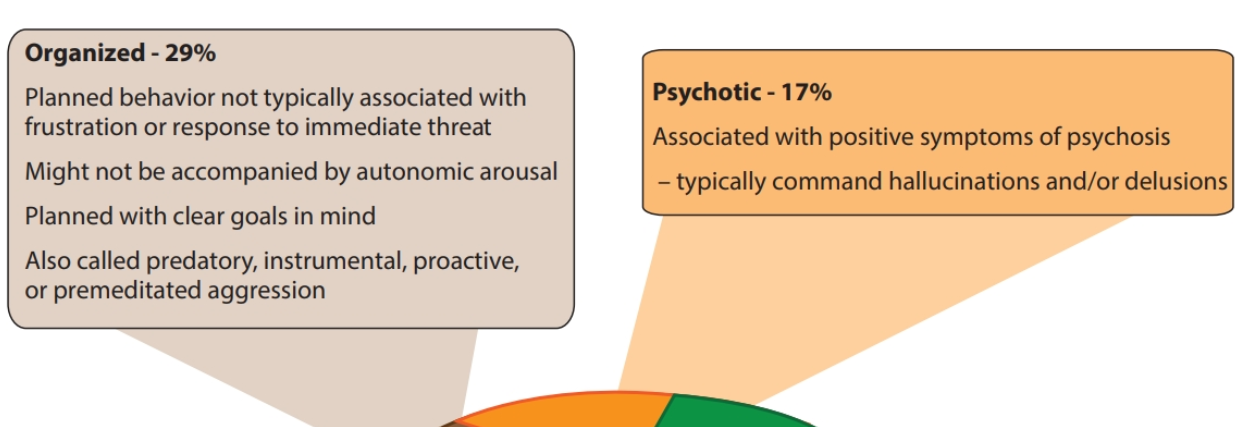
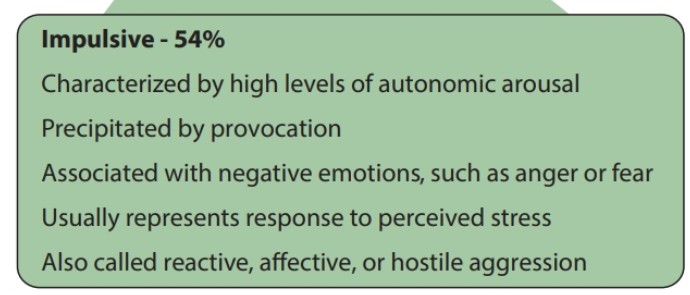
Violence types -
Modern research findings strongly suggest that something is amiss in the way the brain makes, retains, and revises its synaptic connections in schizophrenia, starting from birth. Telltale signs of this include the cognitive deficits, lowering of IQ, oddness, and social deficits of patients before the overt onset of a psychotic break that signals the full diagnostic criteria of schizophrenia
Many patients with schizophrenia have a progressive, downhill course, especially when available treatments are not used consistently and there are long durations of untreated psychosis. Such observations have led to the notion that this illness may thus be neurodegenerative in nature
Those disorders that require the presence of psychosis as a defining feature of the diagnosis include schizophrenia, substance/ medication-induced (i.e., drug-induced) psychotic disorder, schizophreniform disorder, schizoaffective disorder, delusional disorder, brief psychotic disorder, shared psychotic disorder, psychotic disorder due to another medical condition, and childhood psychotic disorder.
We have already discussed how schizophrenia can have symptoms of depressed mood, anxious mood, guilt, tension, irritability, and worry. Thus, schizophrenia can have affective symptoms and mood disorders can have psychotic symptoms
Parkinson’s disease progresses in over half the cases, especially in those with concomitant dementia, to psychosis with delusions and hallucinations, called Parkinson’s disease psychosis (PDP)
Dementia-related Psychosis