Quadratic Equations
A quadratic equation is an equation where the highest power of the variable is 2. It can be written in the form , where does not equal 0.
is the coefficient of , not equal to 0
is the coefficient of
is the constant term
For example, in the equation , the values are , , and .
Quadratic equations can have 0, 1, or 2 solutions, depending on the equation. Consider these examples:
has 0 solutions because a squared number cannot be negative.
has 1 solution: .
has 2 solutions: and , or .
The symbol ± means “plus or minus,” representing both the positive and negative square roots.
Equations from Graphs
To find the equation of a quadratic, we can follow these steps:
Identify the -values of the -intercepts. These occur at the point where .
Substitute the -values found in Step 1 for and in the equation .
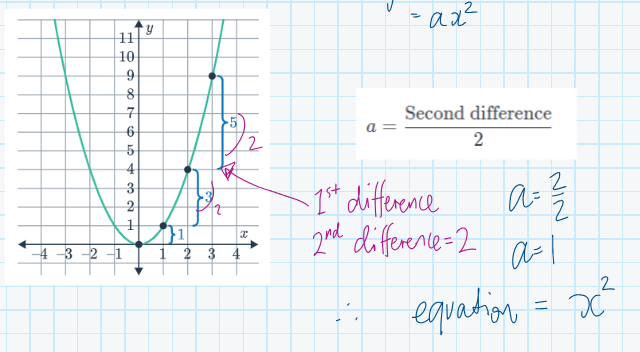
Find the value of by using another known point or by using second differences.
Further Quadratic Equations
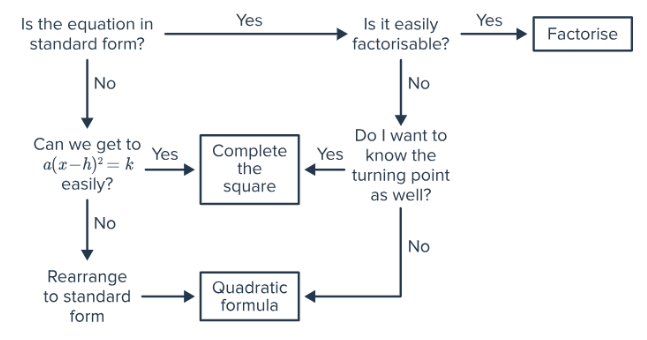
We have looked at a number of ways to solve quadratic equations. These include:
Factorising the quadratic expression and then using the null factor law. In particular, when the quadratic expression is non-monic, we can use techniques for non-monic quadratic trinomials.
Completing the square and then taking the square root of both sides of the equation.
Using the quadratic formula.