Taste
Study Guide on Taste (Gustatory System)
1. Gustatory Cells and Taste Buds
Gustatory cells are the specialized cells responsible for detecting tastants (chemicals) in food.
Taste buds are made up of gustatory cells and supporting cells. Gustatory cells are similar to neurons.
Taste pore is where tastants enter to interact with gustatory cells.
2. Types of Taste Sensations (Receptors)
There are 6 types of taste receptors that can trigger a taste sensation:
Sour: Triggered by acids, especially hydrogen ions (H⁺).
Salty: Triggered by salts, primarily sodium ions (Na⁺).
Sweet: Triggered by simple sugars like sucrose (table sugar). Complex sugars (e.g., starch) do not trigger sweet taste.
Bitter: Triggered by alkaloids, such as caffeine found in coffee.
Umami: A savory taste triggered by amino acids, especially glutamate (e.g., monosodium glutamate or MSG).
Fat: A receptor responds to fatty acids in food (not well understood yet).
3. Mechanisms of Taste Signal Transduction
There are two main mechanisms by which gustatory cells are activated:
1. Direct Depolarization (Ion Channels)
Salt (sodium ions) and sour (hydrogen ions) taste receptors are activated directly by ions.
When sodium (for salty) or hydrogen ions (for sour) enter the gustatory cell, they cause depolarization, making the inside of the cell more positive.
This triggers voltage-gated calcium channels to open, causing the release of neurotransmitters from vesicles.
The neurotransmitter activates the next neuron, sending the signal to the brain.
2. G-Protein-Coupled Receptors (GPCRs)
Sweet, bitter, and umami tastes involve G-protein-coupled receptors (GPCRs).
When a tastant (e.g., sucrose for sweet, bitter substances, or glutamate for umami) binds to the receptor, it activates a G-protein.
The G-protein triggers a signaling cascade within the cell, which eventually causes calcium release and neurotransmitter release.
The neurotransmitter then activates the next neuron, sending a signal to the brain.
4. Taste Pathways
Cranial Nerves:
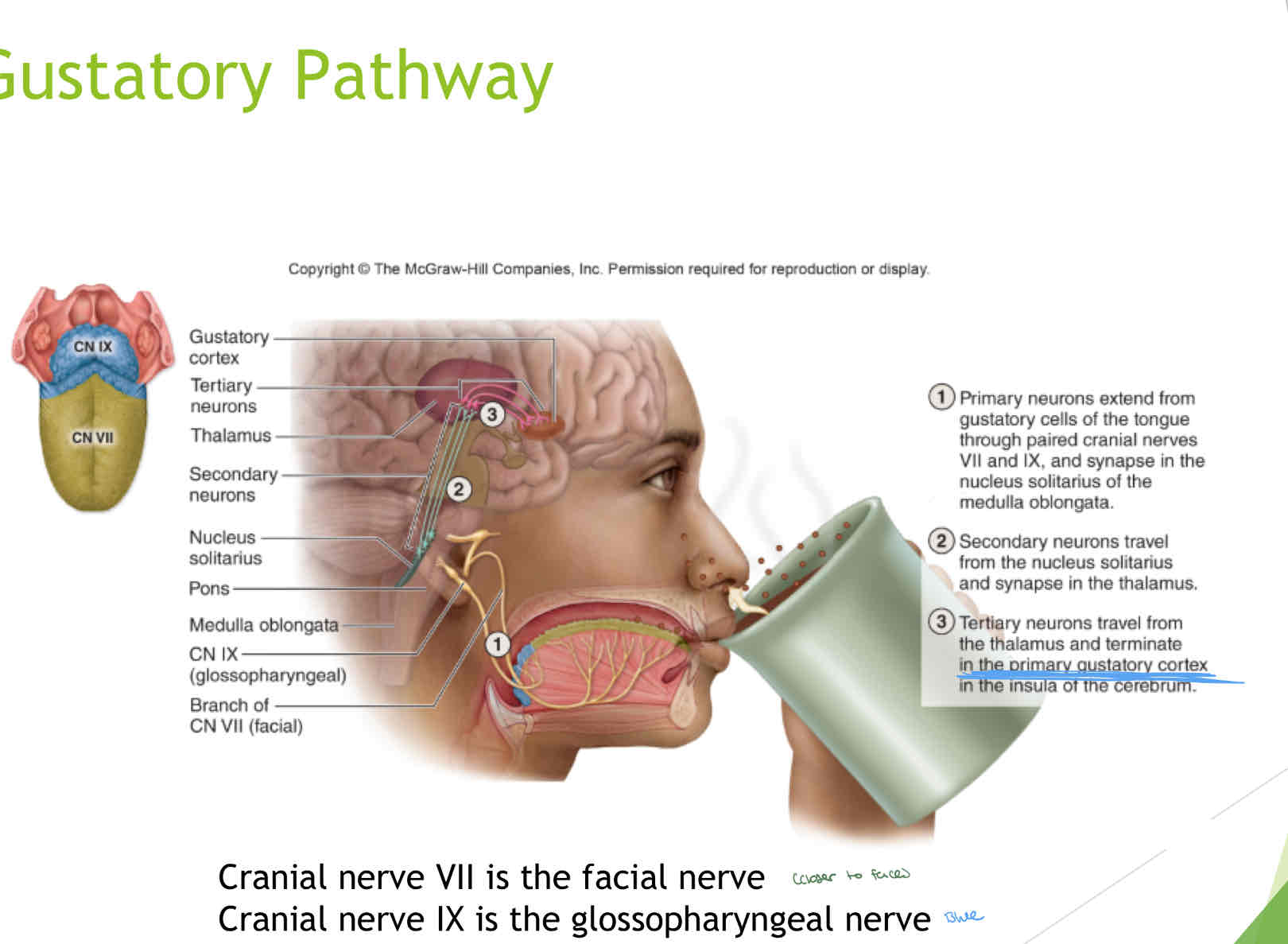
The facial nerve (VII) carries taste signals from the front of the tongue.
The glossopharyngeal nerve (IX) carries taste signals from the back of the tongue and the pharynx.
Thalamus:
The taste information is processed in the thalamus, which then sends the signal to the primary gustatory cortex for conscious perception of taste.
5. Taste and Smell Connection
Tastants need to dissolve in saliva to be detected by gustatory cells, similar to how odorants dissolve in mucus for olfactory detection.
The sense of taste is strongly linked to the sense of smell. For example, vanilla is smelled (odor) rather than tasted, but it is often perceived as a flavor when we taste something sweet.
When you plug your nose and eat something, it may taste bland or less flavorful, as most of the flavor we perceive comes from smell.
6. Important Concepts to Remember
Depolarization: When a cell becomes more positive inside, causing activation and neurotransmitter release.
G-Protein Coupled Receptors (GPCRs): Used in sweet, bitter, and umami tastes to cause signal cascades.
Neurotransmitter Release: In both direct depolarization and GPCR pathways, neurotransmitters are released, which activate the next neuron and send signals to the brain.
Thalamus: All taste information is routed through the thalamus to the primary gustatory cortex.
7. Review of Key Points
Taste receptor types: Sour, salty, sweet, bitter, umami, and fat.
Salt and sour are detected through direct ion channels (depolarization).
Sweet, bitter, and umami are detected via G-protein coupled receptors (GPCRs).
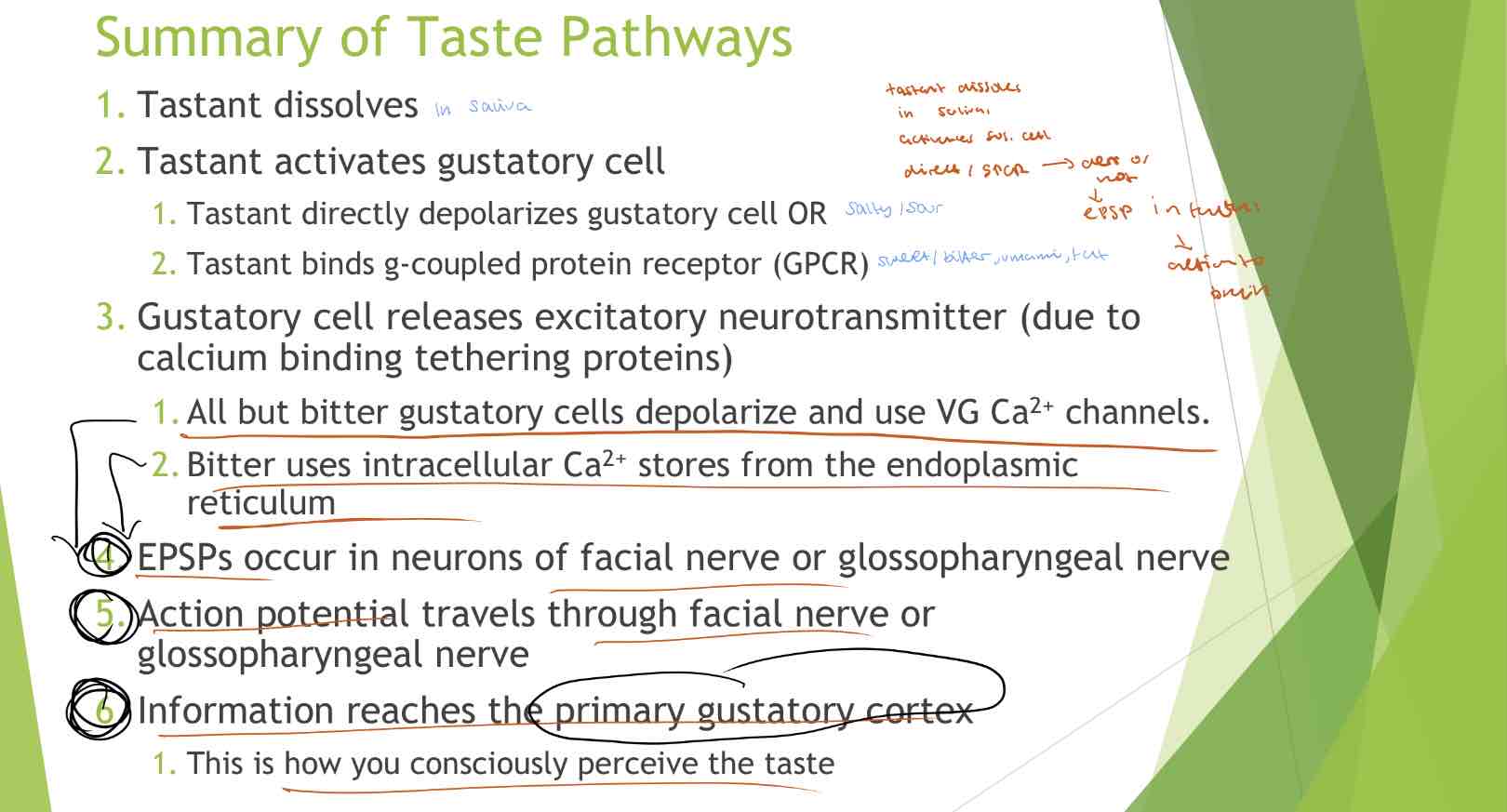
EPSPs are released from gustatory cell and a calcium influx happens from voltage gated channels, but bitter uses intracellular calcium stores from ER
Action potential occurs from this depolarization and is sent to…
Nerves involved: Facial nerve (front of the tongue) and glossopharyngeal nerve (back of the tongue and pharynx).
Taste information is sent to the thalamus, then to the primary gustatory cortex.
Smell and taste are closely linked; what you perceive as taste is often influenced by smell.
 Summary Table for Taste Mechanisms
Taste | Receptor Type | Tastant | Mechanism |
Sour | Ion Channel (Direct) | Hydrogen ions (H⁺) | Depolarization through H⁺ ions |
Salty | Ion Channel (Direct) | Sodium ions (Na⁺) | Depolarization through Na⁺ ions |
Sweet | GPCR | Sugars (e.g., sucrose) | G-Protein cascade leading to depolarization |
Bitter | GPCR | Alkaloids (e.g., caffeine) | G-Protein cascade leading to depolarization |
Umami | GPCR | Amino acids (e.g., glutamate) | G-Protein cascade leading to depolarization |
Fat | Likely GPCR or Ion Channel | Fatty acids | Likely a GPCR or ion channel mechanism |