Excretion

The removal of metabolic waste, substances in excess and toxic substances from the body


Organs that excrete

  • (Liver)

  • Kidney

  • Lungs

  • Large intestines


Metabolic/toxic waste

  • Urea

  • Organ - kidney


Respiration - CO2 + H2O

  • If CO2 is in excess in the body, it can become acidic. Results in acidity.

  • Organ that excretes it - lungs


Sweating

  • Results in sweat then water, excess salts, urea

  • Organ - skin


  • Not for excretion but for thermal regulation


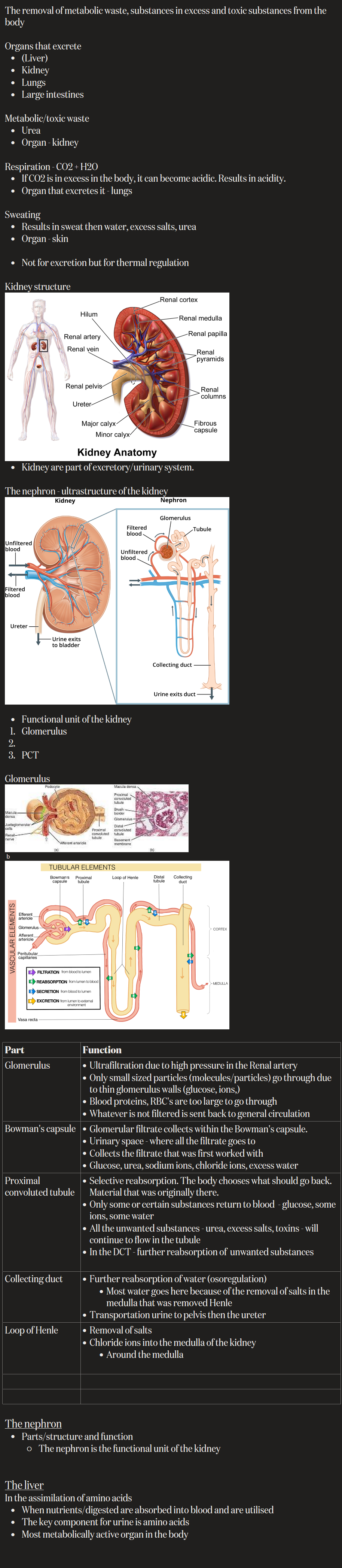
Kidney structure

  • Kidney are part of excretory/urinary system. 


The nephron - ultrastructure of the kidney


  • Functional unit of the kidney

  1. Glomerulus

  2.  

  3. PCT


Glomerulus

 b


Part

Function

Glomerulus

  • Ultrafiltration due to high pressure in the Renal artery

  • Only small sized particles (molecules/particles) go through due to thin glomerulus walls (glucose, ions,)

  • Blood proteins, RBC's are too large to go through

  • Whatever is not filtered is sent back to general circulation

Bowman's capsule

  • Glomerular filtrate collects within the Bowman's capsule.

  • Urinary space - where all the filtrate goes to

  • Collects the filtrate that was first worked with

  • Glucose, urea, sodium ions, chloride ions, excess water

Proximal convoluted tubule

  • Selective reabsorption. The body chooses what should go back. Material that was originally there.

  • Only some or certain substances return to blood  - glucose, some ions, some water

  • All the unwanted substances - urea, excess salts, toxins - will continue to flow in the tubule

  • In the DCT - further reabsorption of  unwanted substances

  •  

Collecting duct

  • Further reabsorption of water (osoregulation)

    • Most water goes here because of the removal of salts in the medulla that was removed Henle

  • Transportation urine to pelvis then the ureter

Loop of Henle

  • Removal of salts

  • Chloride ions into the medulla of the kidney

    • Around the medulla

  •  


The nephron

  • Parts/structure and function

    • The nephron is the functional unit of the kidney


The liver

In the assimilation of amino acids

  • When nutrients/digested are absorbed into blood and are utilised

  • The key component for urine is amino acids

  • Most metabolically active organ in the body