Module 2: New Product Inputs and Identifying Opportunities
This module expands on the new product steps focusing on opportunity analysis and strategic planning.
Opportunity Identification
Many companies have dedicated full-time employees tasked with identifying new opportunities by auditing the company and relevant environments. Additionally, employees across the organization may encounter new opportunities during their work, such as a salesperson learning about a customer moving into a new market or a scientist discovering unexpected activity in a compound.
New opportunities can come from many different sources: underutilized or new resources, mandates originating external to the firm, or internal mandates. There are several ways in which firms can identify opportunities for growth in new markets by finding new ways to create value for customers.
Find another Location or Venue
Leverage the firm's strengths in a new activity centre
Identify a fast-growing need
Find a "new' to you
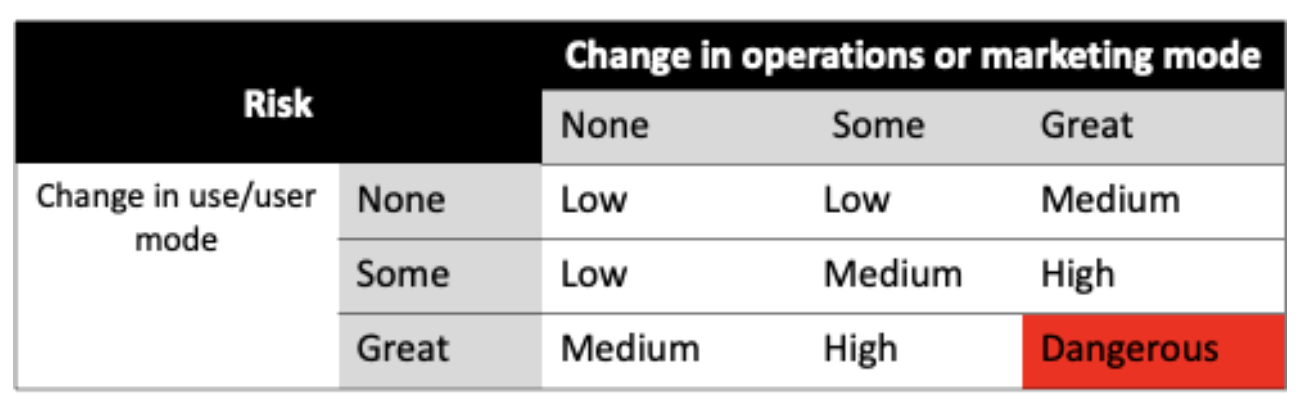
Product Matrix: Risk vs Innovation
This chart below presents a modified version of the traditional product-market matrix, which displays differences in risk and innovativeness as a firm introduces new product types or technologies or markets products that require changes in how they are purchased or used.
Trendspotting
Companies should consistently monitor emerging trends in society and derive product opportunities from them. Some examples of these include:
Climate change and sustainability
Automation and AI
Demographic changes
Digitalisation and virtualisation
Personalisation and customisation
The Product Innovation Charter & New Opportunities
Degrees of Innovativeness
First to market
Adaption
Imitation
Product Portfolio Analysis
Product portfolio analysis for new product development (NPD) involves evaluating and managing a company's existing and potential products to ensure a balanced and successful portfolio. Many companies use a product portfolio approach, where R&D and other scarce resources are allocated across multiple categories based on both strategic and financial criteria. Most companies consider financial criteria while selecting new products for their portfolio. However, high-performing companies incorporate strategic considerations into their assessments.
The process typically includes several key steps:
Portfolio evaluation
Market analysis
Product prioritisation
Resource allocation
Risk management
Lifecycle management
Examples of Product Portfolio Objectives
Strategic alignment
Assessing portfolio value
Project balance
Number of projects
The New Product Strategic Fit
The 'Buckets' Strategy
Several firms adopt a strategic buckets strategy for analysing their new product portfolio. The business unit has established two strategic aspects - product newness and market newness - and has established the appropriate amount of resources to be devoted to the product portfolio.
The Boston Consulting Group Growth-Share (BCG) Matrix
Stars: Products with high market share and high market growth rate. These products have the potential for significant growth and profitability. They require substantial investments to maintain and increase market share.
Cash Cows: Products with high market share but low market growth rate. These products generate consistent cash flow and profit, but their growth potential is limited. They require minimal investment and can be a source of funds for other products in the portfolio.
Question Marks (or Problem Children): Products with low market share but high market growth rate. These products have the potential for growth, but they require careful consideration and investment decisions. They may become stars or fail to gain market share, depending on strategic actions taken.
Dogs: Products with low market share and low market growth rate. These products have limited growth potential and generate low or negative cash flow. They may be candidates for divestment or discontinuation.
The Ansoff Matrix
Market Penetration: This strategy involves increasing the sales of existing products in existing markets. This can be achieved by increasing market share, improving product quality, increasing advertising and promotion, or reducing prices.
Market Development: This strategy involves selling existing products in new markets. This can be achieved by expanding into new geographic regions, targeting new customer segments, or using new distribution channels.
Product Development: This strategy involves developing new products for existing markets. This can be achieved by introducing new features, improving quality, or launching new products that complement existing ones.
Diversification: This strategy involves entering new markets with new products. This can be achieved through related diversification (expanding into new markets that are related to existing products) or unrelated diversification (expanding into completely new markets
Summary
This module discussed the crucial and challenging initial step in the process of creating new products: the formulation of a well-conceived strategy to guide the subset of people and resources responsible for new product development within the company. It then delved into the specifics of a product innovation charter, which serves as the format for such strategic guidance, along with the opportunities and requirements that result in the development of these charters and how they can vary. The final section addressed significant considerations that frequently arise when discussing new product strategies. With this knowledge, we can now move forward and explore the process of generating concepts for new products.