Performance Drive Shafts, Clutches, and Axles
Materials Used in High-Performance Driveshafts
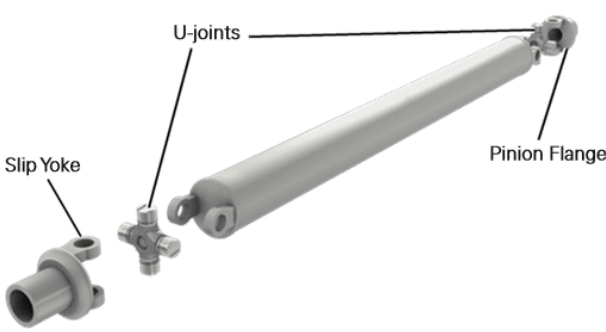
Aluminum
Aluminum driveshafts are used in some racing applications.
Aluminum characteristics:
Strong
Reliable
Lightweight
Construction modifications by manufacturers may include:
Thicker and longer driveshaft tubes for added strength
Increased tube diameter without significantly increasing weight, to improve performance
Carbon Fiber
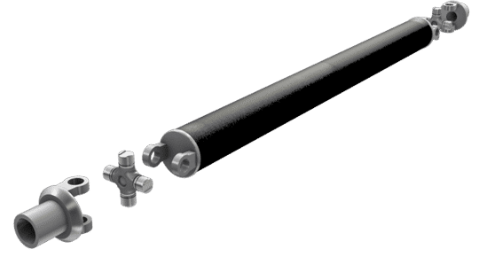
Carbon fiber driveshafts are used in some racing applications.
Characteristics of carbon fiber driveshafts:
Expensive, but highly efficient
Strong with high torsion strength, reducing twisting and shock to the rear wheels
High resistance to flexing at slower speeds, aiding vehicle launch in racing
Chrome Moly Steel
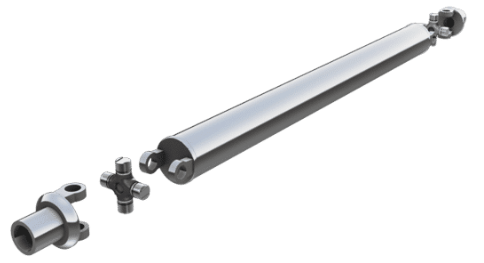
Steel is the most common material used in racecar driveshafts.
Chrome moly steel is the most commonly used steel type.
Relatively inexpensive
Strong, allowing for smaller diameter driveshafts compared to aluminum driveshafts
Driveshaft Dimensional Characteristics
Diameter
Driveshaft length and diameter directly affect racecar performance.
All driveshafts have a critical speed:
The speed at which the driveshaft becomes unstable and vibrates
Reaching critical speed may cause driveshaft failure
Manufacturers increase critical speed by:
Making the driveshaft lighter and stiffer
Increasing diameter without significantly increasing weight
Driveshaft diameter must match vehicle specifications to ensure:
Durability
Resistance to twisting
Balance
Driveshaft balancing is critical for high-performance vehicles.
Manufacturers use balance weights to meet vehicle requirements and specifications.
An improperly balanced driveshaft can:
Vibrate more at higher speeds
Cause driveshaft failure
Result in damage to expensive parts and components
Thickness
Driveshaft thickness depends on:
Material of the driveshaft
Type of driveshaft used in the vehicle
Diameter and thickness work together to affect performance.
Manufacturers must balance diameter and thickness to ensure the critical speed remains safe or unreachable.
High-Performance Driveshaft Modifications
Yoke Flange
Yoke flanges in high-performance driveshafts vary depending on application.
Most driveshaft yokes are made of forged steel or aluminum.
Manufacturers weld each yoke to the driveshaft tube to meet tight specifications and tolerances.
Improperly welded yokes can contribute to an out-of-balance driveshaft, potentially causing failure.
U-joints
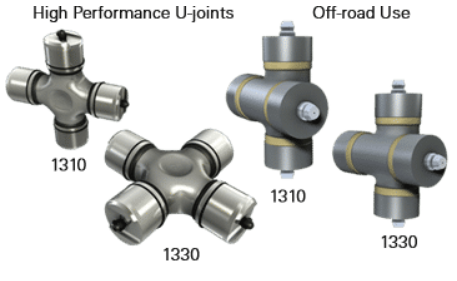
Most common U-joints in high-performance vehicles are 1310 and 1330.
1310 U-joint:
Used in many racing applications
Retained in the driveshaft using an external or internal snap ring, depending on application
1330 U-joint:
Found near the pinion yoke going into the rear axle
Shares the same cap size as the 1310
Has a larger cross to handle higher torque
Materials in High Performance Clutches
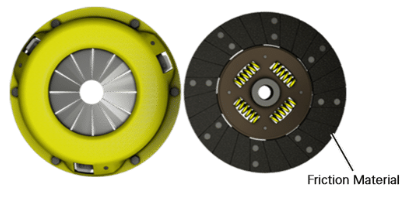
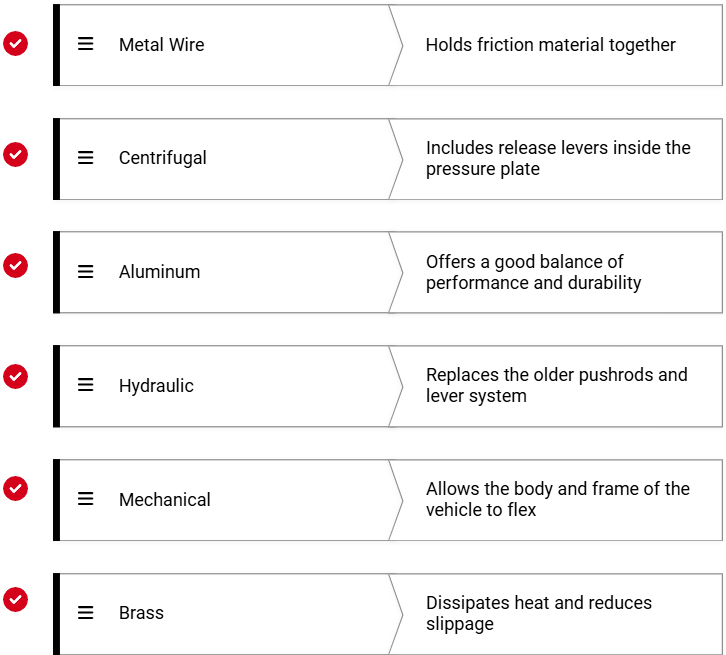
Brass
Some high-performance clutches use brass in the friction material.
Brass benefits:
Better heat dissipation than stock clutch materials
Improved grip, reducing slippage between the clutch disc, pressure plate, and flywheel
Aluminum
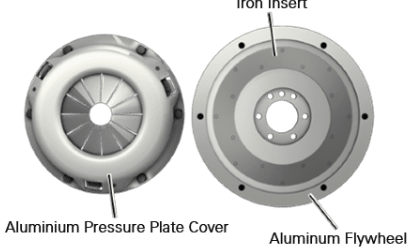
High-performance clutches made of aluminum are lighter and offer a balance of performance and drivability.
Aluminum clutch assemblies are designed for:
Faster engine acceleration
Smoother shifting
To prevent corrosion, aluminum may be coated or anodized.
Aluminum flywheels often include iron inserts for the clutch friction material to engage with.
Metal Wire
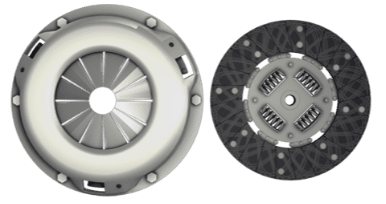
High-performance clutches use metal wire woven through the friction material on the clutch disc.
The wire runs from the outer edge to the inner edge of the friction material.
Purpose of the wire:
Holds the friction material together
Prevents the friction material from breaking apart
Types of High Performance Clutches
Hydraulic Clutch - Overview
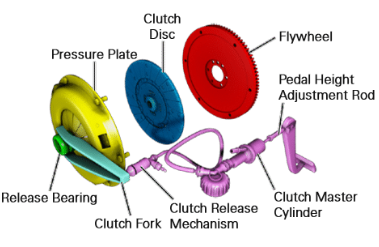
Hydraulic clutch is a self-adjusting clutch system.
Components include:
Master cylinder with an input piston connected to the clutch pedal
Slave cylinder (reaction or actuator cylinder) with an output piston attached to the clutch release lever
Hydraulic connection via plastic tubing or braided hose between master and slave cylinders
Advantages in high-performance vehicles:
Adjustable clutch pedal effort and travel to suit vehicle requirements
Applications
Hydraulic clutch systems in racing replace older pushrod and lever systems.
Provide smooth clutch engagement and minimum pedal effort, enabling fast shifting.
Offer optimal performance and control over clutch engagement and disengagement.
Mechanical Clutch - Overview
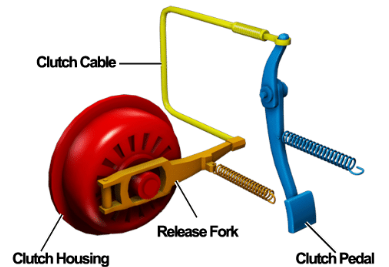
Most racing applications use a cable linkage mechanical clutch.
The cable allows the vehicle body and frame to flex while maintaining clutch control.
Cable connections:
Clutch pedal → Cable → Release fork
Operation: Pushing the clutch pedal pulls the cable and release fork, disengaging the pressure plate from the clutch.
Characteristics
Mechanical clutch cables in race cars are highly adjustable.
Adjustability ensures correct clutch pedal travel and proper pedal height.
Adjuster nut is provided to make precise cable adjustments.
Centrifugal Clutch - Overview
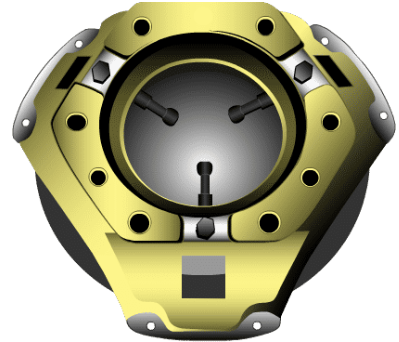
Centrifugal clutches in racing vehicles adjust clamping force automatically.
As the engine speed increases, the pressure plate clamps the clutch disc tighter.
Manufacturers use a lighter spring on the pressure plate to reduce clutch pedal effort needed for disengagement.
Characteristics
The Borg and Beck style is the most popular centrifugal clutch in high-performance vehicles.
Release levers are placed in the clutch cover for:
Quicker pressure plate release
Positive clutch disengagement
Faster gear changes for the driver
Modifications of High Performance Clutches
Heat Treatment
Heavy-duty racing diaphragm springs are heat-treated to:
Increase spring tension
Provide more clamping force for a better hold on the clutch disc
High-performance manufacturers use this treatment to maintain high clamping force without compromising pressure plate integrity
Double Diaphragm
Double diaphragm design increases clamping force by stacking two diaphragm springs.
Special friction-reducing silicone material is placed between the diaphragms to:
Ensure smooth operation
Maintain effective clamping force
This design increases clutch pedal pressure significantly.
To offset higher pedal pressures, manufacturers modify the mechanical linkage to reduce effort needed to push the clutch pedal.
Pressure Plate Modifications
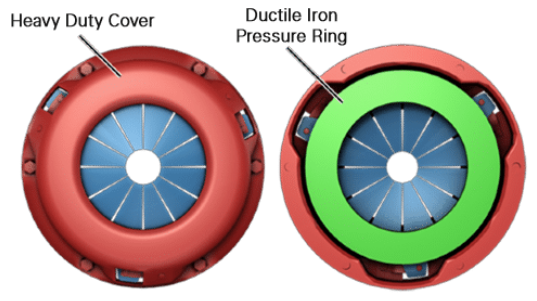
Diaphragm Pressure Plate
Diaphragm pressure plate features a heavy-duty cover to minimize flexibility and ensure:
Strength
Stability
Reliability
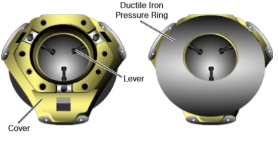
Includes a ductile iron pressure ring that:
Resists cracking
Dissipates heat quickly
Offers light pedal pressure and quick release for precise gear changes
Provides positive engagement capable of handling the horsepower of most high-performance vehicles.
Long Style Pressure Plate
Long-style pressure plate features forged and heat-treated heavy-duty levers for:
Quick release of the clutch disc
Positive gear changes
Assembled with a heavy-duty reinforced cover that includes:
Steel spring
Ductile iron pressure ring
Changes in the Clutch Hub
Clutch disc modifications may include additional torque-absorbing springs in the clutch hub to control driveline shock.
Center hubs are typically custom forged to accept the extra torque springs.
Aluminum is commonly used to lighten the clutch disc weight.
Depending on friction material type and engine power, the clutch hub may be a solid design to reduce dampening effects.
Types of Slave Cylinders
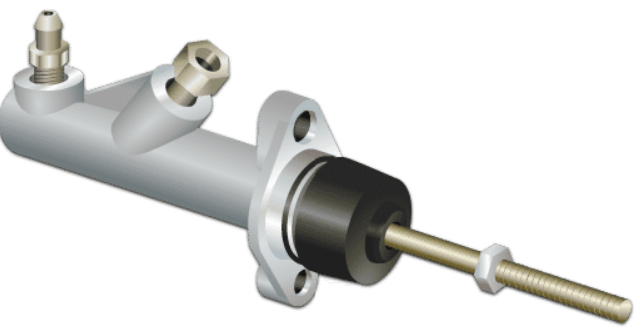
Aluminum Slave Cylinder
Aluminum slave cylinders are used in racing applications for their lightweight properties.
Bleeder screw and hydraulic line ports are located on top of the cylinder body for extra clearance in tight mounting spaces.
Provide ample hydraulic volume for a variety of custom race applications.
Slave cylinder piston can travel further than stock cylinders to ensure full clutch disengagement.
Adjustable pushrod allows fine-tuning of clutch engagement and disengagement.
Pull-type Cylinder
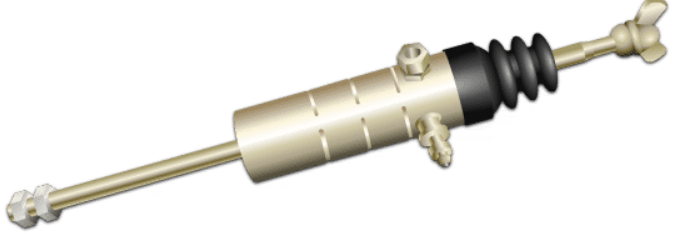
Pull-type slave cylinders are used in racing vehicles with limited mounting space.
Mounting position: behind the clutch release fork, instead of in front.
Operation: When the clutch pedal is pressed, the cylinder pulls the release fork rather than pushing it.
Adjustable to ensure proper clutch engagement and disengagement.
Bearing Modifications
Clutch Release Bearing
High-performance racing vehicles use high-strength clutch release bearings.
Release bearings are made from harder materials to withstand higher operating temperatures.
Manufacturers sometimes use a concentric slave cylinder assembly to replace the traditional release bearing.
In this setup, the slave cylinder is installed inside the transmission bellhousing.
This eliminates the need for a clutch release fork.
Pilot Bearing
Pilot bearing supports the transmission input shaft.
Heavy-duty roller pilot bearing installs at the rear of the crankshaft.
Function when clutch is disengaged: allows the transmission input shaft to rotate independently.
Function when clutch is fully engaged: pilot bearing is not needed, as the engine crankshaft and transmission input shaft rotate together.
Types of Drive Axles
Quick Change
High-performance vehicles sometimes use quick-change drive axle units.
Components include:
Forward end
Rear end
Transversely extending middle portion
Rear end contains a gear system that changes the gear ratio before transferring torque to the ring and pinion gears.
In quick-change axles, a jackshaft connects to the driveshaft:
One end connects to a quick-change gear
The other end connects to the pinion gear
Purpose: Provides a higher final drive ratio, suitable for high-performance applications with high ring and pinion gear ratios.
Rigid Axle
High-performance rigid axles are made from steel or aluminum.
Possible modifications include:
Axle shafts with more splines for increased strength
Improved bearings to withstand higher temperatures
Addition of a locking or limited-slip differential
Ring and pinion ratios may be changed depending on the racing vehicle requirements
Independent Rear Axle
Most open-wheel circle track vehicles use independent rear axles.
Components include:
Upper and lower control arms
Coil springs and shocks
Main advantage: Each wheel can react to uneven track surfaces independently, without affecting the other wheel.
Short Axle Housing
Short axle housings have axle tubes cut down to reduce the overall axle length.
Applications: Most hot rods and drag racing vehicles use short axle housings.
Reason: Allows larger and wider tires to fit under the rear fenders of the vehicle.
Custom-built Housing
Axle housings can be custom-built from scratch based on customer requirements.
Construction methods include:
Welding axle tubes directly to the axle housing
Manufacturing the center section first, then welding the sides to fit the axle tubes
Modifications to Differentials
Center Section - Overview
Removable center section rear axles are popular in racing vehicles.
Center section is usually made from aluminum for lightweight construction.
Reinforcement:
Cross web design with horizontal and lateral supports
Reduces twisting in racing axles
Front pinion bearing pockets may also be made from aluminum and can be customized for different bearing sizes.
Differential options: spool, locker, or limited-slip, depending on the ring and pinion gearset application.
Applications
Removable center section axles are common in many racing car applications.
Advantages:
Easy to disassemble for part replacement
Strong and reliable
Commonly used in a Ford 9-inch axle.
Versatility: Can be modified to fit almost any vehicle, suitable for different competition classes.
Differential Housing Cover - Overview
Rear differential cover is used in racing axles with an integral housing.
Strength enhancements:
Supports added to the cover, which can be lateral, horizontal, or both
Supports increase rigidity and reduce axle flex
Cooling benefits: Supports act as cooling fins, lowering differential fluid temperature.
Additional features:
Fluid fill hole to aid in filling the differential
Some covers have bearing cap studs and fasteners to further stiffen the axle assembly
Applications
Differential housing covers are used in many race car applications.
Removable covers are commonly found in hot rod vehicles.
Can be either:
Integral part of the axle
Added for appearance
Differential Cooler - Overview
Differential cooler is a small radiator that cools differential fluid.
Pump types:
Electric pump:
Includes an electric motor and electric cooling fan
Motor drives the impeller to pump differential fluid through the cooler
Electric fan cools the motor
Mechanical pump:
Driven off the driveshaft or transmission output shaft
Additional features:
Filter screen to prevent large metal particles from entering the pump
Fluid lines route fluid from the differential housing → cooler and pump → back to the differential housing
Applications
Differential coolers are commonly used in circle track racing.
Purpose: Prevent high differential temperatures during long race times.
Ring and Pinion Gears - Overview
Ring and pinion gearsets in high-performance vehicles are often modified by manufacturers.
Material: Mostly hardened steel.
Purpose: Modified to meet specific race track requirements.
Applications
Racing vehicles with solid or independent drive axles use ring and pinion gears.
Manufacturer modifications include:
Gear ratio adjustments
Gear teeth contact pattern modifications
Purpose: Ensure performance meets racing car requirements.
Yokes
Transmission Yoke
Transmission yokes in high-performance vehicles are made from steel or aluminum.
Many manufacturers upgrade the yokes to accommodate larger U-joint series.
U-joint yoke conversion kits are available to convert transmission yokes for use with larger U-joints.
Driveshaft Yoke
High-performance driveshaft yokes are made of steel or aluminum.
Yokes attach to the driveshaft during assembly.
Proper phasing of the driveshaft is required before welding to ensure:
U-joints operate properly
No vibration or binding occurs during launch or high-speed travel
Modifications to Axle Shafts
Materials
Racing axles are made from high-strength steel, with the steel grade varying by manufacturer.
Key features:
Hardened steel construction
Large number of splines at the shaft ends
Purpose of more splines:
Handle higher power without breaking
Increase overall axle strength
Wheel Studs and Bolts
Wheel studs and bolts in most racing vehicles are made of chrome moly steel.
Key properties:
High strength
Can handle heavy loads and high lateral forces common in racing
C-clip Eliminator
C-clip function: Holds the axle shaft in the differential side gear.
C-clip eliminator kit:
Replaces the C-clips in the differential
Installs on the axle tubes and accommodates axle bearings (press-fit on the axle)
Includes a bushing to reduce bearing diameter to fit the shaft
Purpose in racing vehicles:
Keeps the axle inside the axle tube if it breaks
Prevents axle separation from the housing