Rate determining step
Step 1 2NO(g) + O2(g) → 2NO2(g)
Step 1 NO2(g) + NO(g) → N2O3(g)
For the overall reaction it has been suggested that the rate equation is:-k[NO]2[O2]
Every reaction step has a rate associated with it
The slowest step if any reaction will be the one that determines the overall rate, this is called the rate determining step (RDS)
In terms of car analogies the RDS can be considered as the traffic lights that hold all the traffic up
The rate equation for the overall reaction will be that for the RDS
In the above example this tells us that step 1 is the RDS
Establishing the rate determining step
If the concentration of a reactant appears in the rate equation, then that reactant or something derived from it takes part in the rate determining step
What do we mean by ‘something derived from it’?
HCl(aq) + NaOH(aq) → NaCl(aq) + H2O(l) rate = k[HCl][NaOH]
Consider the ionic equation for this reaction
H+(aq) + OH-(aq) → H2O(l) rate = k[H+][OH-}
Same equation?
In aqueous solution all of the HCl is fully ionised into H+ and Cl-, therefore they can be said to be derived from HCl [H+] = [HCl}
The same can be said of NaOH, it is fully ionised into Na+ and OH-, therefore they are derived from NaOH [OH-] = [NaOH]
Determining a mechanism
When we know the rate equation for the reaction this enables us to suggest what the rate determining step is.
With a rate determining step and the overall reaction equation we can suggest a possible mechanism for the reaction as a whole
CH3Br + OH- → CH3OH + Br- rate = k[CH3Br][OH-]
Reaction is first order in CH3Br and OH-
Therefore both of these must be involved in the rate determining step
RDS CH3Br + OH- → CH3OH + Br-
This is the same overall reaction so the reaction must take place in one step
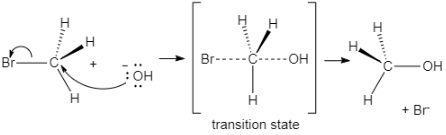
This is an example of a type of reaction called SN2
S stands for substitution
N stands for nucleophilic
2 stands for a bimolecular rate determining step (which means there are 2 reactant molecules in the RDS)
(CH3)3CBr + OH- → (CH3)3COH + Br-
[(CH3)3CBr] / M | [OH-] / M | Rate / Ms-1 |
1.0 | 1.0 | 0.3 |
2.0 | 1.0 | 0.6 |
1.0 | 2.0 | 0.3 |
Reaction is 1st order wrt (CH3)3CBr
Reaction is 0th order wrt OH-
Rate = k[(CH3)3CBr]
Therefore only (CH3)3CBr is involved in the RDS
Overall reaction: (CH3)3CBr + OH- → (CH3)3COH + Br-
Step 1 RDS. : (CH3)3CBr + OH- → (CH3)3C+ + Br- slow
Step 2 : (CH3)3C+ + OH- → (CH3)3COH fast
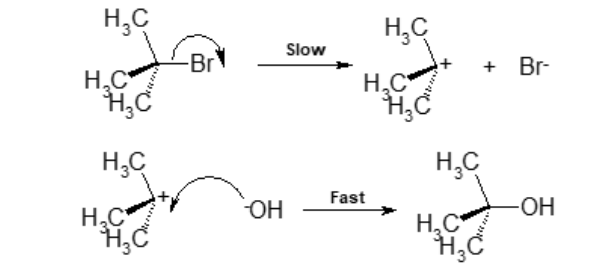
This is an example of a type of reaction called SN1
S stands for substitution
N stands for nucleophilic
1 stands for a unimolecular rate determining step (which means there is 1 reactant molecule in the RDS)
The overall equation for the decomposition of N2O is
2N2O(g) → 2N2(g) + O2(g)
The rate equation is k[N2O(g)]
Suggest a possible 2 step mechanism for the reaction
Step 1: →
Step 2: →
2N2O(g) → 2N2(g) + O2(g)
Work out which step must be the slow step
Remember the rate determining step consists of the slow step and any proceeding fast steps
If the second step is the RDS then the rate equation would match the overall equation which is doesn’t in this case
The rate equation must fit the reactants for the 1st step
Slow Step 1: →
Fast. Step 2: →
2N2O(g) → 2N2(g) + O2(g)
Now look at the overall balanced equation, any reactants that appear in the overall equation which are not in the first step must appear in the second step as reactants.
Slow Step 1: N2O(g) →
Fast. Step 2: N2O(g) → N2(g) + O2(g)
2N2O(g) → 2N2(g) + O2(g)
Now you need to ‘suggest’ what the products of the first equation could be
These need to be chemically feasible - it is most likely that N2 is formed as a product of the first reaction
Slow Step 1: N2O(g) → N2
Fast. Step 2: N2O(g) → N2(g) + O2(g)
2N2O(g) → 2N2(g) + O2(g)
The remaining product of the first equation will be an intermediate - these do not appear in the overall balanced equation so if they are on the right of the 1st step they must be on the left of the second
Slow Step 1: N2O(g) → N2 + O(g)
Fast. Step 2: N2O(g) + O(g) → N2(g) + O2(g)
2N2O(g) → 2N2(g) + O2(g)
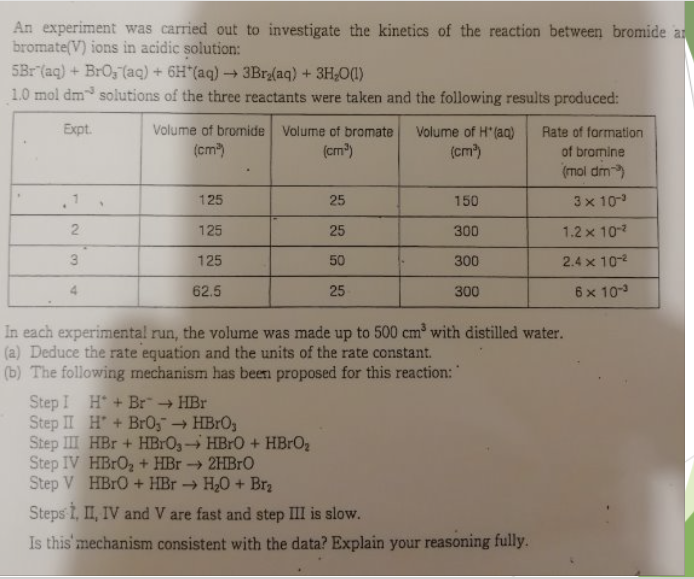
Rate equation= k[BrO3-][Br-][H+]2
Units = dm9mol-3s-1
Write out all steps up to and including the RDS
H+ + Br- → HBr
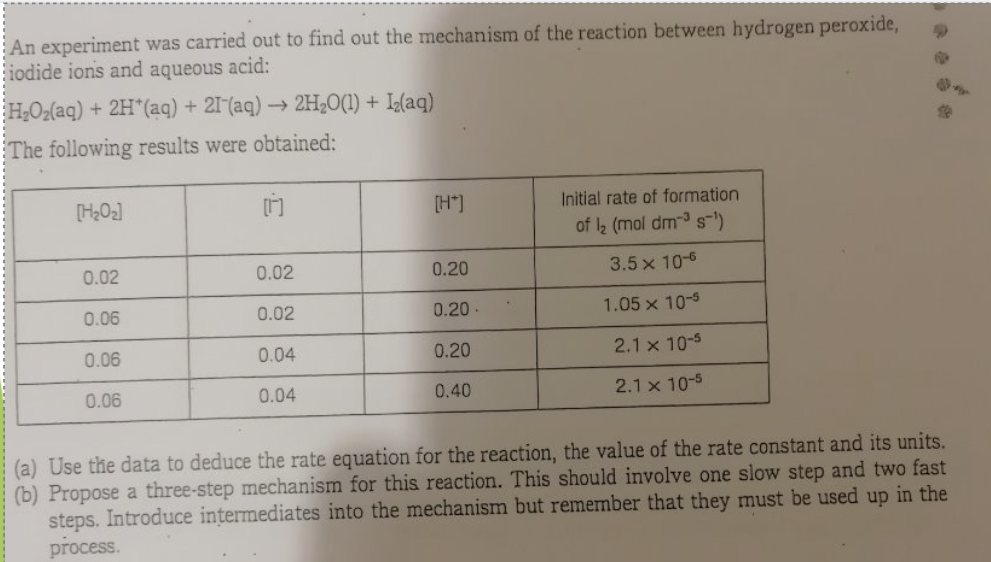
Rate equation = k[H2O2][I-]
k = 8.75 × 10⁻³
dm3mol-1s-1
The mechanism has 3 steps, as the rate equation doesn’t match the overall equation the slow step must be the first or second step.
With only 2 reactants in the rate equation, both first order, it is most likely the first step is the slow step.
Slow Step 1: H2O2(aq) + I-(aq) → H2O(l) + IO-(aq)
Fast Step 2: H+aq) + IO-(aq) → HIO(aq)
Slow Step 3: HIO(aq) + H+(aq) + I-(aq) → H2O(l) + I2(aq)
Suggest a suitable products for the first step, as one of the overall products is H2O, it would make a possible product, the other product must be chemically viable.
Any intermediate formed must be used as a reactant in a later step.