Genetics - lecture 19 - Using Genetics to Understand Biology
Learning Outcomes
This course covers many areas of genetics:
Genetic inheritance
Genotype-phenotype relationships
Mutations
Recombination mapping
Molecular biology and gene regulation
Post-lecture, you should be able to:
Use genetic techniques to explore biological questions.
Identify a receptor for a specific smell using genetic methods from mutation to mapping to gene identification.
Analyze regulation of gene expression through molecular biology and genetics.
Explain the significance of model systems like olfaction in understanding human biology.
Understand the molecular and neuronal basis of olfaction.
Recognize gaps in current biological knowledge.
Model Systems in Genetics
Functionality in experiments not achievable in humans or other organisms.
Infrastructure: involves experimental tools and established background knowledge.
Use in identifying and studying conserved genes and pathways.
Gains fundamenetal principles and identify and study conserved genes and pathways.
Historical Development in Genetic Research
T4 bacteriophage helped elucidate gene structure and genetic code.
E. coli contributed to the understanding of transcriptional regulation.
Yeast provided insights into secretory mechanisms.
Olfaction: Understanding Smell
Smell is essential for detecting environmental chemicals:
Helps find prey and avoid predators.
Influences physiological responses, such as insulin secretion triggered by food smell.
Loss of smell affects diet, quality of life, and can indicate neurodegeneration.
Caenorhabditis elegans (C. elegans)
A small nematode (approx. 1 mm) found in various habitats.
Notable features that contribute to its utility in research:
Simple, small, cheap, and transparent anatomy with stereotyped features.
Fast life cycle (3-5 days) and ease of cultivation.
Self-fertilizing hermaphrodites.
Experimental Observations in C. elegans
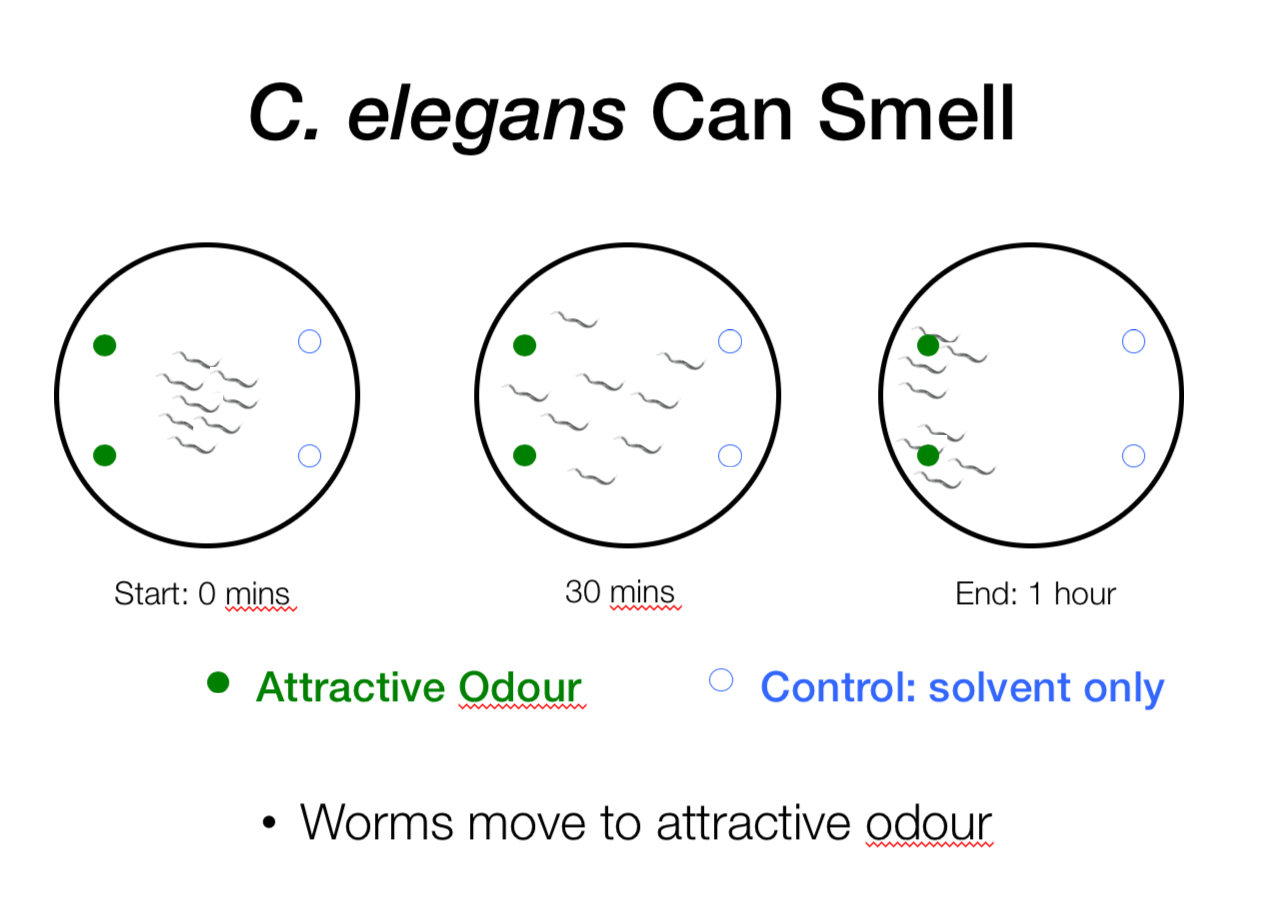
Exhibit attraction towards diacetyl (the buttery flavor in popcorn):
Experiment demonstrated distinct movement behavior towards attractive odors.
Neuroanatomy Related to Smell in C. elegans
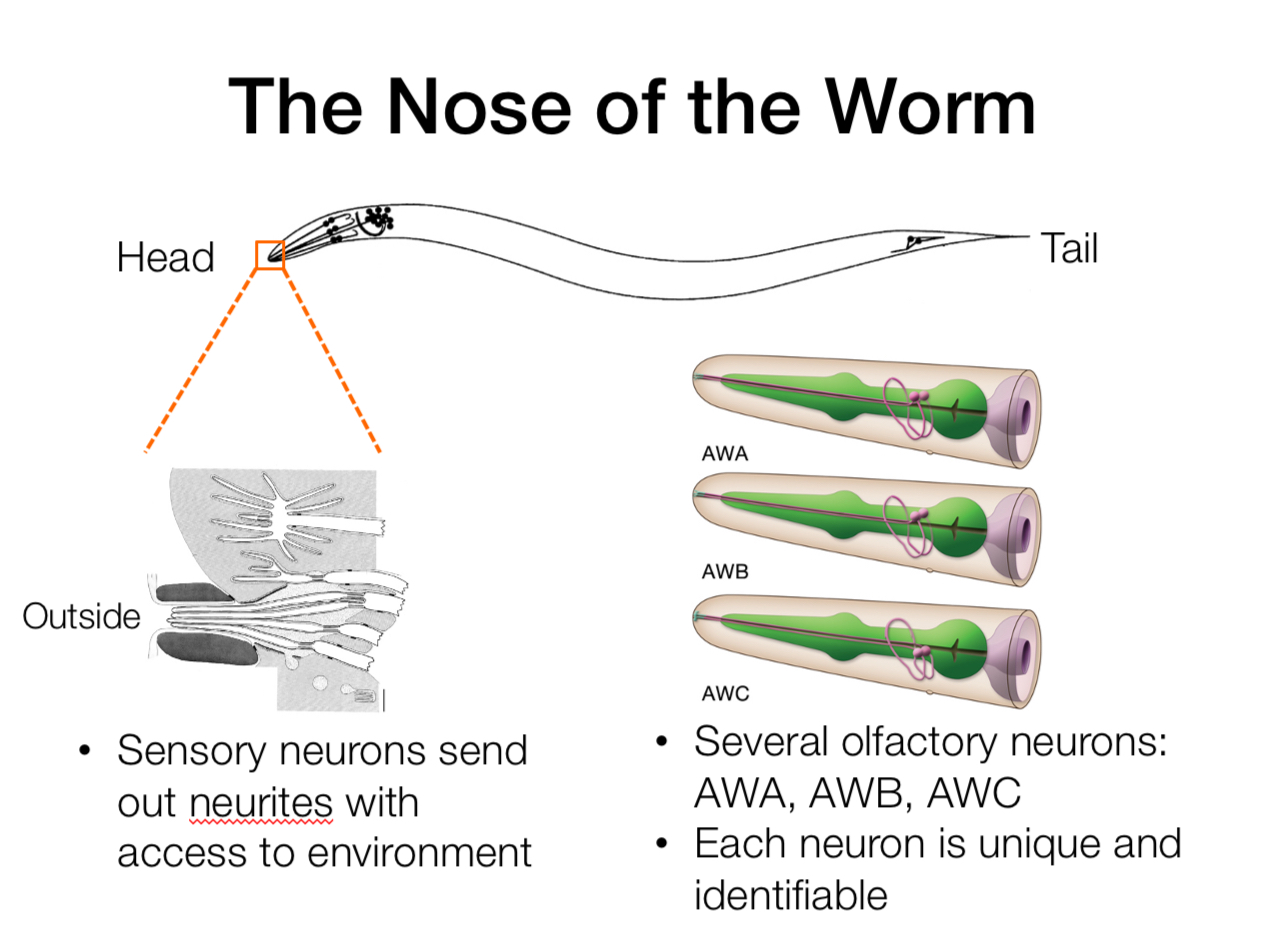
Olfactory neurons identified include AWA, AWB, and AWC:
Neurons are uniquely identifiable with exposed nerve endings.
Investigating Neuron Functionality
Techniques to explore neuron functions include:
Laser ablation to remove specific neurons (e.g., AWA).
Behavioral tests determine the effect of neuron loss on attraction to diacetyl.
Use mutagens to generate random mutations → screen to find ones that can’t smell diacetyl → use complementation analysis → focus on a gene
Complementation analysis - determine which alleles affect the same gene.
Genetic Analysis of Smell
Identifying genes responsible for olfaction involves:
Screening for mutants unable to sense diacetyl after exposure to mutagens.
Focusing on one pivotal gene, odr-10, identified from recessive mutants.
odr-10 Gene Functions
odr-10 is crucial for sensing diacetyl specifically.
Wild type worms show attraction, while odr-10 mutants do not.
Genetic experiments demonstrate that loss of the gene negates the ability to sense this odor.
Recombination Mapping
Localizing the odr-10 gene using recombination mapping techniques to identify chromosomal linkage:
Methods include testing various DNA segments for rescuing expression in mutant animals.
Confirming odr-10 Identity
Gene sequencing to confirm the identity and structure of odr-10:
Encodes a 7-transmembrane receptor relevant in olfactory signaling.
Provides information about mutations across different alleles.
Gene Expression Analysis
Construction of reporter genes (e.g., GFP linked to odr-10 promoter) to visualize gene expression:
Construct plasmid: attach GFP to the odr-10 promoter.
Confirmed expression of odr-10 specifically in AWA neurons responsible for diacetyl detection.
Interaction with Other Genes
Investigation of gene interactions through other mutants (e.g., odr-7), which also failed to sense diacetyl:
odr-7 is a transcription factor necessary for odr-10 expression in neurons.
Understanding Gene Regulation
The expression regulation process by examining the role of transcription factors:
odr-7 is critical for the activation of odr-10, as indicated by GFP reporter assays.
Implications for Mammalian Biology
Structural analysis reveals similar 7-transmembrane proteins in mammals thought to act as olfactory receptors:
However, actual functionalities and chemical interactions remain largely unstudied.
Key Takeaways about Olfaction from C. elegans
Different 7-transmembrane receptors sensitize specific odors in olfactory neurons.
Some receptors can respond to multiple odors and vice versa.