Background Radiation
Geiger Muller tube
Definition
A Geiger-Muller (GM) tube is a device used to detect and measure ionizing radiation, such as alpha particles, beta particles, and gamma rays. It is the key component of a Geiger counter.
Diagram
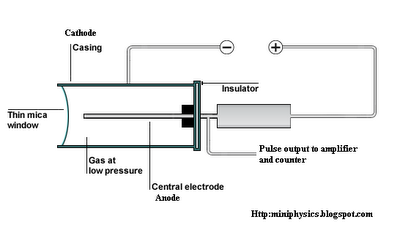
How the GM Tube works
Construction:
The GM tube is a sealed metal or glass tube filled with a low-pressure inert gas (e.g., argon or neon) mixed with a small amount of a halogen gas.
Inside the tube is a central wire electrode surrounded by the gas, with the tube wall often acting as the other electrode.
Principle:
When ionising radiation enters the tube, it ionises the gas inside.
The ions and electrons produced cause a brief electrical discharge or pulse as they move between the electrodes under a high-voltage electric field.
Detection:
Each pulse corresponds to a single ionizing event, which is counted by the connected electronics.
How to measure background radiation
its random nature means that you should:
measure over long periods of time. e.g 1000s
Repeat and calculate the mean value
Small variations in count rate are expected due to radioactive being a random process
Key Notes
No anomalies as it is a random process
Greater time reduces effect of random nature of decay
Background count must always be measure at least 3 times
Background count must always be measured over 60 or 100 seconds
Then the mean value should be calculated
The background account must be subtracted from overall readings
Typical background count is 0.5 s-1
Results Interpretation
If the count rate drops significantly with paper: The source emits alpha radiation.
If the count rate drops with aluminium but not paper: The source emits beta radiation.
If the count rate is only reduced by lead: The source emits gamma radiation