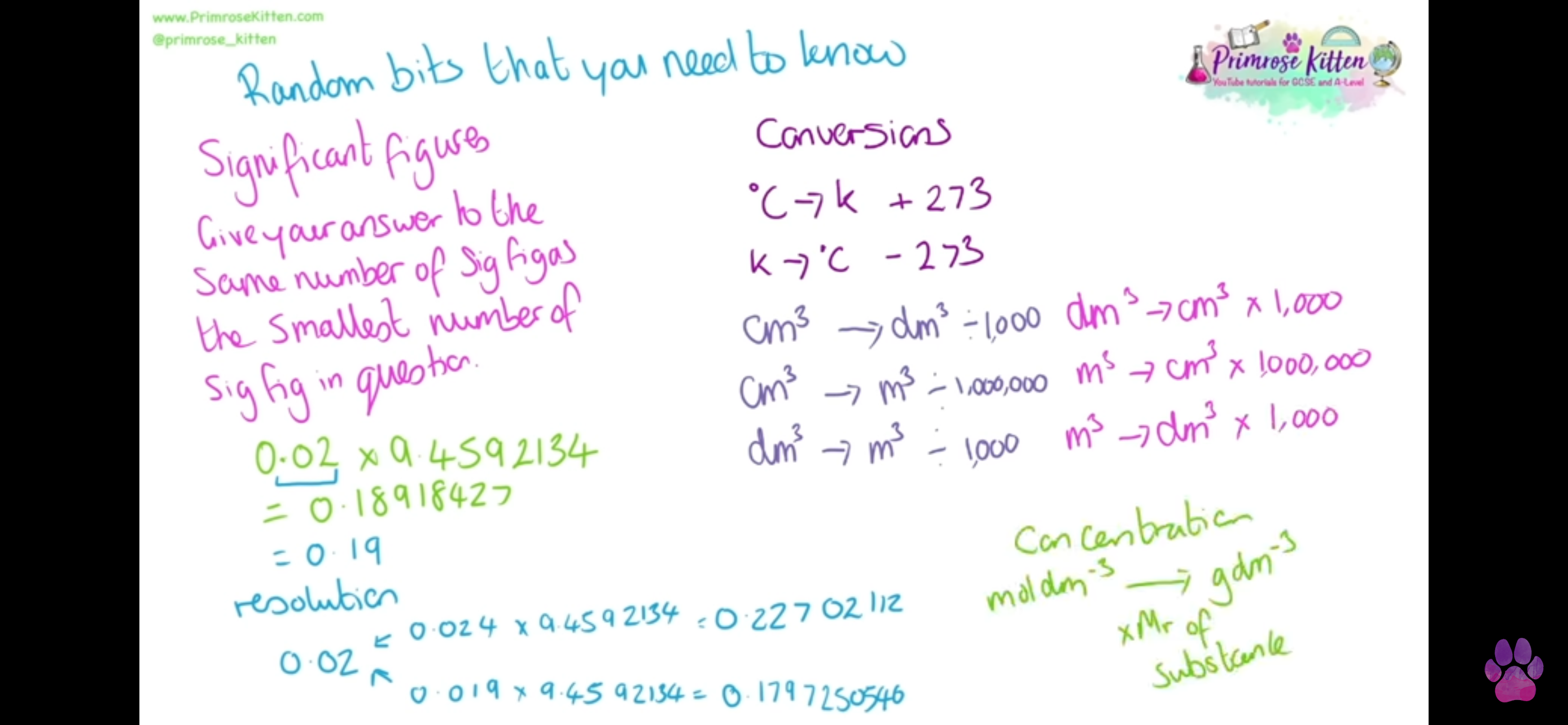
must knows ions atoms compounds
chapter 2.1 - 2.3 OCR A
electrons only change in ions NOT protons
Ar = (mass x % abundance) + (mass x % abundance) etc / 100 (total abundance)
- total abundance must add up to 100%
- mass number is found on periodic table
(aq) → split into ions
(s), (l), (g) → dont split
moles = volume (g) / 24
moles = volume x concentration
moles = mass / Ar (triangle)
Relative Isotopic Mass (RIM)
👉 The mass of one atom of a particular isotope compared with 1/12 of the mass of a carbon-12 atom.Relative Atomic Mass (Ar / RAM)
👉 The weighted mean mass of an atom of an element compared with 1/12 of the mass of a carbon-12 atom.
(Takes into account all isotopes + their abundances.)Relative Molecular Mass (Mr / MAM)
👉 The weighted mean mass of a molecule compared with 1/12 of the mass of a carbon-12 atom.
(For giant structures like NaCl, we often use “relative formula mass.”)
Always soluble (never form a precipitate):
All Group 1 (alkali metal) salts: Na*, K*, Lit, etc.
Ammonium salts (NHa*)
Nitrates (NO3*)
Ethanoates (CH.C00-)
Usually soluble:
Chlorides, bromides, iodides (Cl, Br, F)
X Except with Ag*, Pb2+
+, Hg22+ → insoluble
• Sulfates (SO,?-)
X Except with Ba?+
+, Pb2+,
, Ca? (sparingly), Sr2+
Usually insoluble:
Carbonates (CO?*), hydroxides (OH), sulfides (S2-), oxides (02-)
Except when paired with Group 1 or NHa* (then
soluble)Some hydroxides of Group 2 (like Ca(OH)2) are slightly soluble