之 - zhi
之 can be used as a pronoun, but this usage is not very common
ex:
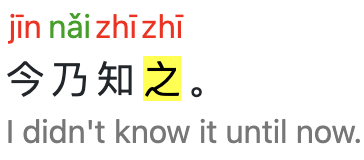
“jin nai” (今乃) indicates the present time in a statement, effectively meaning “until now” in this sentence.
“zhi” (知) means to know, like in “zhi dao” (知道)
Here, 之 is used to refer to the knowledge that the speaker did not know before. It is used as a pronoun.
Another use of this character is to indicate possession/ownership, like the character 的 that you have already learned. Think of it like the Chinese equivalent of the word “of.”
ex:
诡秘之主 - gui mi zhi zhu - Lord of the Mysteries
“gui mi” (诡秘) means mysteries
“zhu” (主) means owner, or in this case, lord
In the example, the word 之 is used to connect the two nouns together by indicating that the mysteries are of the lord’s.
If it helps, replace 之 with 的 in your head to understand the meaning. 之 is not as commonly used in modern times, but it is still important to know.
Another way people use 之 is that it is a part of many words, the most common including
之前 (zhiqian)
之间 (zhijian)
之后 (zhihou)
之上 (zhishang)
之一 (zhiyi)
之内 (zhinei)
之外 (zhiwai)
I’m not explaining each of these words; you’ll learn them later on anyway