Lesson 5: Axis Deviation
Lesson 5: Axis Deviation
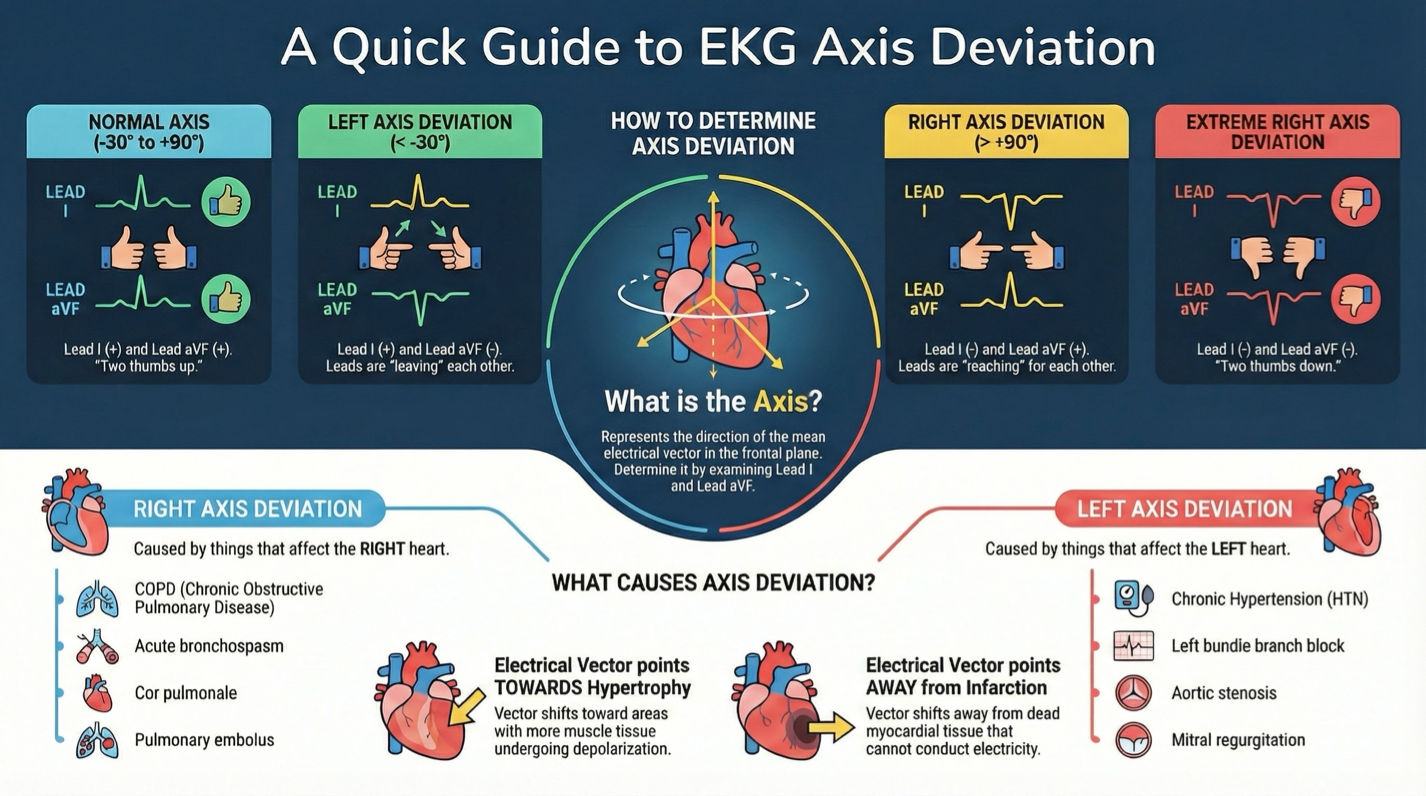
Definition: Axis represents the direction of the mean electrical vector in the frontal plane.
Determining Axis Deviation:
Examine Lead I and aVF.
Axis Categories:
Normal Axis:
Lead I = +
Lead aVF = +
Left Axis Deviation:
Lead I = +
Lead aVF = -
Right Axis Deviation:
Lead I = -
Lead aVF = +
Extreme Right Axis Deviation:
Lead I = -
Lead aVF = -
Causes of Right Axis Deviation:
Chronic Obstructive Pulmonary Disease (COPD)
Acute bronchospasm
Cor pulmonale
Pulmonary embolus
Causes of Left Axis Deviation:
Chronic hypertension
Left bundle branch block
Aortic stenosis
Aortic insufficiency
Mitral regurgitation
Mean Electrical Vector Direction:
Toward hypertrophy
Away from myocardial infarction
Key Numbers:
Normal axis: between and degrees
Left axis deviation: more negative than degrees
Right axis deviation: more positive than degrees
Remembering the Axis Deviations:
Both Lead I and aVF up ➔ Normal axis.
Lead I down, aVF up ➔ Right axis deviation.
Lead I up, aVF down ➔ Left axis deviation.
Both leads down ➔ Extreme right axis deviation.