Midterm Practice
Neurons are filled with an electrolyte that has what difference compared to the outside?
A: Different ionic concentrations
WHY- Neurons maintain a specific chemical environment that differs from the extracellular fluid (the space outside the cell). This difference in ionic concentrations is what allows neurons to generate electrical signals.
Which of the following best describes the difference between electrical 'current' and 'voltage' in a biological system like a neuron?
A: Current is the flow of ions, while voltage is the potential
In neurons, a current results when what flows where?
A: Ions flow through pores
WHY- In the nervous system, a current is simply the movement of electrical charge. Because neurons are surrounded by a membrane that blocks most charged particles, this flow can only happen in specific ways.
🔋 Ions (charged particles like Na+Na+, K+K+, Cl−Cl−, and Ca2+Ca2+) are the charge carriers.
🚪 Pores (specifically ion channels) act as the gateways in the cell membrane.
🌊 When these channels open, ions move down their electrochemical gradient, creating an electrical current.
An electric current exists when there is what?
A: Net flow of charge
WHY- An electric current is defined as the rate at which charge flows past a specific point in a circuit. For a current to exist, there must be a net flow of charge (usually electrons) through a conductor.
At electrochemical equilibrium, electrostatic force equals and opposes chemical diffusion—this is described as which relationship?
A: Equal and opposite
Diffusion tends to move ions down their concentration gradient from where to where?
A: High concentration to low concentration
Positive Coulomb force corresponds to what?
A: Repulsion
Coulomb’s Law states the absolute value of force F depends on what three things (as described)?
A: Distance and charge product
Ligand binding to a channel is compared to which mechanism?
A: Lock and key
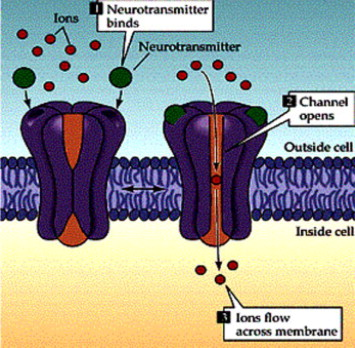
8,9
brainstem- relay center
3.Consider a theoretical model where the concentration of Potassium (K+) is 10 times higher inside the cell than outside. If the membrane is only permeable to K+, why does the membrane potential eventually stabilize at a negative value like −58 mV?
A: The negative electrical force eventually counteracts the outward chemical diffusion force
Why is the sensation of 'heat' perceived when consuming spicy food containing the molecule capsaicin?
A: The molecule binds to and activates thermally gated ion channels
In a resting neuron, the chemical force of _diffusion_ encourages Potassium (K+) to move from the inside of the cell, where it is highly concentrated, to the outside.
The brainstem is a continuous structure with the spinal cord and is composed of three main parts: the midbrain, the pons and the medulla.
According to Ohm's Law, the voltage across a membrane is calculated as the product of the current
and the resistance
LESSON 5
19:50
post-synaptic neuron
GABA
The axon length constant
(lambda, λ; ~1-2 mm) is
how far down the axon
it takes for the voltage to
decay to 37% of the
amplitude at position 0
dendritic spines.
whether the neurons were continuous or whether there was a small space between them called the synaptic cleft.
The action potential (an active process) spreads down the length of the axon, much like a travelling wave.
The GABAergic synapse is the most common inhibitory synapse in the nervous system’’
LESSON 4- DECK
During hyperpolarization, is the membrane more or less negative than the -65 mV resting potential?
A: During hyperpolarization, is the membrane more or less negative than the -65 mV resting potential?
Which equation calculates resting membrane potential when multiple ions contribute?
A: Goldman’s Law
In the Goldman equation, what does permeability represent?
A: Relative open channels
WHY- In the Goldman-Hodgkin-Katz equation, permeability (PP) represents how easily a specific ion can cross the cell membrane.
At rest, what is the permeability ratio PK:PNa:PCl?
A: 1.0:0.04:0.45
What type of process is an action potential?
A: All-or-none
WHY- An action potential is an all-or-none process. This means that once a nerve or muscle fiber is stimulated past a certain threshold, a full-strength electrical impulse is fired.
What produces an action potential?
A: Opening and closing ion channels
WHY- An action potential is a rapid electrical impulse that travels down an axon. This electrical signal is generated and propagated entirely by the controlled movement of ions across the cell membrane.

LESSON 5
In the Goldman equation, what does permeability represent?
A: Relative open channels
What produces an action potential?
A: Opening and closing ion channels
Two factors determine the resting potential of a
neuron.
• 1) Primarily permeable to K+ via leak channels.
• 2) K+ is more concentrated inside vs. outside.
At rest, mainly K+ is flowing. This means the resting potential is close to the Nernst potential for K+.