AP Econ Unit 3
3.1
Production = Converting inputs into outputs
Total Physical Product total output or quantity product
Marginal Product (MP) = The additional output produced from one additional unit of input while keeping all other inputs constant.
MP = Change in total product/ change in inputs
Avg. Product = The output produced, on average, per unit of input used in the production process, calculated by dividing total product by the number of units of input.
AP = Total output/Units of labor
Short run Costs
Fixed Resources are the inputs that cannot be changed in the short run, which may include factors such as land and machinery, impacting production capacity.
Variable Resources (No variable in long run) are inputs that can be adjusted in the short run, such as labor and raw materials, allowing firms to respond to changes in production demands more flexibly.
FC+VC=Total Cost
Average fixed cost = Variable cost/quantity
Average Variable Costs = Variable Cost/Quantity
Average Total Costs = Total Cost/Quantity
Production Function

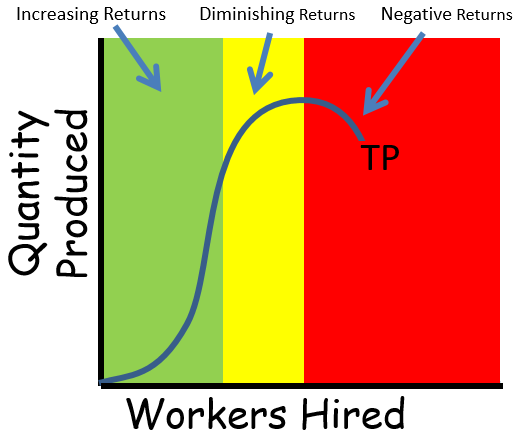
When MP is positive and rising , it indicates that adding more units of variable input is increasing output at an increasing rate, which often occurs in the early stages of production. This behavior reflects increasing returns to scale, where each additional unit of labor or raw material enhances overall productivity more significantly.
IN eimisiing returns MP is positive but begins to decline, indicating that while output is still increasing, it does so at a decreasing rate. This phenomenon typically arises as firms begin to utilize their variable resources more intensively, leading to less efficient production as constraints start to appear.
Total product is maxamized whne MP hits 0
MP always intersects AP at AP maximum
FC=10
3.2
TVC + TFC = TC
3.3
Long-run Costs refer to the costs that a firm incurs when all factors of production are variable, allowing for the adjustment of input levels to minimize costs.
Short term costs refer to the expenses a firm faces when at least one factor of production is fixed, typically leading to a less flexible production process. Understanding the difference between long-run and short-run costs is crucial for firms to make informed decisions about production, pricing, and investment strategies.
Increasing returns to scale occur when an increase in the inputs used in production results in a more than proportional increase in output, thus leading to lower average costs per unit as production expands.
Constant returns to scale occur when a proportional increase in inputs results in an equivalent proportional increase in output, leading to constant average costs per unit regardless of the scale of production.
Decreasing returns to scale occur when an increase in inputs leads to a less than proportional increase in output, resulting in higher average costs per unit as production expands.
Returns to scale refers only to production
Long Run Average total cost
Economies of scale are cost advantages that a business obtains due to the scale of operation, with cost per unit of output generally decreasing with increasing scale.
Diseconomy’s of scale
Accounting Profit = total Rev - Accounting Costs
Economic Profit= total revenue - economic costs
EP=AP-IC