Leaf Formation, Arrangement, Composition
Dendro- means tree in Greek, dendrology is the study of trees including taxonomy, identification, silvicultural, etc

Apical meristems cause primary growth (lengthening of plant), occurs at tips of shoots and roots, produces new leaves and flowers
Lateral meristems cause secondary growth (widening of plant), occurs at the cambium, produces bark on trees
A leaf is always attached below a bud
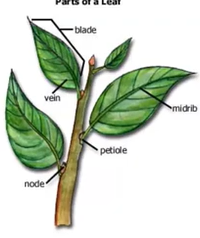
The tissue that makes up the leaf is called the blade
The petiole attaches the leaf to the branch
If the leaf is attached directly to the branch, it is sessile
The node is the point of attachment of the leaf to the branch.
The space between the petiole and the branch where the bud is found is called the axil.
Leaf arrangement
Alternate: one leaf per node (most common, 80% of species)
Opposite: 2 leaves per node
Whorled: three or more leaves per node
MADCAP BUCK: opposite leaf arrangement pneumonic, Maple, Ash, Dogwood, Caprifooliaceae, Buckeye
Leaf arrangement in winter is possible by looking at the buds
Leaf arrangement follows the Fibonacci sequence
Phyllotaxy: describes the arrangement of leaves, flowers, and seeds along a stem
Fibonacci (1170-1230) sequence: describes spirals in nature with mathematics, adding 2 numbers to get next in series (0+1 = 1, 1+1=2, 2+1=3, 3+2=5, etc…)
Leaf venation
Arcuate: veins start and end from the midrib
Palmate: veins originate from single point at base of the midrib
Parallel: veins are parallel and do not intersect
Pinnate: veins emerge along the central vein or midrib
Reticulate: smaller veins form a network

Simple vs. Compound Leaves


