The Origin of Species
Key Concepts of Speciation
24.1 - The Biological Species Concept: Emphasizes reproductive isolation.
24.2 - Modes of Speciation: Speciation can occur with or without geographic separation (allopatric vs. sympatric).
24.3 - Hybrid Zones: Hybrid zones reveal factors that cause reproductive isolation.
24.4 - Tempo and Genetics of Speciation: Speciation can occur rapidly or slowly and result from changes in few or many genes.
Introduction: Darwin's "Mystery of Mysteries"
Darwin was captivated by speciation, the process by which one species splits into two.
Speciation is the source of the tremendous diversity of life.
It also explains the unity of life; when one species splits, the resulting species share characteristics due to common ancestry.
Example: Flightless cormorants in the Galápagos are closely related to flying cormorants in the Americas.
Speciation: Bridging Microevolution and Macroevolution
Speciation connects microevolution (changes in allele frequencies within a population) and macroevolution (the broad pattern of evolution above the species level).
Macroevolution includes the origin of new groups, like mammals or flowering plants, through speciation events.
Defining a Species
The word "species" is Latin for "kind" or "appearance."
Historically, species were distinguished based on morphology (body form).
Modern biologists consider morphology, physiology, biochemistry, and DNA sequences.
The Biological Species Concept
Definition: A species is a group of populations whose members can interbreed in nature and produce viable, fertile offspring, but cannot do so with other groups.
Reproductive compatibility unites members of a biological species.
Example: Humans are one species because individuals from distant populations can interbreed.
Humans and chimpanzees are distinct species because they cannot interbreed and produce fertile offspring.
Gene Flow and Species Cohesion
Gene flow (transfer of alleles between populations) holds a species together genetically.
Reduction or lack of gene flow is crucial for the formation of new species.
Reproductive Isolation
Reproductive isolation is the existence of biological factors (barriers) that impede members of two species from interbreeding and producing viable, fertile offspring.
These barriers block gene flow and limit the formation of hybrids (offspring from interspecific mating).
A single barrier may not prevent all gene flow, but multiple barriers can effectively isolate a species' gene pool.
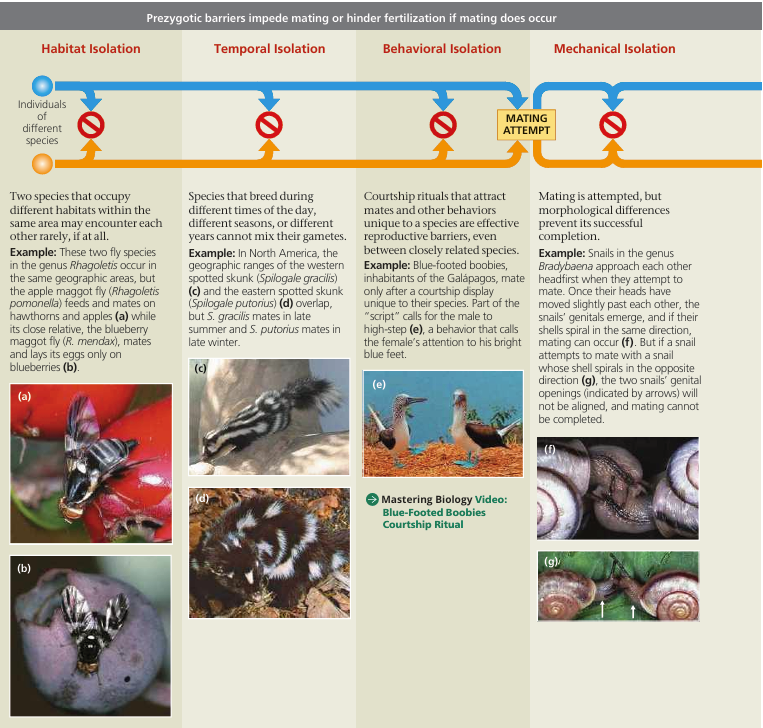
Types of Reproductive Barriers
Prezygotic Barriers (Before the Zygote)
Block fertilization from occurring.
Impede mating attempts.
Prevent mating completion.
Hinder fertilization if mating is successful.
Habitat Isolation:
Species in different habitats within the same area rarely encounter each other. Example: Apple maggot flies and blueberry maggot flies.
Temporal Isolation:
Species breed during different times of day, seasons, or years. Example: Western and eastern spotted skunks.
Behavioral Isolation:
Courtship rituals and behaviors unique to a species act as barriers. Example: Blue-footed boobies' mating displays.
Mechanical Isolation:
Morphological differences prevent mating completion. Example: Snails with different shell spiraling directions.
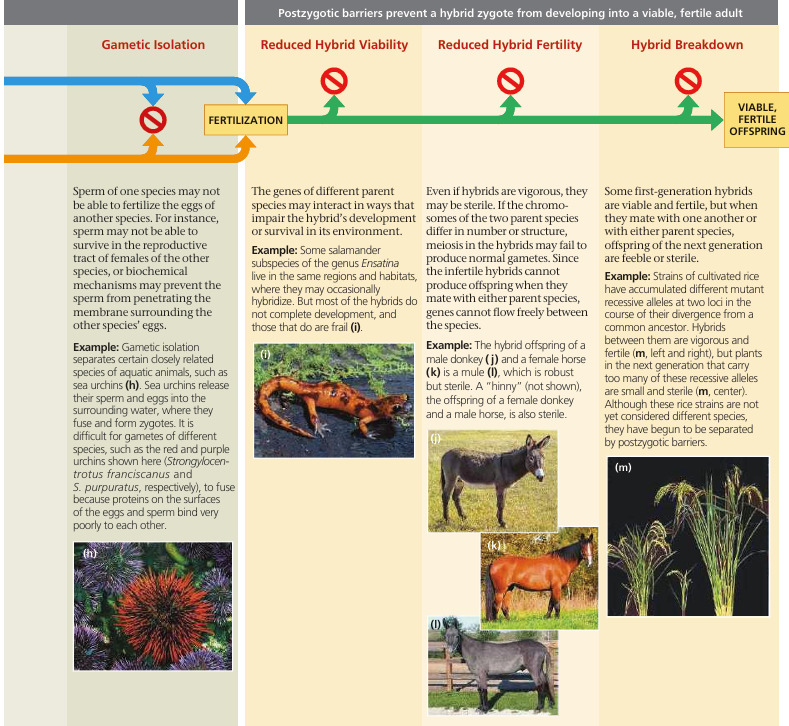
Gametic Isolation:
Sperm cannot fertilize eggs of another species. Example: Sea urchins with incompatible egg and sperm surface proteins.
Postzygotic Barriers (After the Zygote)
Contribute to reproductive isolation after a hybrid zygote is formed.
Developmental errors, infertility, or reduced survival of hybrids.
Reduced Hybrid Viability:
Hybrid offspring cannot complete development or are frail. Example: Certain salamander subspecies hybrids.
Reduced Hybrid Fertility:
Hybrids are sterile. Example: Mule (male donkey x female horse).
Hybrid Breakdown:
First-generation hybrids are viable and fertile, but later generations are feeble or sterile. Example: Cultivated rice strains.
Limitations of the Biological Species Concept
Cannot evaluate reproductive isolation of fossils.
Does not apply to asexual organisms (e.g., prokaryotes).
Gene flow can occur between distinct species (e.g., grizzly bears and polar bears).
Other Definitions of Species
Morphological Species Concept:
Distinguishes species by body shape and structural features.
Applicable to sexual and asexual organisms.
Relies on subjective criteria.
Ecological Species Concept:
Defines species by its ecological niche (how members interact with the environment).
Accommodates asexual species.
Emphasizes disruptive natural selection.
More than 20 other species definitions exist; usefulness depends on the situation.
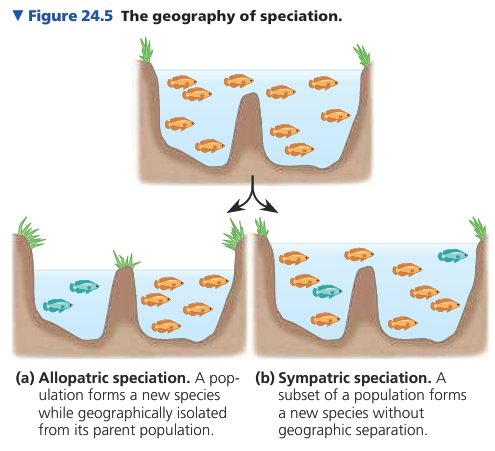
Geographic Context of Speciation
Allopatric Speciation:
Gene flow is interrupted when a population is divided geographically.
Sympatric Speciation:
Speciation occurs in populations within the same geographic area.
Allopatric Speciation ("Other Country")
Allopatric Speciation: Gene flow is interrupted when a population is divided into geographically isolated subpopulations.
Geographic barriers can be changes in water level, rivers changing course, or colonization of remote areas.
Example: the water level in a lake may subside, resulting in two or more smaller lakes that are now home to separated populations.
The Process of Allopatric Speciation
The effectiveness of a geographic barrier depends on the organisms' ability to move.
Divergence occurs due to different mutations, natural selection, and genetic drift in separated populations.
Reproductive isolation evolves as a by-product of genetic divergence.
Example: Mosquitofish in the Bahamas adapting to ponds with and without predators.
Evidence of Allopatric Speciation
Laboratory studies show reproductive barriers develop in isolated populations under different conditions.
Field studies also show it occurs in nature.
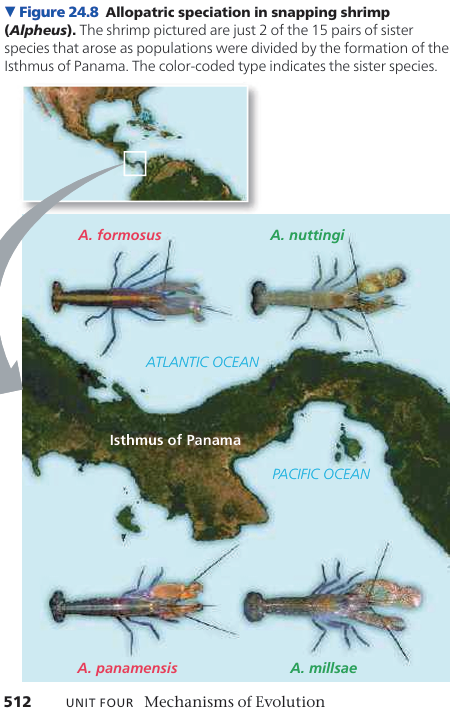
Example: Snapping shrimp (Alpheus) separated by the Isthmus of Panama.
Snapping Shrimp (Alpheus) and the Isthmus of Panama:
15 pairs of sister species exist, one on the Atlantic side and one on the Pacific side of the isthmus.
Genetic analyses suggest species originated from 9 to 3 million years ago, consistent with the isthmus' formation.
Regions isolated or highly subdivided by barriers tend to have more species.
Scientific Skills Exercise Interpretation
Question: Does Distance Between Salamander Populations Increase Their Reproductive Isolation?
Salamander reproductive isolation generally increases with geographic distance, supporting allopatric speciation.
Biological reproductive barriers are intrinsic to the organisms themselves.
Sympatric Speciation ("Same Country")
Sympatric Speciation:
Speciation occurs in populations within the same geographic area.
Less common due to contact and gene flow.
Gene flow reduced by polyploidy, sexual selection, and habitat differentiation.
Polyploidy
Accident during cell division results in extra chromosome sets.
More common in plants.
Estimated that over 80% of plant species are descended from ancestors that formed by polyploid speciation.
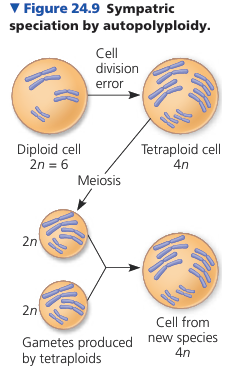
Autopolyploid:
Individual with more than two chromosome sets derived from a single species.
Allopolyploid:
Hybrid of two species with a different number of chromosomes that becomes fertile due to chromosome doubling.
Examples:
Gray tree frog (Hyla versicolor)
Tragopogon (goatsbeard plant)
Wheat (Triticum aestivum) is an allohexaploid (6 sets of chromosomes).
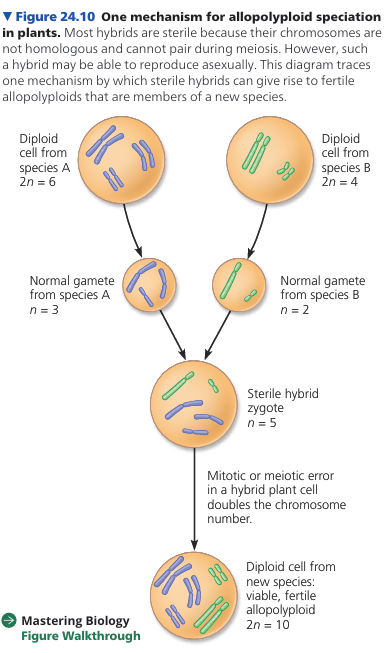
Sexual Selection
Can drive sympatric speciation.
Example: Cichlid fish in Lake Victoria, where female mate choice based on male breeding coloration can act as a reproductive barrier.
Habitat Differentiation
Subpopulation exploits a habitat or resource not used by the parent population.
Example: North American apple maggot fly (Rhagoletis pomonella) adapting to apple trees; the second prezygotic barrier to gene flow between the two populations.
Allopatric and Sympatric Speciation: A Review
Allopatric: New species forms in geographic isolation; intrinsic barriers to reproduction may arise.
Sympatric: Reproductive barrier isolates a subset of a population; polyploidy, sexual selection, or habitat differentiation can play a role.
Hybrid Zones
Regions where members of different species meet and mate, producing offspring of mixed ancestry.
Patterns Within Hybrid Zones
Hybrid zones can form as narrow bands in regions such as Hybrid zone for Bombina toads in Europe.
Obstacles that lead to the reduction of hybrid success is the survival, mating or reproduction for hybrids.
Hybrid Zones and Environmental Change
Environmental changes can shift hybrid zones
Black-capped chickadees (Poecile atricapillus) and Carolina chickadees (P. carolinensis)
Series of winters led to the spread and range in Southern Flying Squirrels
Problem-Solving Exercise
Is hybridization promoting insecticide resistance in mosquitoes that transmit Malaria
DNA analyses that lead to transfer of alleles
Hybrid Zones over Time
Hybrid Zones can reveal traits that can cause reproductive isolation
Formation of plant species (Example: goastbeard plant, or Galapagos archipelago)
situations, there are three common outcomes for a\nhybrid zone over time: reinforcement of
barriers, fusion of species, or stability.
Reinforcement: Strengthening Reproductive Barriers
Natural selection improves the prezygotic barriers causing a reduction with formation of unfit hybrids.
logical prediction that barriers to reproduc-tion between species should be stronger for sympatric popula-tions than for allopatric populations.
Example:
*Two species of European fly.catchers, the pied flycatcher Ficedula hypoleuca and the collared flycatcher
*(Ficedula albicollis.)
Males closely resemble on each other
Fusion: Weakening Reproductive Barriers
Barriers to reproduction is not needed when two species
*Speciation process may reverse. Lead the the Species with gene pool
*Example:
*Cichind fish in Lake Victoria
Stability: Continued Formation of Hybrid Individuals
Many hybrid zones are stable and hybrids continue to be produced
Example:
*Bombina hybrid zone, even in species being selected
#
The Time Course of Speciation
Information with timelines gather with many resources
*patterns in the fossil record
*Studies that utilize fossils and molecular data
Patterns in the Fossil Record
Fossil records include many episodes
*species will appear suddenly
*survive unchanged
*disappear
Example:
Marine invertebrate species with novel morphologies
Concept Term:
Punctuated equilibria used to describe period with sudden change
Speciation Rates
The existence of fossils that display a punctuated pattern suggests rate
Example:
Hybrid Sunflower species
Apple maggot fly
Lake Victoria cichild
ewline
Fruit fly examples that suggest new species that can arise rapidly
Genetics of Speciation
Studies on ongoing cases reveal traits
By identifying traits scientists can explore
*Fundamental question of biology:
How many genes influence the formation of new species?
Example:
Japanese snails
Fruit flies and mice
Monkey flower
A locus that influence pollinator: Explanation
The two monkey flower species are visited by pollinators
*Hummingbirds prefer the red flower
*Bumblebears prefer pink flower
*Pollinator choice is affected by at least two loci in the monkey flowers
From Speciation to Macroevolution
You've seen, speciation may begin with differences as small as the color on a cichlid's back
Furthermore,
*As one group of organisms increases in size by pro-ducing many new species, another group of organisms may shrink, losing species to extinction.
The cumulative effects ofmany such speciation and extinction events have helped shape the sweeping evolutionary changes that are documented in thefossil record.