4. T-tests
Hypothesis testing
• Making inferences from sample means to population means
• Hypotheses about means
• Null: H0: µ1 = µ2
• Alternative: H1: µ1 ≠ µ2
After the statement of the hypothesis: (H0: µ1 = µ2; H1: µ1 ≠ µ2)
H0/HN
H1/HA
Can we reject the null?
• Calculate the sample statistic: t-value
• Determine sig: use tcritical or calculate a p-value
• One tail vs. two-tailed tests
2 tailed can be 1 → P value divided by 2
• Depends on the hypothesis
\One tailed vs two tailed
One-Tailed Test
• Interested in whether differences between groups/values occur in either one
direction or the other, but not both
Two-Tailed Test
• Interested in whether any differences between groups/values exist, regardless of direction
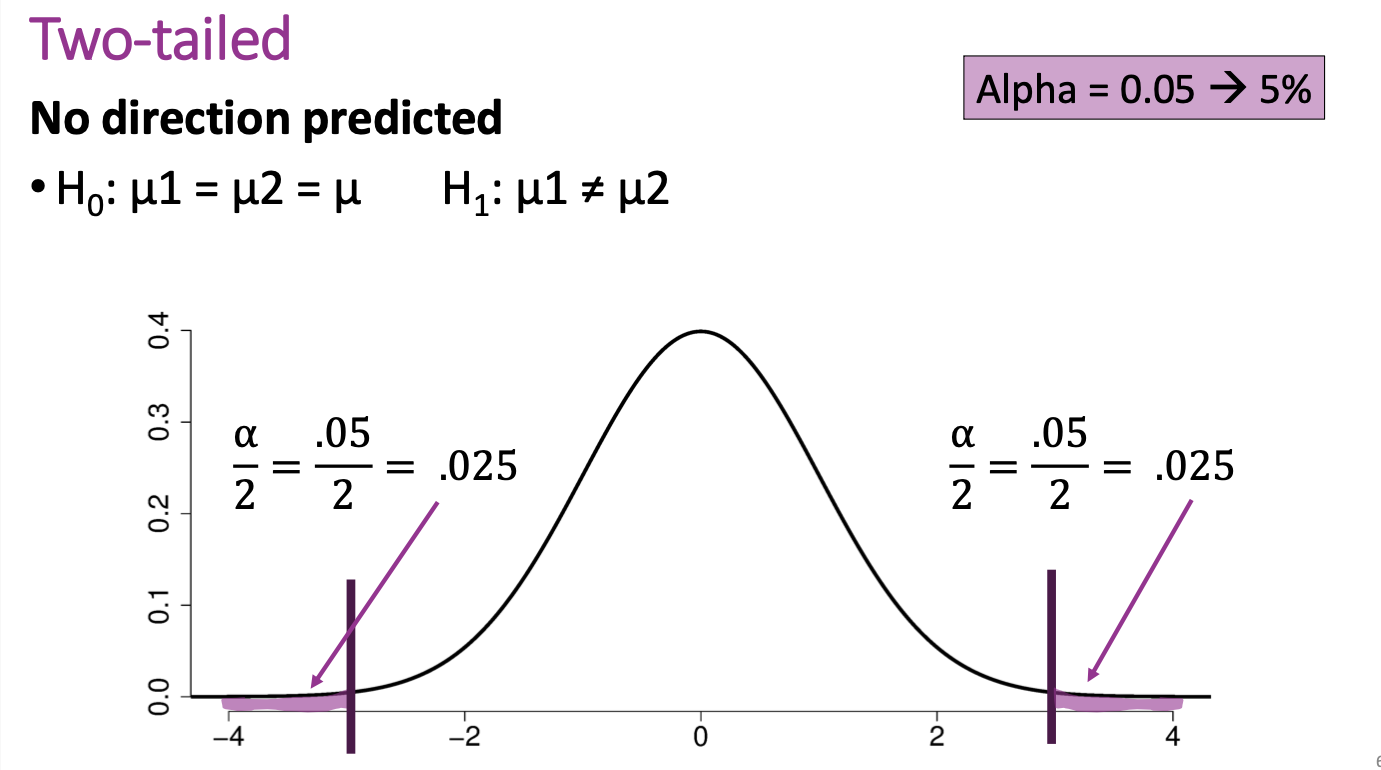
We could be inflating our power to see something that isnt there
False positive
One tailed is less common
Single samples t-test
comparing to something more or less set
final stats grade to upper year stats grade
• IV = 1 factor with 2 levels = 2 groups/conditions
• 1 group = sample mean
• 1 group = population mean
• DV = groups means for the measure/score/etc. (continuous)
Levene’s Test for Homogeneity of Variance
We dont want this to be significant
We’re testing for something innately different
• Not sig. = variances do not differ/approx. equal = assumption was met
• Sig. = variances differ = assumption violated
Effect Size
• Standardized measure of the magnitude of the effect
• Tells us how many SDs there are b/w the two group means
• Reported in addition to t and p
• Allows comparisons across studies
If its significant, how big is that difference?
Within subjects t-test
Paired Samples t-Tests
Test whether two dependent sample means are different between
conditions
• Comparing 2 conditions / groups with the same individuals in each group
• Samples are NOT independent (same ppl in both groups)
• e.g., matched/paired, longitudinal
• IV = 1 factor with 2 levels = 2 groups/conditions
• DV = groups means for the measure/score/etc. (continuous)