INTRODUCTION TO RADIATION PHYSICS
Direct Proportionality
This is when 2 quantities both change by the same factor AKA they are in direct proportion
E.g. you are paid $20 an hour. How much you earn is directly proportional to how many hours you work
QUESTIONS:
You have found that a good ratio of pizzas to people is 1:3. You are having a party and there will be 12 people there. How many pizzas do you need for the party?
ANS: 4
If the dose rate from a radioactive source is 240 mGy per minute at a distance of 1 metre, the total dose you will receive in 10 minutes at this distance is
ANS: 2400mGy = 2.4 Gy
Inverse Proportionality
When 1 value increases as the other value decreases AKA the two quantities change by reciprocal factors
E.g. you drive the same distance in twice the time at 1/2 the speed
QUESTIONS: if the dose rate at 1 metre from the source used in the precious example is increased to 300mGy per min, the time taken for you to receive a radiation dose of 2.4Gy will be… ANS = 8 mins
Inverse Square Law
A specified physical quantity or intensity is inversely proportional to the square of the distance from the source of that physical quantity
In the context of RT, the intensity of a point source of radiation decreases as the distance from the source is increased
The amount of decrease is inversely proportional to the square of the distance
E.g. if you are standing 1 m away from a radioactive source with a dose rate of 240mGy per min, the dose rate at 2 m is 60mGy/min
The dose rate decreases by a factor of 4 even though the distance from the source has only increased by a factor of 2
Example of an Exponential Function
Exp or e^x is used to model a relationship in which a constant change in the independent variable gives the same proportional change (% increase/decrease) in the dependent variable
The decay of radioactive material occurs in an exponential manner
At = A0 x e^-λt
A0 = initial activity
At = activity after a certain time (t)
Λ is a constant specific to the radioactive material under consideration
For example, if the activity of a sample of radioactive iodine-131 is 400 MBq at a certain time, you can use the above equation to determine its activity 4 days later.
To do this, you need to know that the constant, λ, for iodine-131 is 8.6 x 10⁻² per day.
Substituting these values in the previous equation
At = 400 x 0.71 = 284 MBq
Therefore, the activity of the iodine-131 has decayed from 400 MBq to 284 MBq in 4 days.
The atom
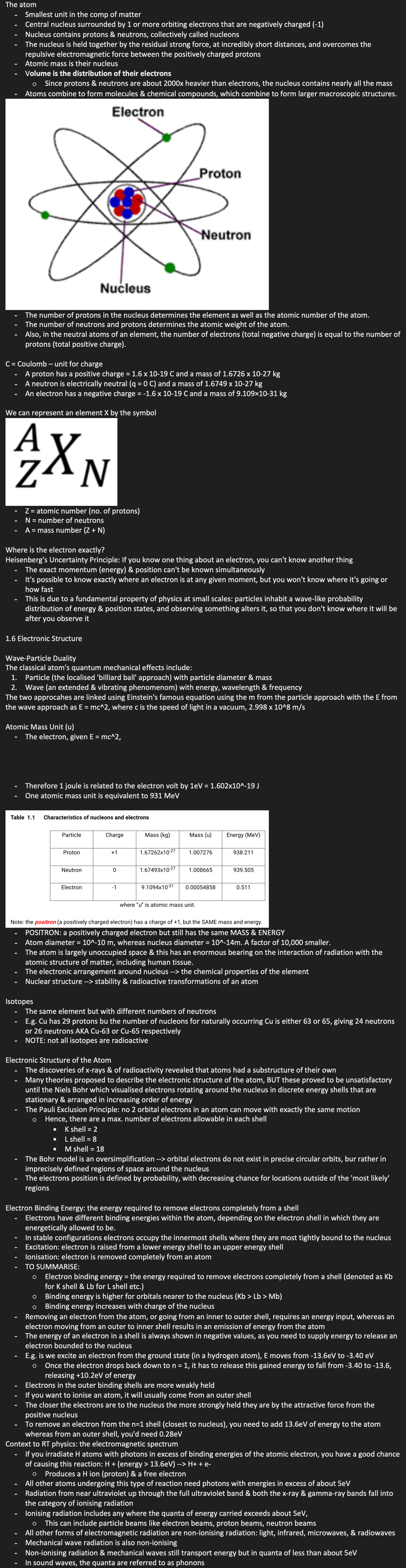
Smallest unit in the comp of matter
Central nucleus surrounded by 1 or more orbiting electrons that are negatively charged (-1)
Nucleus contains protons & neutrons, collectively called nucleons
The nucleus is held together by the residual strong force, at incredibly short distances, and overcomes the repulsive electromagnetic force between the positively charged protons
Atomic mass is their nucleus
Volume is the distribution of their electrons
Since protons & neutrons are about 2000x heavier than electrons, the nucleus contains nearly all the mass
Atoms combine to form molecules & chemical compounds, which combine to form larger macroscopic structures.
The number of protons in the nucleus determines the element as well as the atomic number of the atom.
The number of neutrons and protons determines the atomic weight of the atom.
Also, in the neutral atoms of an element, the number of electrons (total negative charge) is equal to the number of protons (total positive charge).
C = Coulomb – unit for charge
A proton has a positive charge = 1.6 x 10⁻¹⁹ C and a mass of 1.6726 x 10⁻²⁷ kg
A neutron is electrically neutral (q = 0 C) and a mass of 1.6749 x 10⁻²⁷ kg
An electron has a negative charge = -1.6 x 10⁻¹⁹ C and a mass of 9.109×10⁻³¹ kg
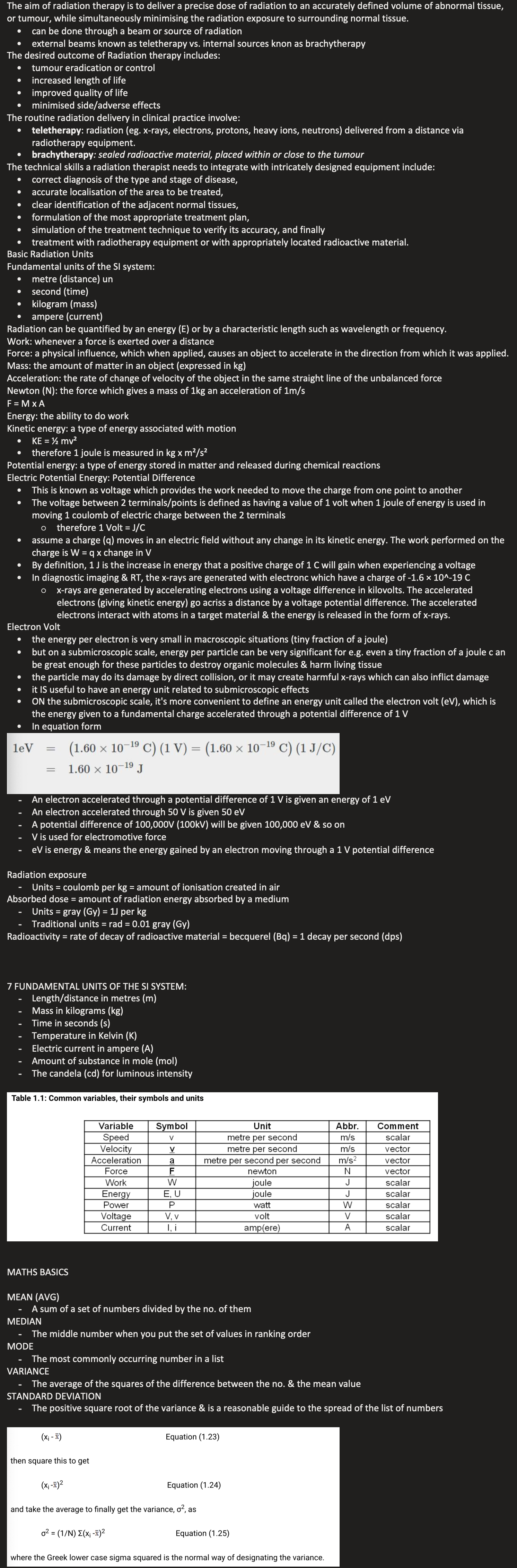
We can represent an element X by the symbol
Z = atomic number (no. of protons)
N = number of neutrons
A = mass number (Z + N)
Where is the electron exactly?
Heisenberg's Uncertainty Principle: If you know one thing about an electron, you can't know another thing
The exact momentum (energy) & position can't be known simultaneously
It's possible to know exactly where an electron is at any given moment, but you won't know where it's going or how fast
This is due to a fundamental property of physics at small scales: particles inhabit a wave-like probability distribution of energy & position states, and observing something alters it, so that you don't know where it will be after you observe it
1.6 Electronic Structure
Wave-Particle Duality
The classical atom's quantum mechanical effects include:
Particle (the localised 'billiard ball' approach) with particle diameter & mass
Wave (an extended & vibrating phenomenom) with energy, wavelength & frequency
The two approcahes are linked using Einstein's famous equation using the m from the particle approach with the E from the wave approach as E = mc^2, where c is the speed of light in a vacuum, 2.998 x 10^8 m/s
Atomic Mass Unit (u)
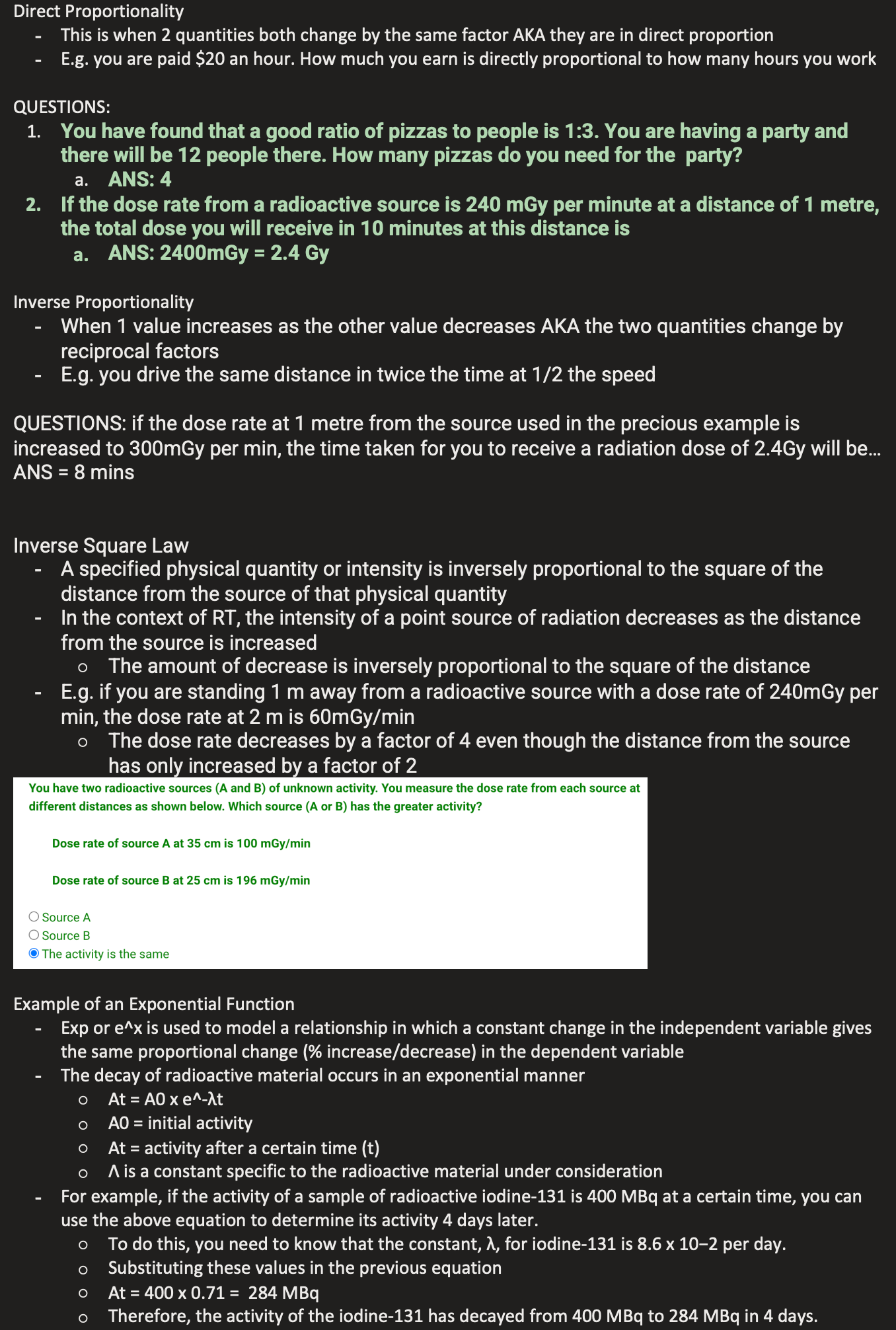
The electron, given E = mc^2,
Therefore 1 joule is related to the electron volt by 1eV = 1.602x10^-19 J
One atomic mass unit is equivalent to 931 MeV
POSITRON: a positively charged electron but still has the same MASS & ENERGY
Atom diameter = 10^-10 m, whereas nucleus diameter = 10^-14m. A factor of 10,000 smaller.
The atom is largely unoccupied space & this has an enormous bearing on the interaction of radiation with the atomic structure of matter, including human tissue.
The electronic arrangement around nucleus --> the chemical properties of the element
Nuclear structure --> stability & radioactive transformations of an atom
Isotopes
The same element but with different numbers of neutrons
E.g. Cu has 29 protons bu the number of nucleons for naturally occurring Cu is either 63 or 65, giving 24 neutrons or 26 neutrons AKA Cu-63 or Cu-65 respectively
NOTE: not all isotopes are radioactive
Electronic Structure of the Atom
The discoveries of x-rays & of radioactivity revealed that atoms had a substructure of their own
Many theories proposed to describe the electronic structure of the atom, BUT these proved to be unsatisfactory until the Niels Bohr which visualised electrons rotating around the nucleus in discrete energy shells that are stationary & arranged in increasing order of energy
The Pauli Exclusion Principle: no 2 orbital electrons in an atom can move with exactly the same motion
Hence, there are a max. number of electrons allowable in each shell
K shell = 2
L shell = 8
M shell = 18
The Bohr model is an oversimplification --> orbital electrons do not exist in precise circular orbits, bur rather in imprecisely defined regions of space around the nucleus
The electrons position is defined by probability, with decreasing chance for locations outside of the 'most likely' regions
Electron Binding Energy: the energy required to remove electrons completely from a shell
Electrons have different binding energies within the atom, depending on the electron shell in which they are energetically allowed to be.
In stable configurations electrons occupy the innermost shells where they are most tightly bound to the nucleus
Excitation: electron is raised from a lower energy shell to an upper energy shell
Ionisation: electron is removed completely from an atom
TO SUMMARISE:
Electron binding energy = the energy required to remove electrons completely from a shell (denoted as Kb for K shell & Lb for L shell etc.)
Binding energy is higher for orbitals nearer to the nucleus (Kb > Lb > Mb)
Binding energy increases with charge of the nucleus
Removing an electron from the atom, or going from an inner to outer shell, requires an energy input, whereas an electron moving from an outer to inner shell results in an emission of energy from the atom
The energy of an electron in a shell is always shown in negative values, as you need to supply energy to release an electron bounded to the nucleus
E.g. is we excite an electron from the ground state (in a hydrogen atom), E moves from -13.6eV to -3.40 eV
Once the electron drops back down to n = 1, it has to release this gained energy to fall from -3.40 to -13.6, releasing +10.2eV of energy
Electrons in the outer binding shells are more weakly held
If you want to ionise an atom, it will usually come from an outer shell
The closer the electrons are to the nucleus the more strongly held they are by the attractive force from the positive nucleus
To remove an electron from the n=1 shell (closest to nucleus), you need to add 13.6eV of energy to the atom whereas from an outer shell, you'd need 0.28eV
Context to RT physics: the electromagnetic spectrum
If you irradiate H atoms with photons in excess of binding energies of the atomic electron, you have a good chance of causing this reaction: H + (energy > 13.6eV) --> H+ + e-
Produces a H ion (proton) & a free electron
All other atoms undergoing this type of reaction need photons with energies in excess of about 5eV
Radiation from near ultraviolet up through the full ultraviolet band & both the x-ray & gamma-ray bands fall into the category of ionising radiation
Ionising radiation includes any where the quanta of energy carried exceeds about 5eV,
This can include particle beams like electron beams, proton beams, neutron beams
All other forms of electromagnetic radiation are non-ionising radiation: light, infrared, microwaves, & radiowaves
Mechanical wave radiation is also non-ionising
Non-ionising radiation & mechanical waves still transport energy but in quanta of less than about 5eV
In sound waves, the quanta are referred to as phonons