QoW 4
Which of the following best describes how cation exchange affects the availability of N, P, and K in soil?
Cation exchange primarily influences nitrogen (N) availability by binding it directly to clay particles, limiting its mobility.
Potassium (K) availability is highly influenced by cation exchange, as it is a positively charged ion (K⁺) that negatively charged soil particles can hold.
Phosphorus (P) availability is directly affected by cation exchange, as it typically exists in the soil in the form of negatively charged ions that are easily exchanged.
Cation exchange affects nitrogen (N), phosphorus (P), and potassium (K) equally because all three nutrients are exchanged as positively charged cations.
Cripes! One of the EARS 1 tricksters mixed up all the soil samples when you weren’t looking, and the lab with EARS 18 is in ten minutes! All you have is the labels of all four samples, and the quick observations you can make – can you match the soils to the correct observations?
Labels:
Gellisol
Spodosol
Aridisol
Inceptisol
Observations:
Soil A: This greyish soil is clearly early in its development, and it’s hard to tell where one horizon ends and another begins.
Soil B: This soil is an extremely dark brown, almost black colour, with a relatively thin A-layer. The entire soil sample is frozen solid.
Soil C: This soil is rich in gypsum content and exceedingly dry, with little O-horizon. Its material is a light yellow-grey colour.
Soil D: This soil is rich in organic matter and damp, with a dark reddish-brown colour. Testing it with your soil pH meter, you determine that it’s quite acidic.
What soils would you assign the labels to, in order to get your lab back on track?
A: Aridisol, B: Gellisol, C: Inceptisol, D: Spodosol
A: Gellisol, B: Spodosol, C: Aridisol, D: Inceptisol
A: Aridisol, B: Inceptisol, C: Spodosol, D: Gellisol
A: Inceptisol, B: Gellisol, C: Aridisol, D: Spodosol
What is the best answer explaining the importance of having a high cation exchange rate in soil?
The cation exchange rate is the sum of negative charges in the soil, so it creates a high pH value for the soil since there is less hydrogen ions which is important for the range of tolerance of soil critters
Cation exchange rate refers to the amount of N P K a soil can hold, so the higher the cation exchange rate, the more of the three essentials nutrients are in the soil
The cation exchange rate can only be affected by weathering, so the cation exchange rate will always reflect the amount of weathering in a certain biome, so you can tell what type of environment the soil comes from just from the cation exchange rate
The higher the cation exchange rate, the higher the sum of negative charges on the soil, which makes more nutrients stay in the soil (because of the attraction from the negative charge) creating more fertile soil which are important for farming and plant life
Potassium | Phosphorus | Nitrogen | |
Soil A | High | High | High |
Soil B | Medium | Low | Low |
Compare Soil A to Soil B. Given that the pH of the two soils is the same, which would you expect to have the higher Cation Exchange Rate (CEC) and why?
A. Soil A most likely has a higher CEC than Soil B because it exhibits higher concentrations of cationic nutrients.
B. Soil B most likely has a higher CEC than Soil A because it exhibits lower concentrations of anionic nutrients.
C. Soil A most likely has a higher CEC than Soil B because it exhibits higher concentrations of anionic nutrients.
D. Soil B most likely has a higher CEC than Soil A because it exhibits lower concentrations of cationic nutrients.
The Downer O horizon, which is rich in organic material such as decomposed leaves and plant matter, contains the highest level of organic carbon compared to the Downer A horizon. This high organic matter content allows the O horizon to have a greater cation exchange capacity (CEC), which enhances its ability to retain moisture and support microbial life. Based on this information, which of the following best explains why the Downer O horizon plays a more significant role in nutrient cycling and moisture retention compared to the Downer A horizon?
A)The Downer O horizon contains more organic material, leading to a higher cation exchange capacity (CEC), which allows it to retain more moisture and promote microbial activity, both key factors in nutrient cycling.
B) The Downer A horizon contains more organic matter, allowing it to hold more exchange cations and support a higher level of microbial life and moisture retention than the Downer O horizon.
C) The Downer O horizon contains less organic matter but has a unique structure that allows it to retain more moisture and support microbial life better than the Downer A horizon.
D)The Downer A horizon has a higher cation exchange capacity (CEC) than the Downer O horizon due to its organic content, making it more efficient in nutrient cycling and moisture retention.
What is the primary factor that creates voltage in a Microbial Fuel Cell (MFC)?
A) The difference in oxygen concentration between the two electrodes.
B) The amount of nutrients available in the anodic media.
C) The speed at which microbes form biofilms on the anode.
D) The temperature difference between the anode and cathode.
Which of the following best explains why the O horizon in inceptisol has a higher cation exchange capacity (CEC) than the O horizon in spodosol?
A) Inceptisols contain more clay minerals than spodosols, which increases their ability to retain cations.
B) Inceptisols are younger soils that both contain less weathered minerals that provide more available cations for exchange.
C) Spodosols have higher organic matter content, which leads to lower CEC due to cation depletion.
D) Spodosols are more prone to erosion, which reduces their ability to retain cations in the soil.
You are analyzing volcanic soil types from two different regions to determine their ages using radionuclide dating. Region A has been exposed to weathering and groundwater flow over millions of years, while Region B is in a dry, stable environment with minimum weathering. Based on the conditions in Regions A and B, which of the following statements is MOST accurate regarding the use of open vs. closed radionuclide chronometry models?
For Region A, a closed system model is appropriate because weathering and groundwater flow would not affect the isotopic composition.
For Region B, an open system model is necessary due to the minimal geological activity, allowing isotopes to freely exchange with the environment.
For Region A, an open system model is appropriate because weathering and groundwater flow may cause an accumulation of sediment and therefore radionuclides, impacting the accuracy of a closed system model.
For Region B, a closed system model is inappropriate because the dry, stable environment might lead to isotope exchange with the surrounding rocks.
After testing a spodosol soil that has clearly defined layers you find that it has an overall low PH. Specifically looking at the ion exchange capacity in the E Horizon (leached layer) of the soil, you would hypothesize that..
A) this E horizon has an overall a low ion exchange captivity
B) this E horizon has an overall high ion exchange capacity
C) the E horizon has a higher ion exchange capacity compared to all of the other horizons in the soil profile
D) this information does not tell us anything about the possible differences in ion exchange capacity
Why might the recorded decay of a FRN from a sediment core not match the calculated decay curve of that element? Select the incorrect answer.
A. Construction or other land-altering events may have disturbed the layers.
B. Another FRN may have infiltrated the layers of sediment and interacted with the FRN in question.
C. Sediments are a non-ideal environment since they are porous and can blend together. Deviation from the calculated curve is normal to some degree.
D. Other chemical processes in the environment could have consumed some of the decay products, so the calculations were based on incorrect estimates.
Imagine you’re designing a sustainable garden, and you want to make sure the soil holds onto essential nutrients like nitrates and phosphates without them being washed away. Which soil property are you focusing on that determines how well the soil can hold onto negatively charged particles?
A) The ability of the soil to hold onto and exchange positively charged nutrients like calcium or magnesium.
B) The soil’s total positive charge, which helps it attract and hold onto negatively charged particles like nitrates and phosphates.
C) The process that allows soil to absorb and store water for plant growth.
D) The rate at which organic material decomposes in the soil.
The metabolic pathways of the microbial community formed on the anode break down the nutrients in the surrounding environment. This produces biomolecules that are highly reduced. Which of the following is NOT a way in which the extra electrons are donated to the anode?
A. The cell wall of the microbe is in contact with the anode surface. Electrons are donated through direct transfer.
B. Electrons are transferred directly to the cathode without passing through the anode.
C. The electron passes through “nanowires” which are conductive and grown by the microbes.
D. Another biomolecule carries the electron to the anode.
Which of these statements is NOT accurate in regards to cation exchange capacity (CEC):
A) CEC is the cumulative ability of a soil to hold nutrients, so a higher CEC enhances soil fertility.
B) More organic matter in soil is likely to raise its cation exchange capacity.
C) A soil with a pH of 4.0 is more likely to support plant growth than a soil with a pH of 6.2.
D) CEC is usually related to the sum of all negative charges in a soil.
Which of the following soil layers would likely have the highest cation exchange capacity?
The E horizon of a spodosol that has a pH below 4 and few phosphorus, potassium and nitrogen ions present.
The O horizon of the same spodosol has a pH below 4 and more phosphorus, potassium and nitrogen ions than the E horizon.
The O horizon of an inceptisol that has a pH above 5.5 and is rich in phosphorus, potassium and nitrogen ions.
The B horizon of an inceptisol that has a pH below 5.5 and has several phosphorus, potassium and nitrogen ions, but not as much as the O horizon of the same inceptisol.
Which of the following most accurately describes the way our Mudwatt from class is able to light up the small LED light?
A. The LED lights up when the microbes release gases that directly power the anode, creating a spontaneous charge between the electrodes. This charge is enough to sustain the light for short periods before the gases dissipate.
B. The Mudwatt generates power by trapping heat from the microbial activity. The temperature difference between the anode and cathode creates a thermoelectric effect, which generates a current to power the LED light.
C. The LED lights up because the microbes’ metabolic processes generate light energy that is captured by the anode and converted into electrical energy, which then powers the light.
D. The microbes create biomolecules which release electrons as they break down nutrients, transferring them to the anode through direct contact, electron shuttles, or nanowires. These electrons travel to the cathode, creating a current that powers the LED.
Which pollutant of the Anthropocene has lowered within the past 30 years?
Black Carbon
Microplastics
Plutonium
Particulate Matter
Given the processes of wet and dry deposition, including how these interact with vegetation, how would you interpret a large enrichment factor value of a trace metal in the atmosphere?
1) A large enrichment factor value (above 100%) is indicative of a sudden, catastrophic event that released a large amount of this trace metal into the atmosphere. This sudden atmospheric increase created significant dry deposition on the tree, which when rinsed off during rainfall, can be seen in this reading as a large EF value.
2) A large enrichment factor likely means this tracemetal’s presence in the atmosphere is suddenly decreasing. With a lower presence of the trace metal in the atmosphere, there is less of this element in the open fall. However, the dry deposition collected on the tree is still indicative of the previous atmospheric amounts, leading to a greater TF value from the collected dry deposition, but a low OF value as there are no longer significant amounts of this metal in the atmosphere.
3) The half lives of the element can cause it to to break down while condensing in the atmosphere and before it is rained out; however, the dry deposition was freshly deposited, therefore a suddenly high EF value is not necessarily indicative of a recent environmentally catastrophic event.
4) The large EF factor may have been caused by a release of this element from the canopy. As wet deposition occurs, the canopy develops a storage of this element, and the release of this element may also cause a sudden increase in dry deposition (and consequently TF collection) that is not necessarily indicative of a sudden event.
How do MudWatts generate electricity?
A) By harnessing internal heat from the soil, which is converted into electrical energy
B) Through chemical reactions between minerals in the mud and water, resulting in electron flow
C) Using bacteria that metabolize organic matter and release electrons that are transferred to an electrode
D) By capturing solar energy that warms the soil and converting that into electrical energy
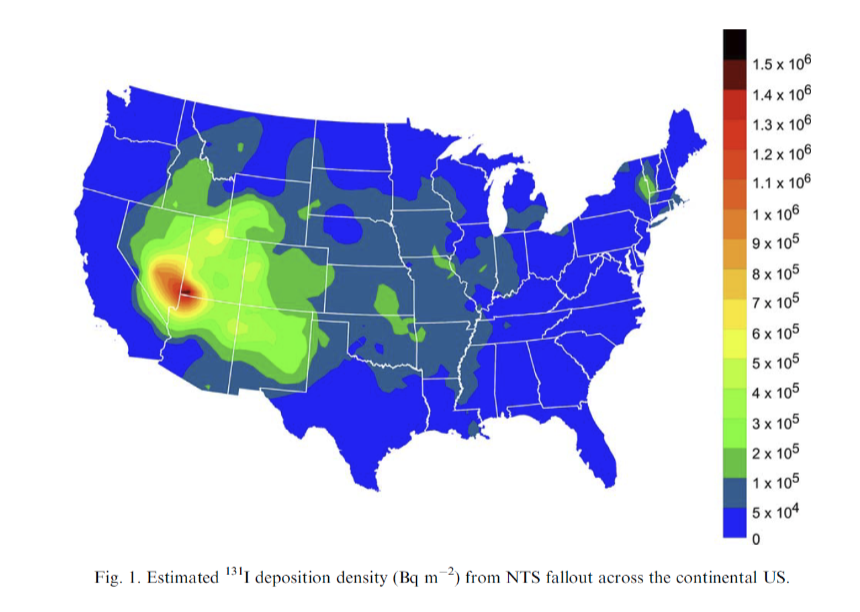
Which process described below allowed radioactive fallout from the Nevada Test Site to reach the Northeast, specifically upstate New York and Vermont?
A. A temperature inversion formed in the atmosphere above the Northeast, trapping radioactive particles near earth’s surface, where they were then deposited
B. Trade winds carried radioactive particles to the Northeast, where they were dry deposited onto the canopy
C. Radioactive particles in the atmosphere were absorbed through the stomata of leaves, accumulating in vegetation in the Northeast
D. High levels of precipitation in the Northeast caused radioactive particles to be wet deposited onto vegetation, soil, and bodies of water