Chapter 7 - Chemical Quantities and Reactions
7.1 - The Mole
- One element mole contains a mixture of 6.02 x 10^23; a mole of a compound contains a mold of 6.02 * 10^23.
7.2 - Molar Mass
- Any substance has a molar mass (g/mole) equal to its numerical atomic mass in grams or the sum of the atomic masses, which were multiplied in a formula by their subscriptions.
7.3 - Calculations Using Molar Mass
- The molar mass is used as a factor in conversion to moles or to change certain moles to grams in grams.
7.4 - Equations for Chemical Reactions
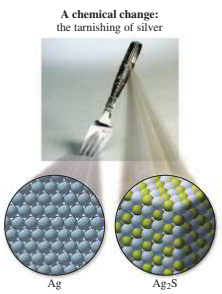
- When the atoms of the initial substances rearrange to form new substances, a chemical reaction occurs.
- The formulas of the substances which respond to a reaction arrow on the left and the products forming on the right side of the reaction arrow are shown by a chemical equation.
- In order to balance the atoms of each element of reactants and products, a chemical equation is balanced by writing coefficients, small whole numbers, in front of formulas.
7.5 - Types of Chemical Reactions
- Many chemical reactions can be organized according to the type of reaction: combination, decomposition, single substitution, double substitution, combustion.
7.6 - Oxidation–Reduction Reactions
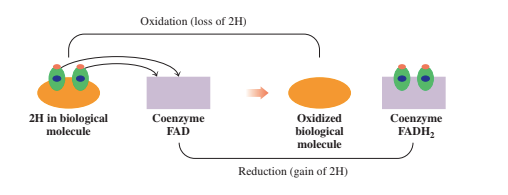
- It is oxidation – a reduction reaction when electrons are transferred in a reaction.
- One is losing electrons and another is gaining electrons
- The number of lost and acquired electrons is overall the same.
7.7 - Mole Relationships in Chemical Equations
- The total weight of reactants is equal to the total weight of products in a balanced equation.
- The factors used in an equation that describes the relation between mole/mole factors of any two components
- A mole-mole factor is used to find moles of a different substance in the reaction when the amount of moles in one substance is known.
7.8 - Mass Calculations for Chemical Reactions
- The molar masses and the mole-mole factors of the compounds are used to change the number of grams of a substance to the gram of a different substance in calculations using equations.
7.9 - Energy in Chemical Reactions
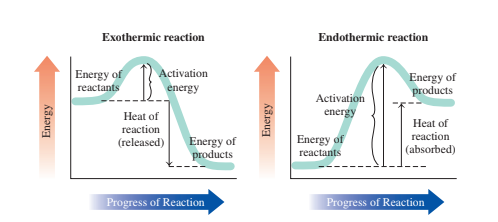
- The energy difference between the products and the reactants is the heat of the reaction in chemicals.
- Heat is released in an exothermal reaction because the energy of the products is lower than the energy of the reactants.
- Heat is absorbed during an endothermic reaction as the energy of the products is greater than the energy of the reactants
- The rate of response is the speed of conversion of the reactants to products.
- The rates of response can increase by increasing reactants levels, increasing the temperature, or adding a catalyst.