STERILIZATION AND DISINFECTION
INTRODUCTION
Microbes are ubiquitous and many microorganisms are associated with undesirable consequences, such as food spoilage and disease. Therefore, it is essential to kill a wide variety of microorganisms or inhibit their growth to minimize their destructive effects.
The goal is twofold: a) To destroy pathogens and prevent their transmission. b) To reduce or eliminate microorganisms responsible for the contamination of water, food, and other substances.
DEFINITION OF USED TERMS
STERILIZATION defined as a process by which an article, surface, or medium is freed of all living microorganisms either in the vegetative or in the spore state.
Sterile any material that has been subjected to process of sterilization.
Sterilant sterilizing agent because of their ability to destroy spores.
GERMICIDE also called a microbicide, is any chemical agent that kills pathogenic microorganisms. A germicide can be used on inanimate (nonliving) materials or on living tissue, but it ordinarily cannot kill resistant microbial cells.
Germicidal properties any physical or chemical agent that kills “germs”
DISINFECTION refers to the use of a chemical agent that destroys or removes all pathogenic organisms or organisms capable of giving rise to infection.
It is important to note that disinfectants are normally used only on inanimate objects because they can be toxic to human and other animal tissue, when used in higher concentrations. Examples of disinfection include: a) applying a solution of 5% bleach to examining table b) boiling food utensils used by a sick person c) immersing thermometers in an isopropyl alcohol solution between use.
Sepsis defined as the growth of microorganisms in the body or the presence of microbial toxins in blood and other tissues.
Asepsis refers to any practice that prevents the entry of infectious agents into sterile tissues and thus prevents infection.
Antiseptics Chemical agents called antiseptics are applied directly to the exposed body surfaces wounds, and surgical incisions to destroy or inhibit vegetative pathogens.
\ Examples of antisepsis include. a) preparing the skin before surgical incisions with iodine compounds b) swabbing an open root canal with hydrogen peroxide c) ordinary hand washing with a germicidal soap.
SANITIZATION is any cleansing technique that mechanically removes microorganisms (along with food debris) to reduce the level of contaminants.
Sanitizer is a compound (e.g., soap or detergent) that is used to perform this task.
Degerming procedures procedure often necessary to reduce the numbers of microbes on the human skin.
This process usually involves scrubbing the skin or immersing it in chemicals, or both. It also emulsifies oils that lie on the outer cutaneous layer and mechanically removes potential pathogens from the outer layers of the skin.
Examples of degerming procedures are: a) surgical hand scrub b) application of alcohol wipes to the skin c) cleansing of a wound with germicidal soap and water
STERILIZATION
A. PHYSICAL METHODS
Physical methods of sterilization include the following:
- Sunlight
- Heat
- Filtration
- Radiation
- Sound (sonic) waves
\
1. Sunlight
Direct sunlight is a natural method of sterilization of water in tanks, rivers, and lakes. Direct sunlight has an active germicidal effect due to its content of ultraviolet and heat rays. Bacteria present in natural water sources are rapidly destroyed by exposure to sunlight.
\
2. Heat
Heat is the most dependable method of sterilization and is usually the method of choice unless contraindicated. As a rule, higher temperatures (exceeding the maximum) are microbicidal, whereas lower temperatures (below the minimum) tend to have inhibitory or microbistatic effects. Two types of physical heat are used in sterilization—moist and dry heat.
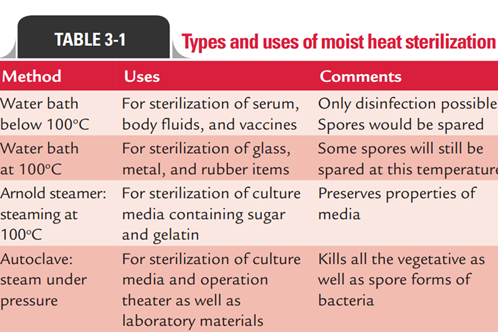
\ Sterilization by moist heat can be classified as follows:
a) Sterilization at a temperature <100°C
Ex: Pasteurization
b) Sterilization at a temperature of 100°C
Ex: Boiling
c) Sterilization at a temperature >100°C
Ex: Autoclave
d) Intermittent sterilization
Ex: Tyndallization
\
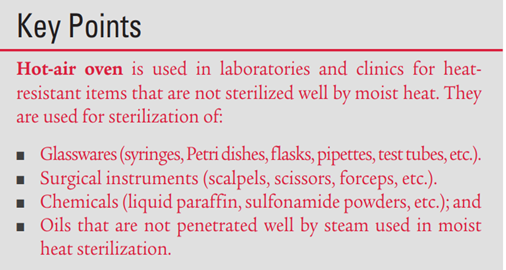
Sterilization by dry heat can be classified as follows:
a.) Flaming
b.) Incineration
c.) Hot-air oven
\
3. Filtration
Filtration is an excellent way to reduce the microbial population in solutions of heat-labile material by use of a variety of filters. Filters are used to sterilize these heat-labile solutions. Filters simply remove contaminating microorganisms from solutions rather than directly destroying them.
\ a) Depth filters
Depth filters consist of fibrous or granular materials that have been bonded into a thick layer filled with twisting channels of small diameter.
Examples:
· Candle filters
· Asbestos filters
· Sintered glass filters
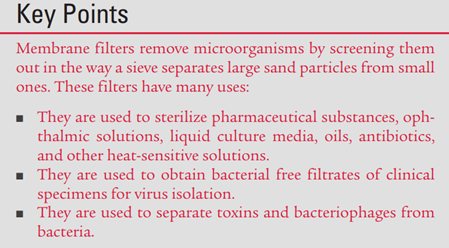
\ b) Membrane filters
4. Radiations
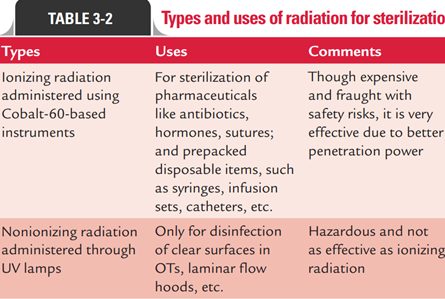
a) Ionizing radiations
· X-rays
· Gamma rays
· Cosmic rays
b) Nonionizing radiations
· Infrared radiations
· Ultraviolet radiation
\
5. Sound (sonic) waves
High-frequency sound (sonic) waves beyond the sensitivity of the human ear are known to disrupt cells. Sonication transmits vibrations through a water-filled chamber (sonicator) to induce pressure changes and create intense points of turbulence that can stress and burst cells in the vicinity. Sonication also forcefully dislodges foreign matter from objects. Heat generated by the sonic waves (up to 80°C) also appears to contribute to the antimicrobial action.
B. CHEMICAL METHODS
Several chemical agents are used as antiseptics as well as disinfectants. All these chemical agents (e.g., alcohols, aldehydes, etc.) are described later in detail under disinfection.
DISINFECTION Disinfection is the process of inactivating microorganisms by direct exposure to chemical or physical agents. Differences between sterilization and disinfection: • Disinfectants are products or biocides that destroy or inhibit the growth of microorganisms on inanimate objects or surfaces. Disinfectants can be sporistatic but are not necessarily sporicidal. • Antiseptics are biocides or products that destroy or inhibit the growth of microorganisms in or on living tissue.
ACTION OF DISINFECTANTS • They produce damage to the cell wall and alter permeability of the cell membrane, resulting in exposure, damage, or loss of the cellular contents. • They alter proteins and form protein salts or cause coagulation of proteins. • They inhibit enzyme action and inhibit nucleic acid synthesis or alter nucleic acid molecules. • cause oxidation or hydrolysis.
FACTORS AFFECTING THEIR ACTIVITY a) Temperature b) Type of microorganism c) Physiological state of cell d) Environment
\ TYPES OF DISINFECTANTS
- PHENOLIC COMPOUNDS
a) Phenol b) Cresol c) Halogenated Diphenyl
\
- HALOGENS
Halogens are fluorine, bromine, chlorine, and iodine—a group of nonmetallic elements that commonly occur in minerals, sea water, and salts.
\
- ALCOHOLS
Ethyl alcohol and isopropyl alcohol are the two most popular alcohol germicides. They are effective at a concentration of 60–70% in water. They act by denaturing bacterial proteins and possibly by dissolving membrane lipids. They are used as skin antiseptics.
\
- ALDEHYDES
The Formaldehyde and glutaraldehyde are the two most used aldehydes that are used as disinfectants. They are highly reactive molecules that combine with nucleic and alkylating molecules. They are sporicidal and can also be used as chemical sterilant.
\
- GASES
Various gaseous agents are used for sterilization of large volume of heat-sensitive disposable items and also instruments. Ethylene oxide, formaldehyde gas, and beta propiolactone are frequently used gaseous agents.
\
- SURFACE ACTIVE
a) Cationic surface-active agents b) Anionic surface-active agents c) Nonionic surface-active agents d) Amphoteric compounds
\
- OXIDIZING AGENTS
This group includes halogens, hydrogen peroxide, potassium permanganate, and sodium perborate. They are good disinfectants and antiseptics but are less effective in the presence of organic matter.
\
- DYES
a) Acridine dyes b) Aniline dyes
\
- HEAVY METALS
Soluble salts of mercury, silver, copper, arsenic, and other heavy metals have antibacterial activity, both bactericidal and bacteriostatic. They combine with proteins, often with their sulfhydryl groups and inactivate them. They may also precipitate cell proteins. Silver compounds are widely used as antiseptics.
\
- ACIDS AND ALKALIS
Acids (such as sulfuric acid, nitric acid, hydrochloric acid, and benzoic acid) and alkalis (like potassium and sodium hydroxide and ammonium hydroxide) are germicidal in nature. They kill microorganisms by hydrolysis and altering the pH of the medium.