task 2.3
CHAPTER 9, SECTIONS 9.1 to 9.3
The following information is from the book Student’s Guide to Foundations Writing at the University of Arizona. It gives a foundation for doing research and future classes by following a process for developing a research topic and question, looking into and keeping track of sources and, finally, writing an annotated bibliography.
Every research project requires that you complete secondary research or information discovered about the topic created by other writers; on the other hand, the project might additionally required that you complete primary research or interrogate the main subjects and collect data from there by themselves.
If you are using the main library at the University of Arizona's Library website, you can consult with librarians via the information Commons reference desk or the chat function on the website. You might also want to schedule an appointment to meet with a member of the library staff. These librarians are trained in evaluating and finding information and will provide a valuable asset to your college career. You can find core specific resources by looking under the “Research by Course” tab.
FW - foundations writing
Debatable topics - topics that has more than one point of views
Debatable topics, first, stimulate some sort of argument or they go beyond reporting undisputed facts. Then, you will find that others have written enough about this topic for you to be able to locate more than one perspectives to inform your understanding of the issues at hand. It's important to find a grand topic that others have published information about but also narrow enough for you to pinpoint the most vital sources and arguments before the deadline. You might prefer to read a few encyclopedic entries and introductory articles about the broader topic to provide to yourself a basic layout of information from where you can investigate more nuanced issues.
3A TO 3B - HOW CAN I DRAFT MY RESEARCH QUESTION?
Have you start to generate ideas for a research question, ask whether what you've discovered about the issue has altered your comprehension of your writing situation. Then ask what would you like to learn now. Maria are you asking these questions, think about how disciplinary or professional questions might alter the questions you can ask.
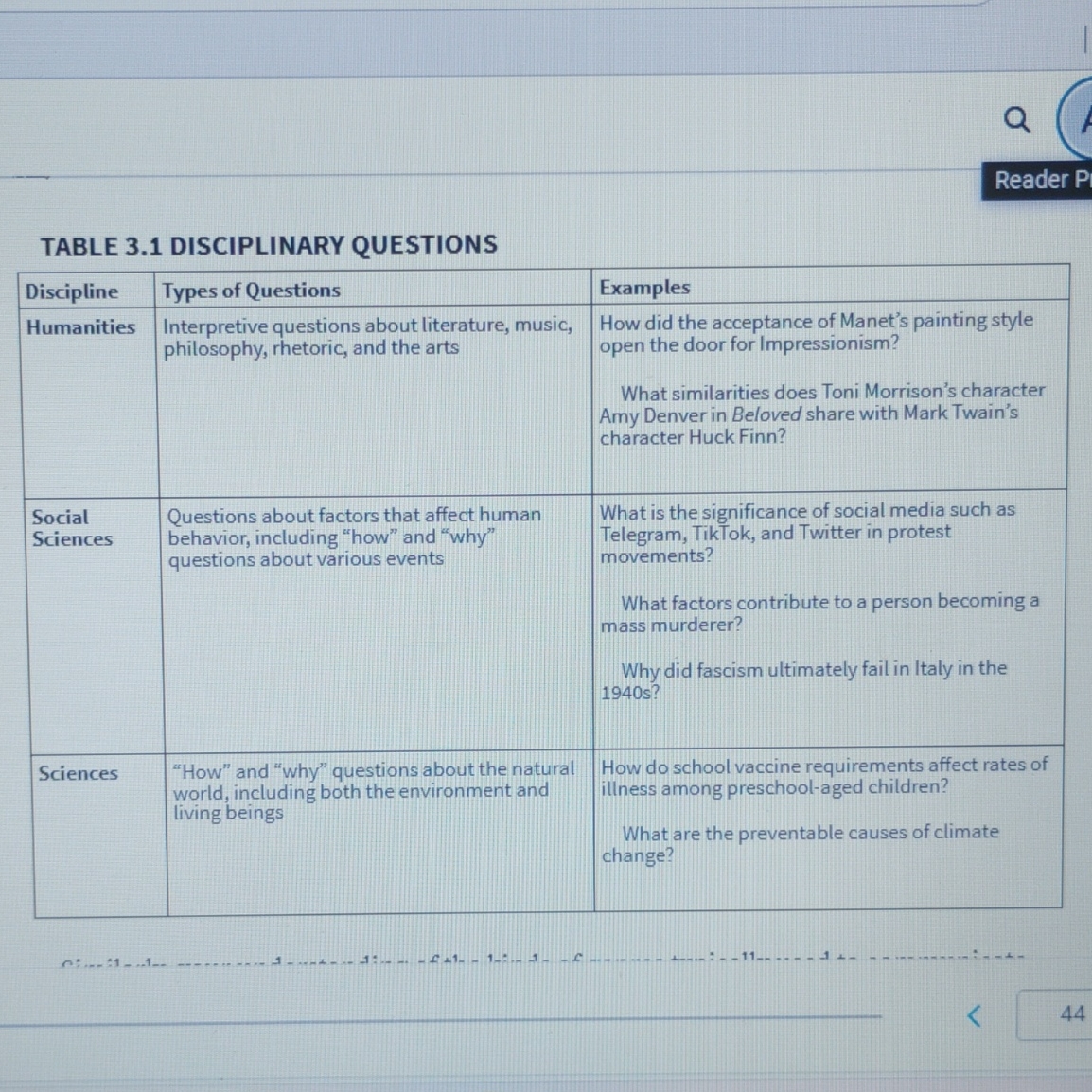
Additionally, your knowledge of the kinds of genres commonly used to educate within the discipline or profession will alter your work on your research question. For example, some genres like books or longer reports, are well used for broader questions. Others, due to their comparative brevity (e.g., postal questions, essays, conference presentations and reports) better used to highly focused research questions.
Reflect On Your Purpose and Role
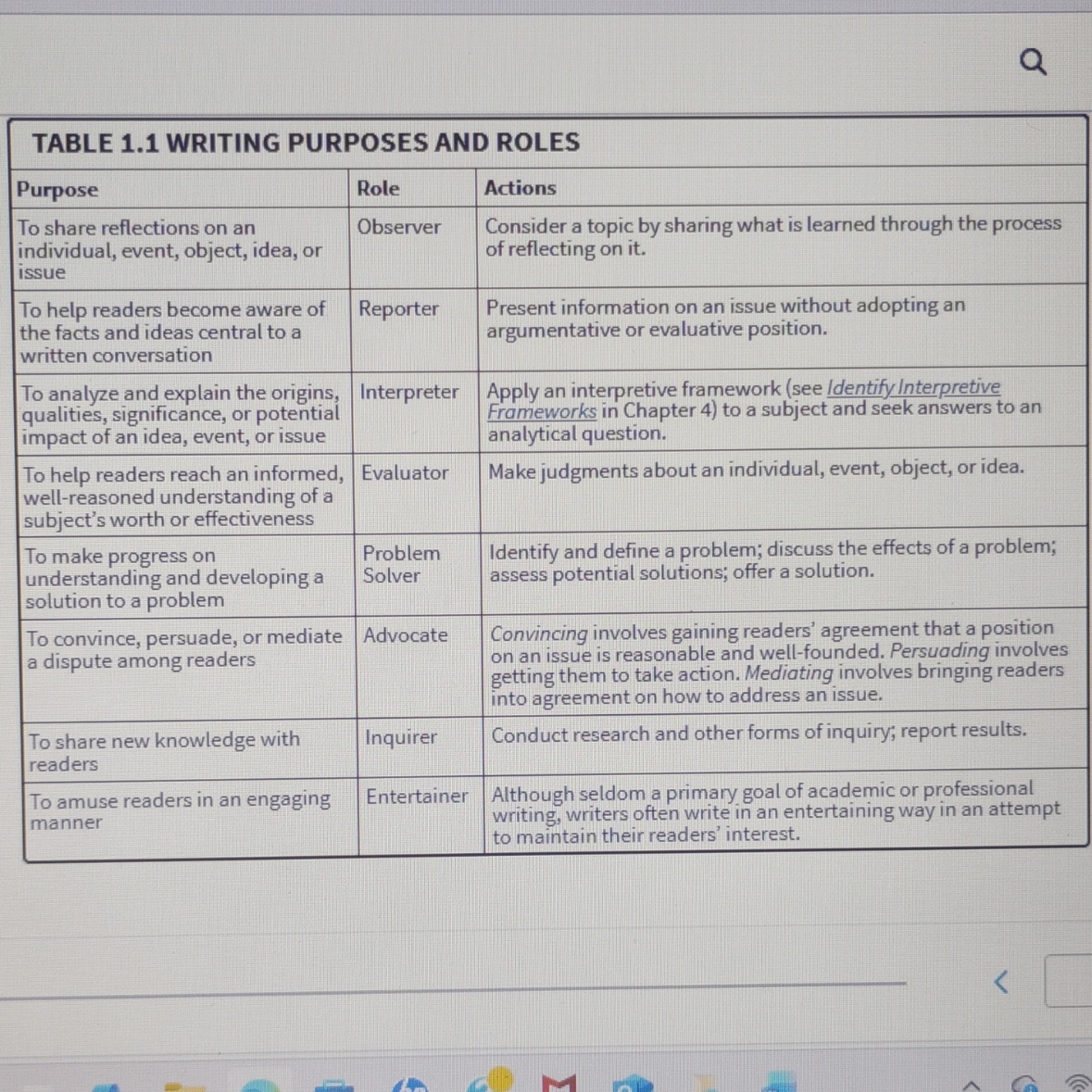
As a writer, you will adopt a role you will play for your audience. Additionally, this roll will have a significant impact on your choices relating to your research question. The following provides some of the roles and purpose you may adopt and give examples of the kinds of questions writers in specific roles might say.
To inform
Reporter, “What is knows — and not known — about ______? How might we define ______?”
To create and share new knowledge
Inquire, “What causes ______? What are the effects of ______? What can [cure/repair/prevent] ______?”
To reflect
Observer, “What are the implications of ______? How can we learn from the example of [an individual or a group]? What can we gain from thinking about [an idea, a work of art, a work of literature, or a performance]?
To evaluate
Evaluator, “What conclusions — merited or not — have writers and readers already made about ______? What assumptions are shaping current thinking about ______? What are the best choices available for addressing ______? What are the relative strengths and weaknesses of ______?”
To analyze
Interpreter, “what has occurred in the past that is relevant to ______? What causes ______? What are the effects of ______? Does the data suggest that ______ [is/is the result of] a trend? What is likely to happen [to / as a result of ______? In what ways is ______ similar to ______? In what ways does ______ differ from ______?
To solve problems
Problem Solver, “Why is a problem ______? What is the best solution to ______? Why should we adopt ______ as a solution to ______?
To convince, persuade or mediate
Advocate, “What are the origins of this argument? What is the status of this argument? Who has made the best arguments about ______? What do the writers and readers involved in conversation about ______ want to [see happen/not happen]? What should be done about ______? How should ______ be accomplished? How can we find common ground about ______?
Look for Gaps in the Conversation
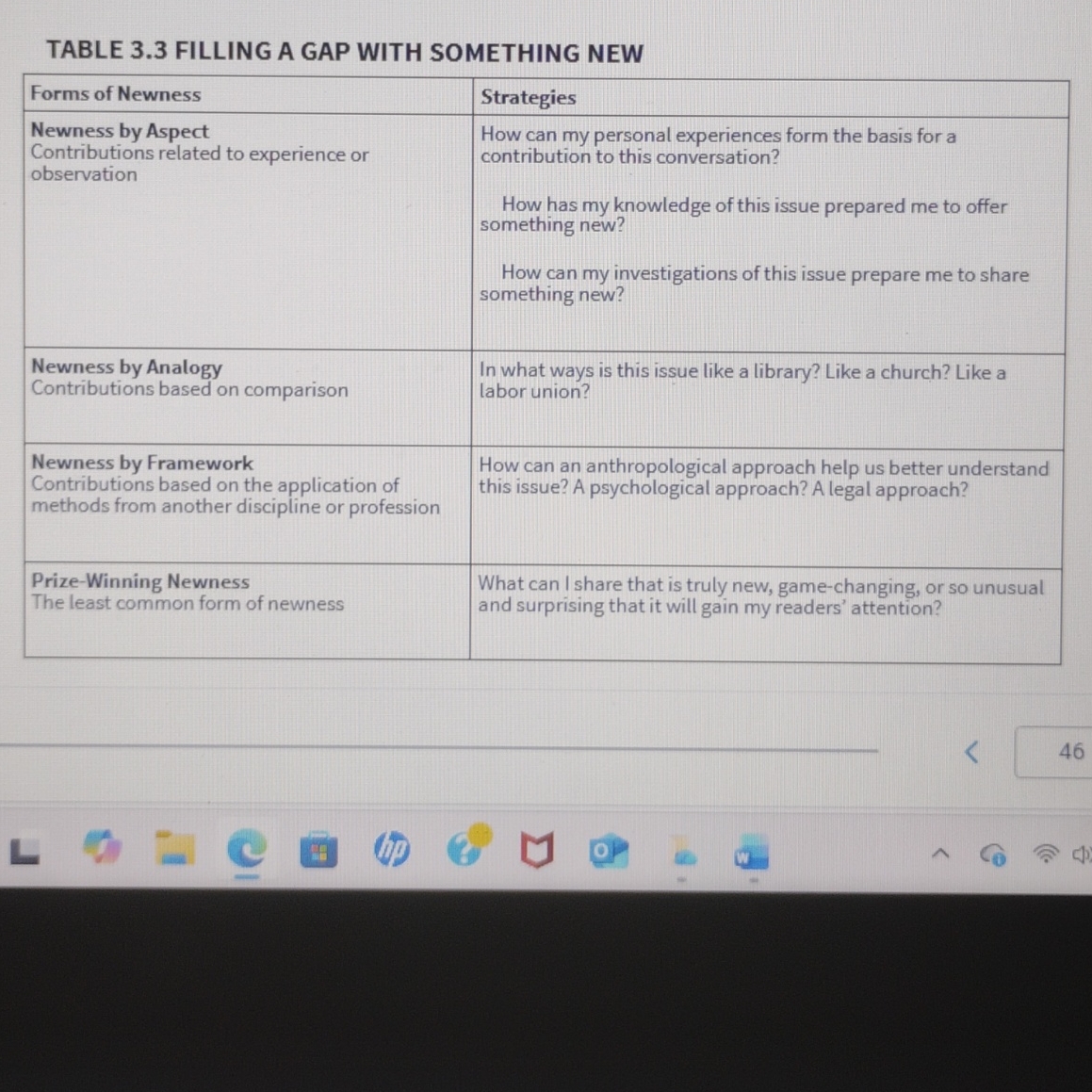
Think about where you might offer something new the topic. You don't have to, but you should offer something of value to your audience. The following image uses a method to newness developed by David Kaufer, Cheryl Geisler and Christine Neuwirth.
Focus on an Aspect of Your Issue
You can formulate potential research questions by using looping (writing for a set amount of time, reading what you've written, identifying one key idea of what you've written and writing again for a certain amount of time with the new key idea as your beginning point), freewriting (writing full sentences quickly without stopping and altering what you write), the general questions and table 3.2, the sentence starters (prompts that need blanks filled in) and the question matrix in table 3.4 on page 50 in the Bedford Researcher Book. Brainstorming is lifting ideas as they come to you. This should not contain complete sentences; as a matter of fact, brainstorming is better when you stay away from Pennsylvania self. Even though you'll end up using only asylum out of ideas you generate during brainstorming, don't worry about organizing these ideas until later on. As you create potential questions, consider your rules, the general areas of aim within the problem you've decided to talk about and gaps in the conversation about that problem. The following areas usually lead to helpful lines of inquiry:
Information: what is known — not known — about an issue?
History: what has occurred in regards to the issue?
Assumptions: what conclusions — merited or not —have readers and writers perceive about an issue?
Goals: what do readers and writers concerned about the conversation about the problem want (or not want) to happen?
Outcomes: what has happened already? What will most likely happen?
Policies: what are the best tools or methods to use for carrying out actions (for making decisions)?
Well thinking about your issue and the rule, you can create questions by exploring the intersections between these aspects of your issue and specific analytically thinking processes:
Definition: describe specific aspects of the issue
Causes and effects: ask what leads to a specific result
Trends: ask about sequences of events
Relationships: examine connections between aspects of an issue
Similarities and differences: compare and contrast
Strengthen weaknesses: access relative merits
Choose and Focus Your Research Question
Choose a research question that might fill a gap in the conversation, is appropriate for your research writing situation and interests you.
Too broad example: how did real estate development in the US Midwest affect the environment during the 20th century?
Too narrow example: in what ways have source-points pollution of the Minnesota River affected the profit margins of women-owned metal fabrication companies in the Mankato area?
Balanced focus example: how can we best address drinking water problems caused by the release of polluted lake water into rivers and estuaries in the upper midwest?
Hold it specific question words can help you create a more narrowed research question. For example, if you're striving to conduct an analysis, you might use the words what, why, when, where, who and how. Words for informing readers include would or could. Use the word should for conversations aimed to determine an appropriate course of action.
How Can I Refine Mr Research Question?
Limit the focus of your research question.
Example:
Original research question
What is behind the increased popularity of women's sports?
Refined
What had led to the increased popularity of women's sports and colleges and universities?
Look at shared assumptions and current conditions. In other words, narrow your research question by using qualifying phrases and words so now we're at school by focusing on assumptions that have been developed by the community of readers and writers who are addressing your issue and by referring to current conditions in regards to your issue.
Conduct Preliminary Searches
One great way to test your research question is to conduct some preliminary searches in the library database or catalog or on the web. If you find a lot of information in your searches, you might need to revise your question so it can focus more on manageable aspects of the issue. On the other hand, if you find nothing in your search, you might need to broaden the school of your research question.
Example:
Featured writer: Nicolette Brady
Topic: wetlands ecology
Issue: impact on beavers on wetland ecosystems and other species
Initial research question: what do readers need to know about the rule of beavers in wetland ecosystems?
Final Research Question: what do individuals need to know to develop an informed understanding of the critical role played by beavers in North America and watersheds?
DEVELOPING A RESEARCH QUESTION
Pick a topic: (e.g., women in politics)
Narrow the topic: (e.g., how they vote, women politicians, differences from Men, women voters, numbers of, factors affecting, etc)
Ask som questions (e.g., why do some countries have more women politician than others? What barriers hinder women entering politics?)
Pick a question (e.g., why do some countries have more women politicians than others?)
Focus the question (e.g., Who? What? When? When?)
Let's narrow the question some more:
Original
Why do some countries have more women politicians than others?
More focused
Why does Sweden have more women politicians at the national level than Canada?
Good Research Questions Criteria
One issue only
Requires analysis (how, why)
Specific, focused
No vague words
What do you do with your research question?
You conduct research to locate the answer to your question. The information needed for the more focused question above are:
Statistics
Reasons: Sweden
Differences: Canada
Your thesis is the answer to your question concluded into one sentence. (E.g., Sweden's electoral system encourages the participation of women in politics better than Canada's)