Unit 1 notes
Paleolithic- Old Stone Age
hunters/gathers
small portable structures
Mesolithic- Middle Stone Age
Period of settled communities
Inventions like the bow and arrow, pottery, domestication of animals
Neolithic- Stone Age
People cultivated the earth and raised livestock
Lived in organized settlements
Divided labor into occupations
Constructed first homes
Climate stabilized
People created/drew
CAMELID SACRUM
In the shape of a canine
14000-7000BCE, bone, National Museum of Anthropology, Mexico
Bone Sculpture from a camel-like animal
Sacrum is a triangular bone at the base of the spine
Bone has been worked to create the image of a dog or wolf
One natural form used to take the shape of another
Mesoamerican idea that sacrum is a second skull
Found in 1870
Later artwork and literature of Mesoamerica includes dogs associated with burial and sacrificial rituals as well as in creation myths
ANTHROPORPHIC STELE
4th millennium BCE sandstone, Pergamon Museum, Berlin
One of the earliest known works of art from Arabia
Found in an area that had extensive trade routes
Religious burial purpose
Belted robe from which hangs a double-bladed knife or sword
Anthropomorphic: Resembles human form but is not
Stele: An upright stone slab used to mark a grave or site
JADE CONG

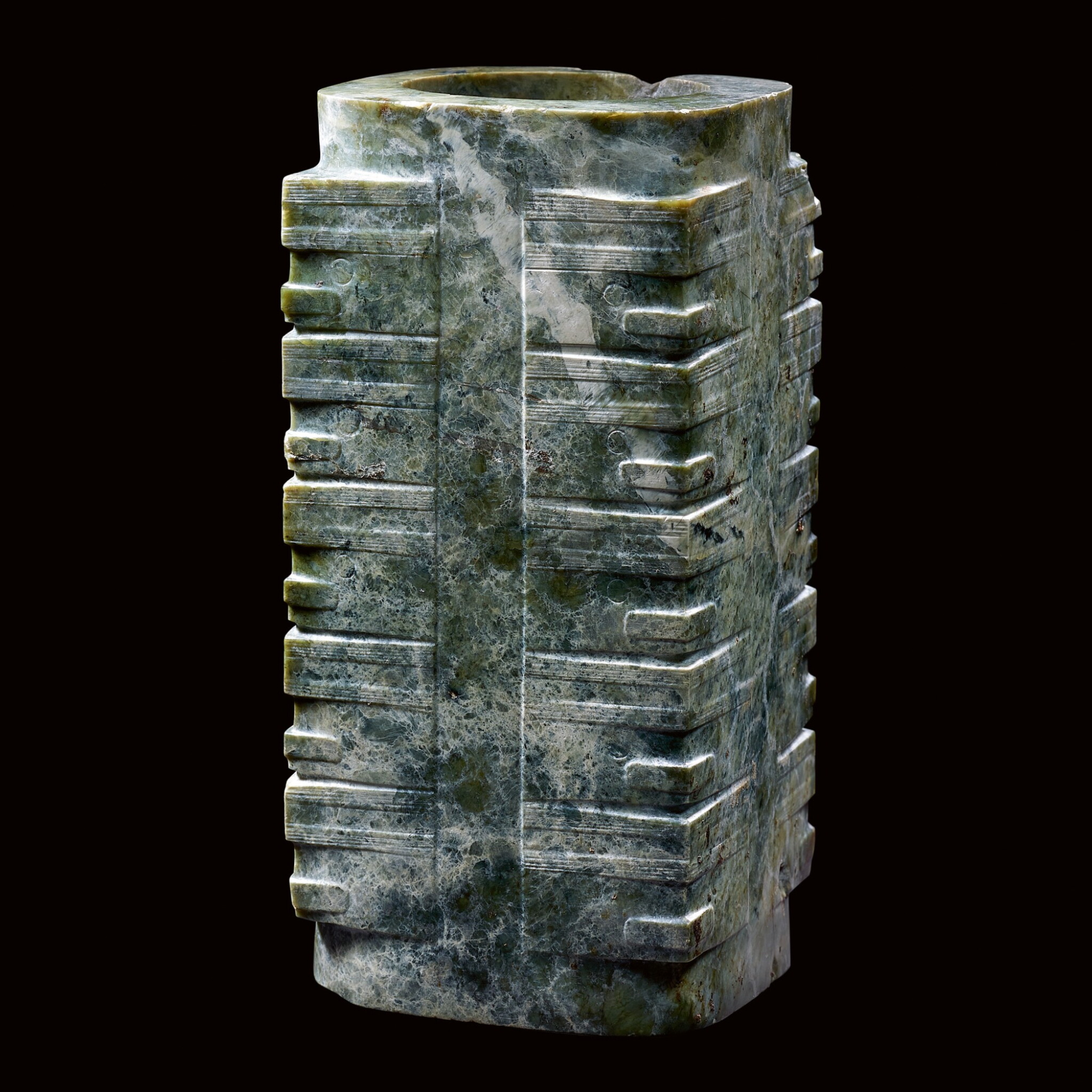
From Liangzhu, China, 3300-2200 BCE, jade, Zhejiang Institute of Archaeology,
HangzhouA circular hole placed within a song (square)
Abstract designs, main decorations is a face pattern, perhaps of spirits or deities
4 corners of the cong usually carry mask-like images with pronounces eyes and a fanged mouth
Jades appear in burials of people of high rank
Jade religious objects found within tombs, interred with the dead in elaborate rituals
Chinese linked jade with virtues such as durability, subtlety, beauty
Placed in a burial around bodies, some broken, some show signs of international burning
Made in a Neolithic era in China
THE AMBUM STONE FROM PAPUA NEW GUINEA
//national-gallery-of-australia/media/dd/images/40724_pm_-_Aubum_stone.jpg)
C. 1500B.C.E., greywacke, National Gallery of Australia, Canberra
Stone Age work, artists used stone to carve stone (Oceanic)
Composite human/animal figure; perhaps an anteater head and a human body
(Composite: made up of various parts or elements)
(Zoomorphic: having or resembling animal forms)
Theories:
Masked humans, spirit beings, or ancestors
Anteater embryo in fetal position
Anteaters are thought of as significant because of their fat deposits
It may have a ritual purpose
Stylized eyes, ears, and nostrils are depicted in relief (Stylized art is a form that has moved away from natural forms and shapes.)
TLATICO FEMALE FIGURES

C.1200-900 B.C.E, ceramics, Princeton University Art Museum, Princeton
Tlatilco, Mexico, noted for pottery
Many shapes & forms: male & female, couples, genre scenes, ball playing games, animals, imaginary creatures, etc.
Found in graves amidst remains.
Female figures show elaborate details of hairstyles, clothing, & body ornaments
Many show deformities including the 2-headed females: perhaps signifying a cluster of conjoined twins; stillborn
Theories that they show bifacial images, & therefore would show the first evidence of congenital defects
May have had a shamanistic function
Style: flipper-like arms, huge thighs, pronounces hips, narrow waists, unclothed except for jewelry; arms extend
TERRA-COTTA FRAGMENT (laptipa, from the solomon islands
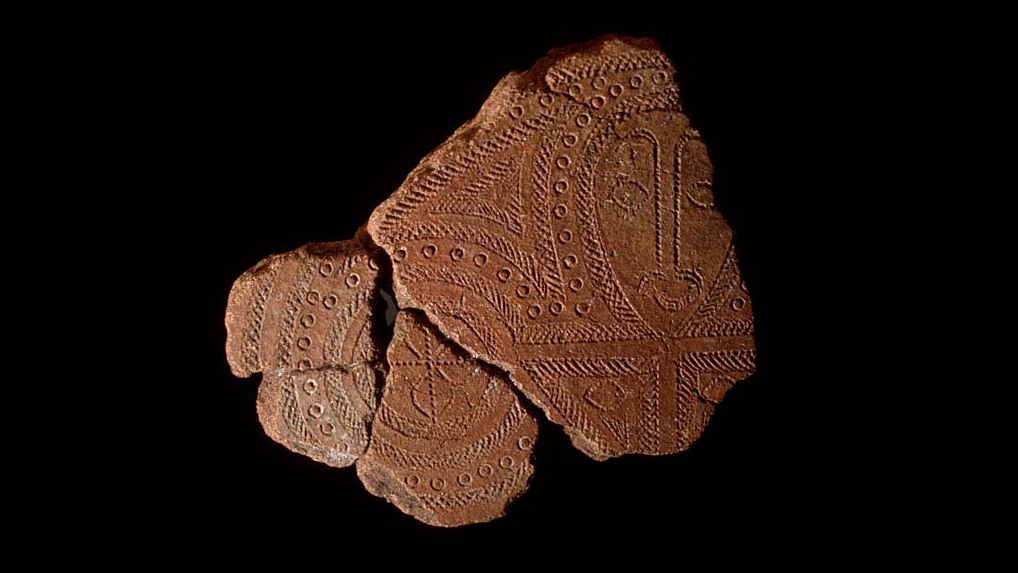
1000B.C.E., terra cotta, University of Aukland, New Zealand
Lapita culture of the Solomon Islands, known for their pottery
May have been used for serving or storing food
Characteristics use of curved stamped patterns: dots, circles, hatching
Outlined forms: used a comb-like tool to stamp designs onto the clay
One of the oldest human faces in Oceanic Art
PREHISTORIC PAINTING
Images of animals dominate with black outlines, sometimes deeply recessed from their openings. Images appear to be placed about the cave surface with no relationship to one another.
Animals are depicted realistically & 3-dimensionally while humans are depicted as stick figures with little anatomical detail.
Handprints found mostly negative prints. (meaning that a hand was placed on the wall & paint blown or splattered all over it, leaving a silhouette.)
Handprints occasionally showed missing joints or fingers indicating that prehistoric people practiced voluntary mutilation, however, the thumb, the most essential finger, was never harmed.
APOLLO 11 STONES, ocher on stone, State Museum of Namibia, Windhoek, Namibia
c. 25,000-25,300 B.C.E.
Some of the world’s oldest works of art, found in
Wonderwerk Cave in NamibiaThe profile of an animal is seen in the profile and done in charcoal.
Several stone fragments were found
Named after Apollo 11 moon landing; a cave was discovered at the time of the moon landing.
The location supports the idea that humans began in Africa.
What were they used for?
LASCAUX CAVES, (HALLS OF BULLS
C15,000-13,000 B.C…
generational artwork
scaffolding
Natural products used to make paint; charcoal, Iron ore, plants 650 paintings: most common are cows, bull, horses, & deer (2,000 painted figures over 2,000 years)
Animals were placed deep Inside the cave, some hundreds of feet from the entrance
The animals are rendered In what has come to be called "twisted perspective," In which their bodies are depicted in people while we see the horns from a more frontal viewpoint the images are sometimes entirely linear -Iine was drawn to define the animal's contour.
frontal or diagonal view of horns, eyes, & hooves; some animals appear pregnant
Evidence still visible of scaffolding erected to get to higher areas of the caves (holes in walls)
Caves were not dwellings because prehistoric people led migratory lives following herds of animals; some evidence exists that people sought shelter at the mouths of caves Walls were scraped to an even surface; paint colors were bound with animal far; lamps lit the interior of the caves; flat stones served as palettes
There are many theories about the reasons for the paintings:
~ Used to ensure a successful hunt (express the importance of animals to human survival) Almals deplated larger than men-size matters?
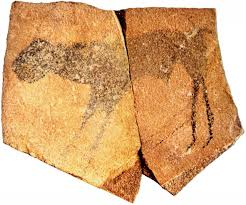
RUNNING HORNED WOMAN
6,000-4,000 B.C.., rock painting, Tassili n'Ajjer, Algeria
15,000 + drawings & engravings found at this sight
Composite view of the body (twisted perspective)
Depicts livestock (cows, sheep, etc.); wildlife(giraffes, lions)
humans (hunting and harvesting)
Some drawings are naturalistic (derived from nature or real life, or imitating it closely); some are abstract (not based on real life or realistic)
found on an isolated rock whose base was hollowed out Into several small shelters that could not have been used as dwellings. This remote location, coupled with an Image of marked pictorial quality-
depicting a female with two horns on her head, dots on her body probably representing scarification, and wearing such attributes of the dance as armlets and garters-suggested to him that the site, and the subject of the painting, fell outside of the everyday. More recent scholarship has supported the belief in the painting's symbolic, rather than literal, representation. Egyptian influence
BUSHEL WITH IBEX MOTIFS
4,200-3,500B.C.E., terra-cotta Louvre, Paris
Found near a burial site, but not with human remains or funerary object
Found with hundreds of baskets, bowls, & metallic items
Use of the potter’s wheel, a technological advance
Stylized ( non-realistic manner of representing the visible world & its contents) aquatic birds on top; below stylized running dogs with long narrow bodies
In the middle of the horns is a clan symbol of family ownership
Perhaps the image identifies the deceased as belonging to a particular group or family Made in Susa, in Southwestern Iranover anayzed old sippy cup
STONEHENGE
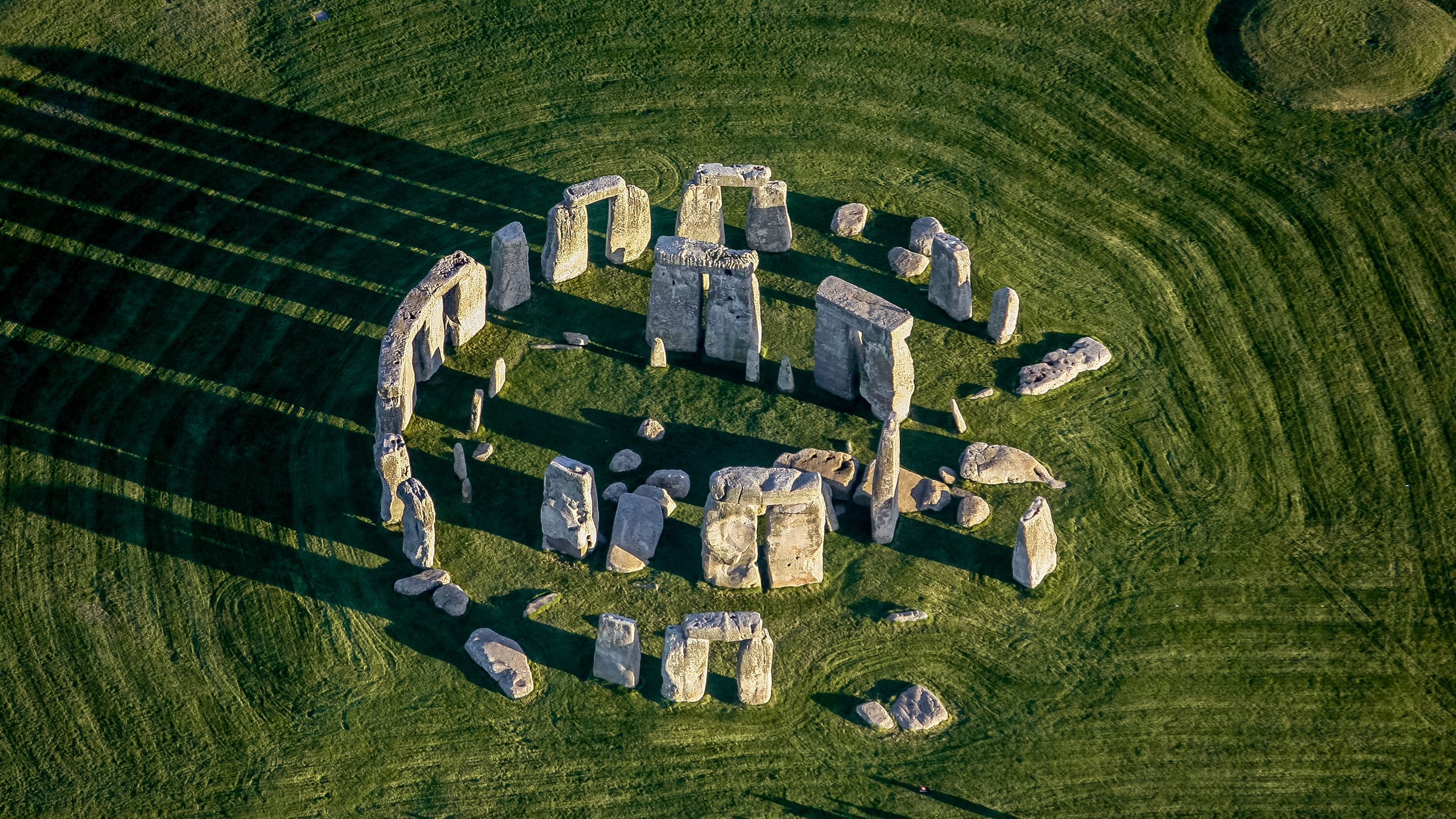
c.2500-1600B.C.E., sandstone, Wiltshire, England
what we see today is the result of at least 3 phases of construction?
2 Building components are...Post and Lintel structure
The People Buried at Stone Henge: analysis of these bones has revealed that nearly all the burials were of adult males, aged 25-40 years, in good health and with little sign of hard labor or disease. No doubt, to be interred at Stonehenge was a mark of elite status and these remains may well be those of some of the first political leaders of Great Britain
Some stones were over 50 tons and were Imported from areas over 250 miles away
Generally thought to be oriented toward sunrise on the longest day of the year; may also predict eclipses
New theory: the center of ceremonies concerning death & burial
Henge: Neolithic monument characterized by a circular ground plan