Lifespan Development
Continuous: Cumulative, gradual improvement on existing skills
Discontinuous: Unique stages occurring at specific times or ages, sudden changes
Nature: biology and genetics
Nurture: environment and culture
Your environment can turn genes “on” and “off” (epigenetics)… and your genes can regulate how much your environment affects you.
Lifespan Development Theories
Psychosexual Theory of Development: Personality develops during early childhood, and childhood experiences shape our personalities and behaviors for the rest of our lives.
Psychosocial theory of Development: Based on the social nature of our development.
Personality develops throughout the lifespan
Our interpersonal interactions shape our sense of self
We need to achieve competency in primary life tasks.
Cognitive Theory of Development: Thinking is the central aspect of development
Cognitive abilities develop through specific stages
Schema: mental models that are used to help us categorize and interpret information, or a pattern of thought or behavior that organizes information and the relationships among them.
Assimilation: Take in information that is comparable to what we already know
Accommodation: Changing your schemata based on new information
Piaget’s Stages of Cognitive Development
Age | Stage | Description | Developmental tasks |
0-2 | Sensorimotor | The world experienced through senses and actions | Object permanence Stranger anxiety |
2-6 | Preoperational | Use words and images to represent things, but lack logical reasoning | Pretend play, egocentrism, and language development |
7-11 | Concrete operational | Understand concrete events and analogies logically; perform arithmetical operations; can mentally manipulate information | Conservation, reversibility, and mathematical transformations |
11+ | Formal operational | Formal operations utilize abstract reasoning (hypothetical thinking) | Abstract logic Moral reasoning |
Sociocultural Theory of Development: The social world forms the basis for the formation of language and thought.
Intrapersonal and interpersonal experiences and interactions
Human development is rooted in one’s culture
Historical influences (that create culture) are key to development
The process of development is an interaction with the environment
Moral Theory of Development
A major phase beginning in childhood and continuing through adolescence is knowing right from wrong.
Proposes that moral development occurs in stages
Prenatal Stages of Development
Germinal Stage
Conception: Sperm fertilizes the egg and fuses
Zygote: Single-celled structure that forms upon conception and begins to divide through mitosis
Embryonic Stage
A cluster of cells travels down the fallopian tubes and implants into the uterine lining
Cells begin to specialize
Placenta: a structure that provides oxygen and nourishment via the umbilical cord
Fetal Stage
Sex organs differentiate
Internal organs continue to form and develop
Nearly fully developed around 36 weeks; premature complication risks are minimized
Fetus: embryo after 9 weeks of development
Age of viability: Around 24 weeks, when the fetus has a chance to survive outside the womb
Prenatal Influences
Teratogen: An environmental agent that causes harm to the fetus
Critical period: Specific periods of development where organs are particularly susceptible to teratogenic effects
Infancy and Childhood
Newborn Reflexes
Stepping: walking movement
Rooting: turning the mouth and head towards stimulation
Grasping: palm grasp for objects
Babinski: pantar grasp and ‘tickle.’
Moro: Startle reflex
Tonic neck: preparing for coordinated movement and crawling
Physical Development
Growth does not occur at a steady rate
Born with all our brain cells = nervous system continues to grow and develop.
Brain size increases rapidly
Motor development occurs in a sequence
Gross motor skills - movement and coordination of large muscle groups
Fine motor skills - movement and coordination of small actions with fingers, toes, and eyes
Temperament: innate traits, first displays of personality
Attachment: Connection or bond with others, especially caregivers
Attachment Styles
Secure: healthy attachment, caregiver as a secure base, preferred over a stranger
Avoidant: Child unresponsive to parent
Resistant: Clingy but rejects attempts for interactions from caregivers
Disorganized: Odd behavior when faced with a caregiver, common in cases of abuse
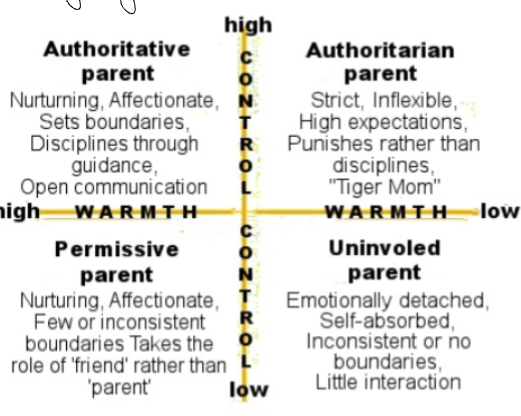
Parenting Styles