Unit 5 Heredity Study Guide
Genotype: set of genes that an organism has
Phenotype: set of traits that an organism expresses
Dominant: a trait that appears in every generation (not every individual)
Recessive: sufficiently rare trait that skips every other generation (almost all affected individuals have non-affected parents)
Heterozygous: having two different alleles of a particular gene or genes
Homozygous: having two identical alleles of a particular gene or genes
True-breeding: where parents produce an offspring who carries the same phenotype
Hybrid: the offspring of two plants or animals of different species or varieties
Diploid: cells with 2 sets of chromosomes
Haploid: a cell contains a single set of chromosomes
Homologous chromosomes: a pair of chromosomes that are similar in size and shape and carry the same genes
Mitosis vs. Meiosis
Mitosis
Occurs in all organisms (except viruses)
Creates all body (somatic) cells
Involves one cell division
Produces 2 diploid daughter cells
Daughter cells are genetically identical
Creates a human cell with 46 chromosomes
Meiosis
Occurs only in fungi, animals, and fungi
Creates only sex (germ) cells
Involves 2 successive cell divisions
Produces 4 haploid daughter cells
Daughter cells are genetically different
Creates a human cell with 23 chromosomes
Both
Occurs in plants and animals
Starts with a diploid parent cell
Produces new cells
Cells undergo DNA replication
Same basic steps
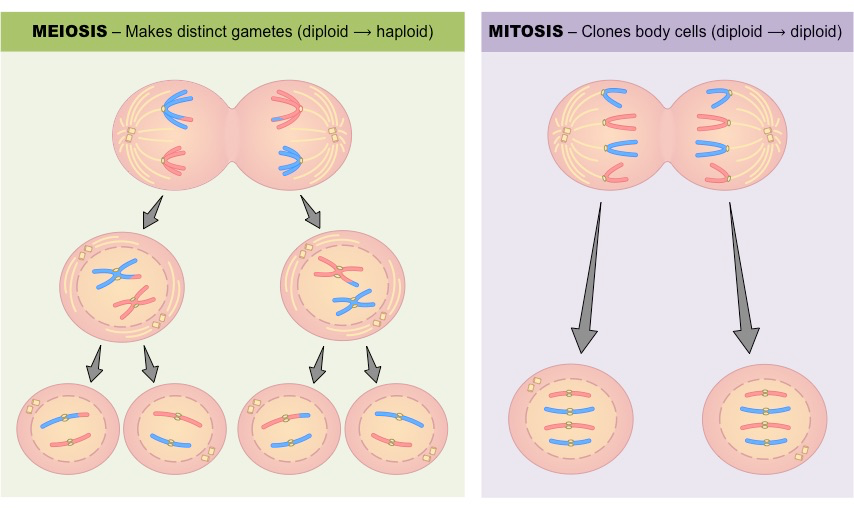
Meiosis: Genetic Variation (how and when)
Crossing Over: in prophase I, the reciprocal exchange of genetic material between nonsister chromatids during synapsis of meiosis I (recombinant chromosomes)
Random Fertilization: many different sperms paired up with many different egg cells which result in many diploid combinations
How do the movement of chromosomes during meiosis explain Mendel’s Law of Segregation of alleles and Mendel’s Law of Independent Assortment?
This law describes how the pair of alleles separate from one another during cellular meiosis division (gamete creation), leaving each gamete with only one allele. According to Mendel's law of independent assortment, genes sort independently of each other into gametes during meiosis. This occurs because chromosomes, on which the genes reside, assort independently during meiosis and crossovers cause most genes on the same chromosomes to also behave independently.
What is genetic linkage?
Refers to the closeness of genes or other DNA sequences to one another on the same sequence (map distance - units)
Practice Chi Square Problem
In mice, brown fur is dominant to white fur. A heterozygous brown mouse is mated to a white mouse. They produce 43 brown offspring and 47 white offspring. What is your null hypothesis? Are the observed numbers of offspring significantly different from the expected numbers? Why or why not? Show your work. (Brown Fur - B, White Fur - b)
H0: The amount of brown fur mice is equal to the amount of white fur mice. (No difference)
HA: There is more brown fur mice than the amount of white fur mice. (brown fur is dominant to white fur)
B | b | |
|---|---|---|
b | Bb | bb |
b | Bb | bb |
Observed | Expected | |
|---|---|---|
Brown Fur | 43 | 45 |
White Fur | 47 | 45 |
Total | 90 | 90 |
DF: 1 x^2: .178 c-value: 3.841
Since the x^2 value of .178 is less than the c-value of 3.841, then we would fail to reject the null hypothesis and conclude that the amount of brown fur mice is equal to the amount of white fur mice, therefore, brown fur is not dominant than white fur.
How can environment affect phenotype?
Environment affects phenotype by ultimately affects the diet, temperature, oxygen levels, humidity, light cycles, and the presence of mutagens. It can impact the way that an animal’s genes are expressed.
What is the difference between pleiotropy, epistasis, and genomic imprinting?
Pleiotropy: production by a single gene of two or more unrelated effects (occurs when a single gene determines multiple phenotypes)
Epistasis: the interaction of genes that are not alleles, in particular the suppression of the effect of one such gene by another (one gene affects the expression of another located at a different location)
Genomic Imprinting: the process by which only one copy of a gene in an individual (either from their mother or their father) is expressed, while the other copy is suppressed
Karyotypes & Interpreting them
Male or Female Chromosomes? (XY or XX)
Females - 46 chromosomes, Males - 46 chromosomes
Aneuploid: one or more extra or missing chromosomes leading to an unbalanced chromosome complement, or any chromosome number that is not an exact multiple of the haploid number
Pedigree Review
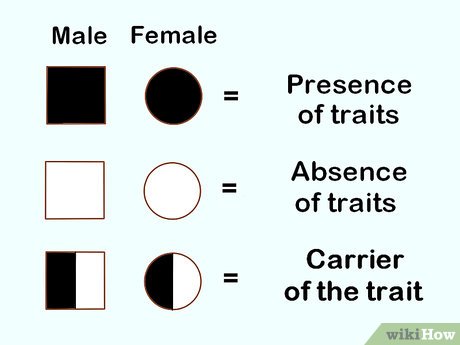
Questions to ask:
Is the trait dominant (doesn’t skip generation) or recessive (skips generations)?
Is the trait autosomal (doesn’t matter about gender) or sex-linked (more affected males/females than affected females/males)?
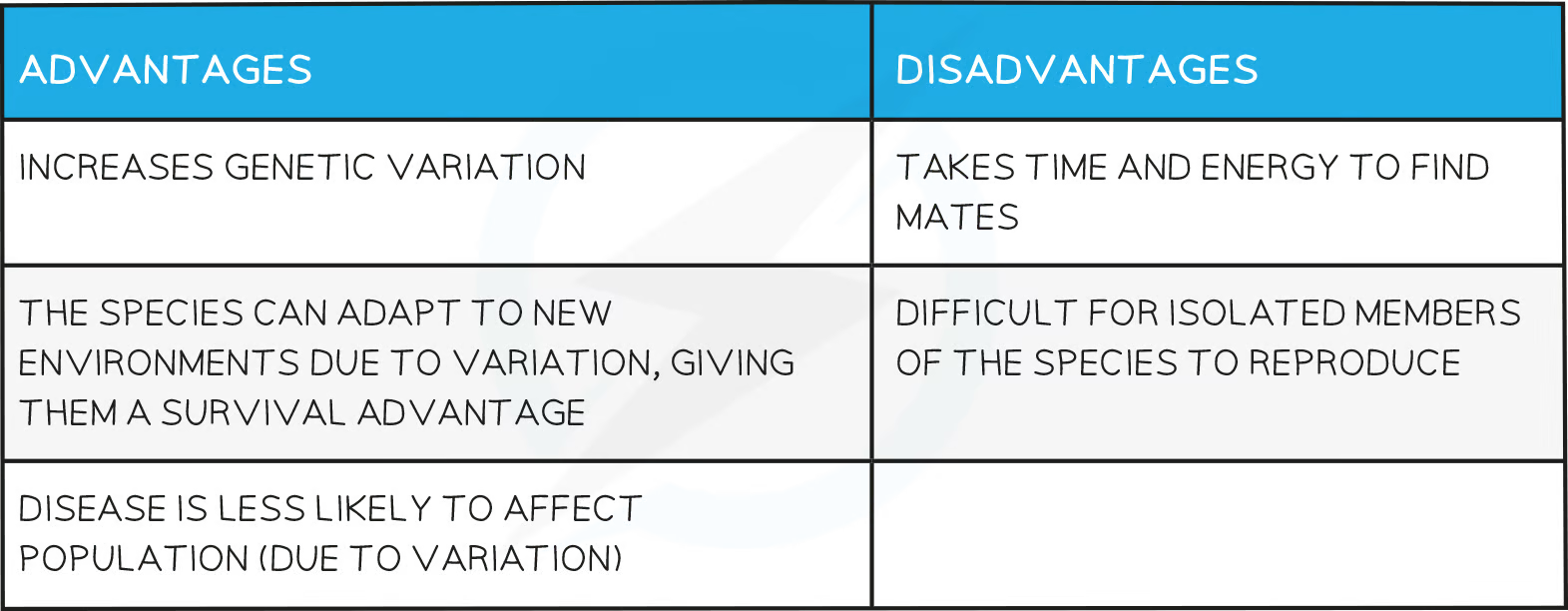
Advantages & Disadvantages of Sexual Reproduction
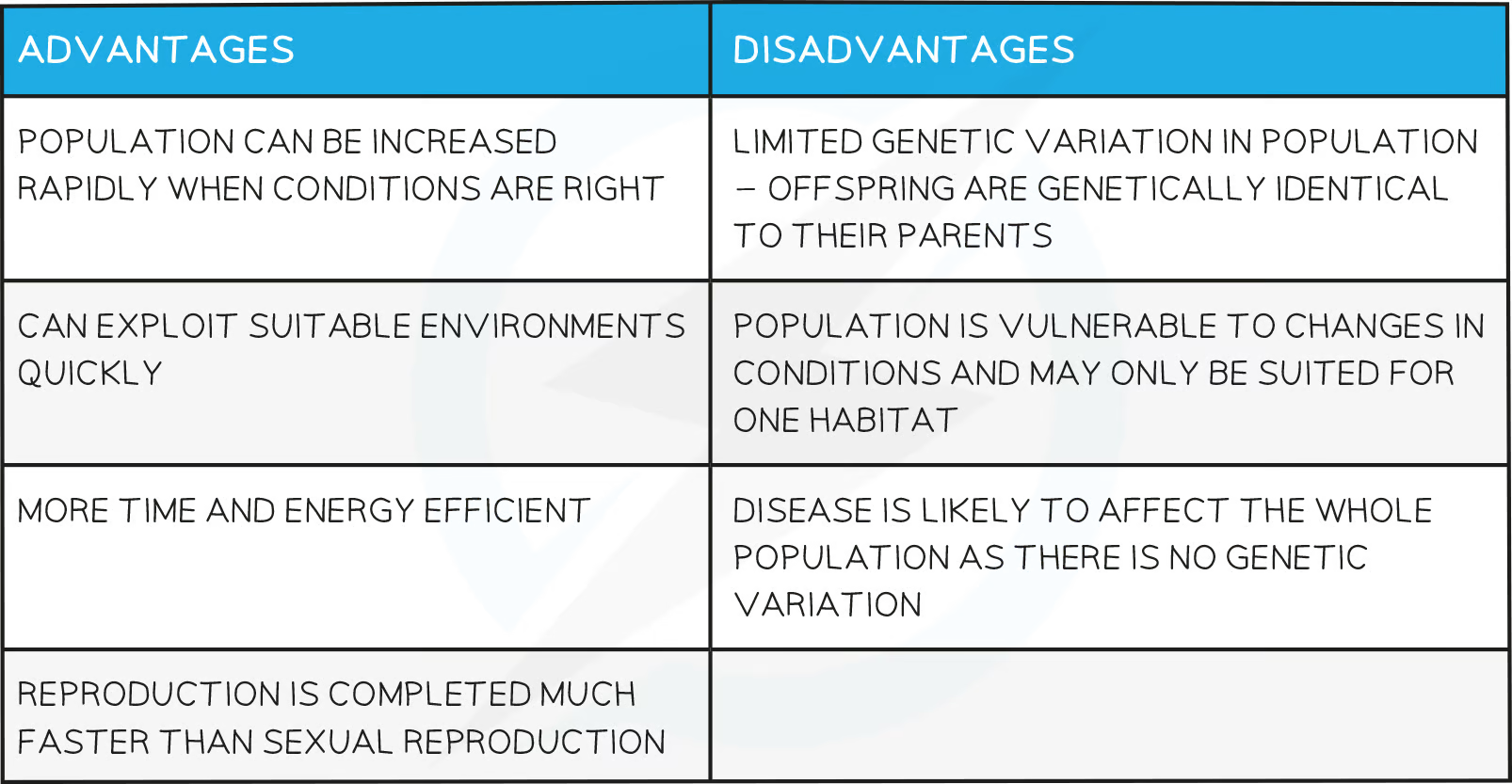
 Advantages & Disadvantages of Asexual Reproduction