Court systems-LSPL
Change at the top in ELS
The House of Lords ended its function as the highest domestic court in July 2009 where it was replaced by the new Supreme Court for the UK on 1st October 2009 however House of Lords decisions are still vital for study and frequently used.
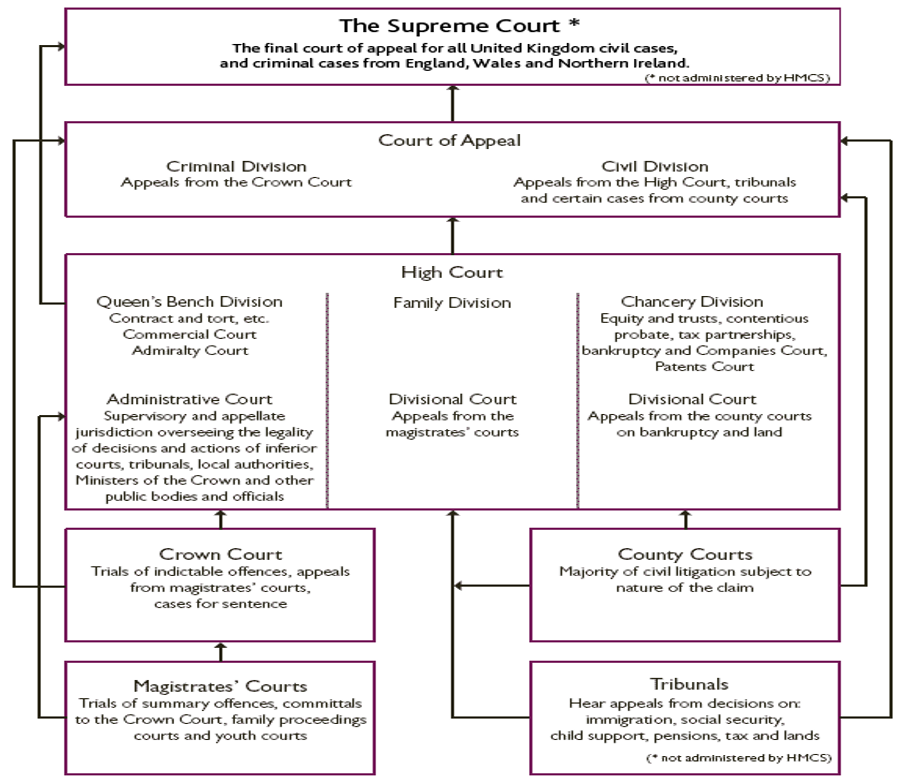
The system of courts in England and Wales
Most courts have both criminal and civil jurisdiction albeit one may have much more of one than the other. First instance jurisdiction is the first court to decide or rule on the case sometimes called the “trial court” and appellate jurisdiction means that the court hears appeals on the decisions made at first instance in lower court (courts may have both or one of these). Most courts are run by her Majesty’s Court Service this includes the Secretary of State for Justice which is the Lord Chancellor (executive), the Lord Chief Justice which is the head of Judiciary for England and Wales (judicial) and the Supreme Court which is not administered by HMCS.
House of Lords (Appellate Committee of the House of Lords)
Historically headed by the Lord Chancellor but in reality in final years, headed by senior law lord (final was one was Lord Philips who then became president of the Supreme Court). Five or seven (rarely nine) sat in on cases in the House of Lords.
The Supreme Court
Appellate court
Headed by the president of the Supreme Court
Final civil court of appeal in Scotland
Final civil and criminal court of appeal win England, Wales and Northern Ireland
Odd number of judges must sit in on a case- usually 5 or 7 but sometimes more on a case that will set an important precedent
Judges are justices of the supreme court
Court of Appeal
The court of Appeal is divided into two division which are criminal and civil. The civil division president is the Master of the Rolls (MR). The criminal division president is the Lord Chief Justice (LCJ). The Lord/Lady Justice's of appeal is Lady Justice Kaur (Kaur LJ).
High Court
The high court has three divisions, the Kings bench division headed by President, the chancery division headed by chancellor (formerly called the vice-chancellor), the family division headed by president.
The high court is staffed by High Court judges known as puisne judges who are generally assigned to one division such as Mr.Justice Singh (Singh J). They have appellate and original jurisdiction and one judge sits, sometimes two or three on appeals.
KBD of the High Court
The Kings Bench Division of the High Court are the first instance jurisdiction over contract and tort claims alongside the County Court. Cases are allocated on ‘tracks’ depending on the expense and complexity of the case.
The Divisional (appeal) Court is called the Administrative court and hears applications for judicial review, some appeals from the county court such as tort/contract and criminal appeals by way of case stated from the Magistrates court on a point of law.
The Kings Bench division civil list claims for damages in respect of personal injuries and fatal accidents, professional negligence including clinical negligence, nuisance, breach of contract, non-payment of a debt, false imprisonment and malicious prosecution , human rights and applications in relation to enforcement of judgements.
The Kings Bench Division Commercial Court specialise in the determination of commercial disputes, approximately 75% of this work is international. Parties whether domestic or foreign, corporate or international choose the commercial court due to its expertise in the efficient resolution of complex international business disputes.
Admiralty Court
The Admiralty Court deals with shipping and maritime disputes such as collision, salvage, carriage of cargo, limitation and mortgage disputes.
Technology and construction court
The technology and construction court is a specialist court consisting of specialist judges who deal with all types of construction, engineering and technology disputes from both within the UK and those which arise internationally. The work of the technology and construction court includes building, construction and engineering contract disputes; claims relating to design, supply and installation of computers, software and related network systems; professional negligence disputes relating to surveyors, engineering, architects, accountants and other specialist advisers in the construction, engineering and technology fields; claims relating to supply and provision of materials, goods, plant and other services, dilapidations claims as between landlord and tenant; environmental issues including pollution and reclamation, nuisance claims relating to land use, claims arising out of fires and explosions; public procurement (in all fields); enforcement of or challenges to adjudicators decisions arising out of the Housing Grants, Construction and Regeneration Act 1996 (as amended); challenges to decisions of arbitrators in the construction, engineering and technology fields; insurance disputes related to construction, engineering and technology; contractual disputes involving oil and gas installations, onshore and offshore.
Chancery Division
The chancery division deals with a number of issues including cases under the business list, financial list, competition list, insolvency and companies list, intellectual property list, property trust and probate list and revenue list.
Family Division
The family division of the High Court retains first instance jurisdiction over certain complex matters such as child abductions as well as certain decisions made by the family court.
County Court
Civil cases that the County Court deal with include businesses trying to recover money they are owed, individuals seeking compensation for injuries, landowners seeking orders that will prevent trespass.
Crown Court
The crown court deal with mainly criminal jurisdiction and at first instance tries cases on indictment before a jury. The judiciary in the crown court includes circuit judges, recorders, his/her/their honour also high court judge may also sit as well as they have appellate jurisdiction over appeals on matters of fact or sentence from magistrates. The crown court can also sentence those tried in the magistrates court.
Family Court
The family court deals with the validity of marriages, forced marriage, divorce, protection from domestic abuse and coercive and controlling behaviour as well as child protection, adoption and surrogacy.
Courts of Protection
The courts of protection decide whether a person ‘has capacity’ to make a particular decision for themselves. They make declarations, decisions or orders on financial or welfare matters affecting people who lack capacity to make these decisions and appoint a deputy to make ongoing decisions for people lacking capacity to make those decisions. The courts of protection decide whether a Lasting Power of Attorney (LPA) or Enduring Power of Attorney (EPA) is valid.
Magistrates Court
The Magistrates Court is the starting point for all criminal cases and deal with over 90% of criminal work, magistrates are Justices of the peace (lay citizens not trained lawyers) they sit in panels. District Judges in the Magistrate Court are professional judges who hear some cases firmly known as stipendiary Magistrates and they sit alone. The magistrates court also has some civil law jurisdiction such as granting licenses.
The Judicial Committee of the Privy Counsel
The Judiciary Committee of the Privy Counsel is an anachronism and it is Supreme Court personnel with a different jurisdiction, it is the highest court of appeal for many Commonwealth countries, UK overseas territories, crown dependencies and military sovereign base areas. They hear appeals from a number of ancient and ecclesiastical courts which include the Church Commissioners, Arches Court of Canterbury, Chancery Court of York, Court of Admiralty of the Cinque Ports.
The Court of Justice of the European Union (international court)
When the UK was part of the EU decisions of the ECJ (prior name) were binding on the courts of all member states in its areas of competence, in that way it became part of the legal system of every member state. When the Uk left the EU all such decisions remained valid and will continue to be good law until they are change by the UK Courts of Parliament
The European Court of Human Rights
Decisions made in the European Court of Human Rights are not binding on Uk courts, the rulings are directed to the state but the court cannot enforce them
Other courts and tribunals
Coroners Court, Employment tribunal, Employment Appeal Tribunal, First Tier Tribunal, Upper Tribunal