Enthalpy Changes
Overview:
Heat transfer
Endothermic vs exothermic
Energetic stability and direction
Measuring enthapy changes
Heat Transfer:
Heat is the process of energy transfer where energy is the measure of the ability to do work. When heat is transfered to a system it increses the average kinetic energy of the molecules. Heat is the process of energy transfer whereas temperature is a measure of the average kinetic energy of particles, which is a properties of an object or system. There can be an open system in which energy and matter is exchanged with the surroundings or it can be a closed system where energy may be exchanged with the surroudnings but matter cannot.
Enthalpy is the measure of the chemical potential energy within a system. Change is enthalpy is denoted by delta H. A negative value means that heat is lost from the system and a positive value means that heat is added ot the system.
Reactions may be endothermic or exothermic. Endothermic reactions require energy and therfore absorb it from the surroundings into the system, represented by a positive enthalpy value. Exothermic reactions release energy from the system into the surroundings and therefore have a negative enthapy value.
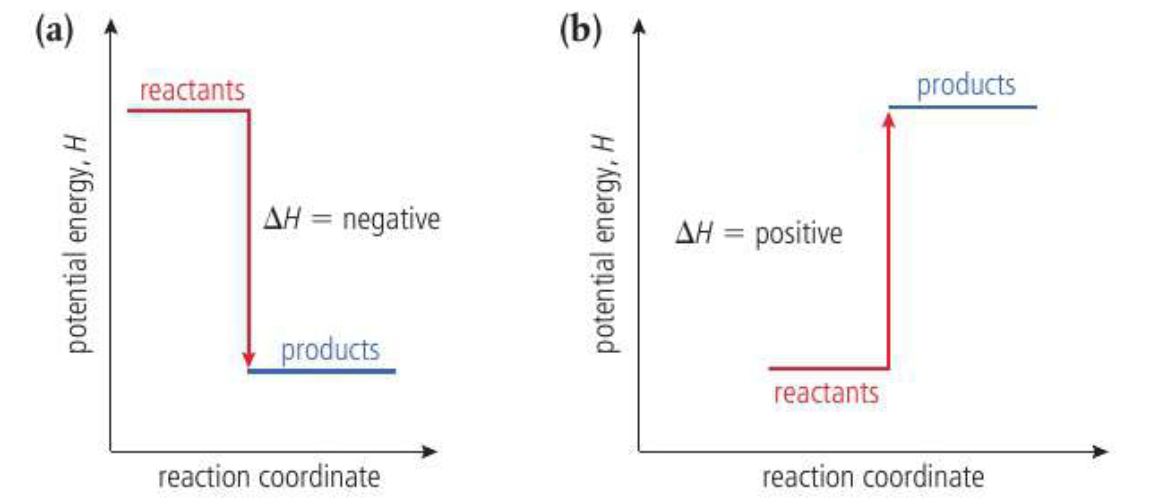
The lower the energy the more stable, therefore exothermic reactions occur more frequently, an example of a common exothermic reaction is combustion. It is important to note that change in enthalpy additionally does not relate to the rate of reaction, exothermic reactions to not occurs quicker than endothermic reactions. This is often because reactants require the same amount of energy to be able to react, known as activation energy.
Standard enthalpy changes are given in the data booklet. The overal enthalpy of a reaction is the difference between the enthalpy of the reactants and products and will hae a negative or positive value depending on if the r:eaction is exothermic or endothermic.
Ethalpy can additionally be calculated using the equation:
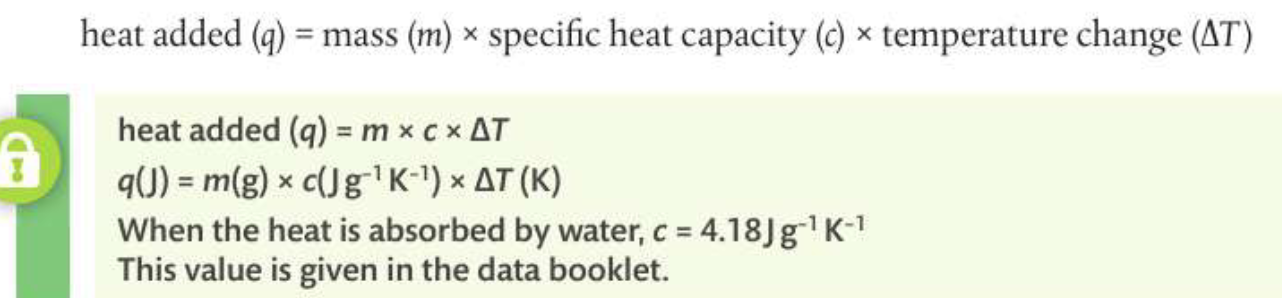
where specifc heat capacity is the heat needed to increase the temperature of one unit mass by 1 K
To calculate enthapy changes of a reaction within a solution, the following assumptions can be made:
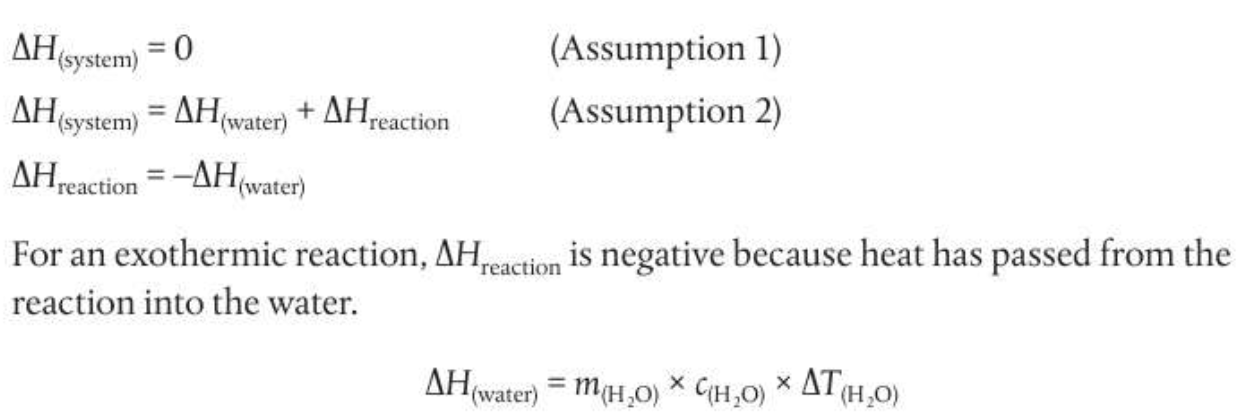
The molar enthalpy change is the enthalpy change of the reaction divided by moles of the limiting reactant. The equation to calculate this in a colution would be: C=n/v