Tile Pattern Analysis and Arithmetic Sequence Calculation
Table Data and Initial Observations
Figure contains tiles.
Figure contains tiles.
Figure contains tiles.
Figure contains tiles.
The sequence of tile counts corresponding to the sequential figure numbers is , , , ,
Identification of Sequence Type and Common Difference
The difference between consecutive terms is evaluated as follows:
Difference between Figure and Figure :
Difference between Figure and Figure :
Difference between Figure and Figure :
Because the difference between consecutive figure outputs remains constant (), the system represents an arithmetic sequence (a linear pattern).
The initial value or first term is .
The common difference between consecutive figures is
Explicit Formula Derivation
The general formula for the \text{-th} term of an arithmetic sequence is given by:
Substituting the established parameters ( and ) into the standard formula gives:
Distributing the common difference across yields:
Combining like terms simplifies the relation to the explicit linear equation:
Verification of the Explicit Formula
Verification for Figure ():
Verification for Figure ():
Verification for Figure ():
Verification for Figure ():
Calculation for Figure 10
Method 1: Explicit Formula Evaluation
To find the number of tiles in Figure , substitute into the derived formula :
Method 2: Sequential Recursive Extension
Figure : \,\text{tiles}
Figure : \,\text{tiles}
Figure : \,\text{tiles}
Figure : \,\text{tiles}
Figure : \,\text{tiles}
Figure : \,\text{tiles}
Figure : \,\text{tiles}
Figure : \,\text{tiles}
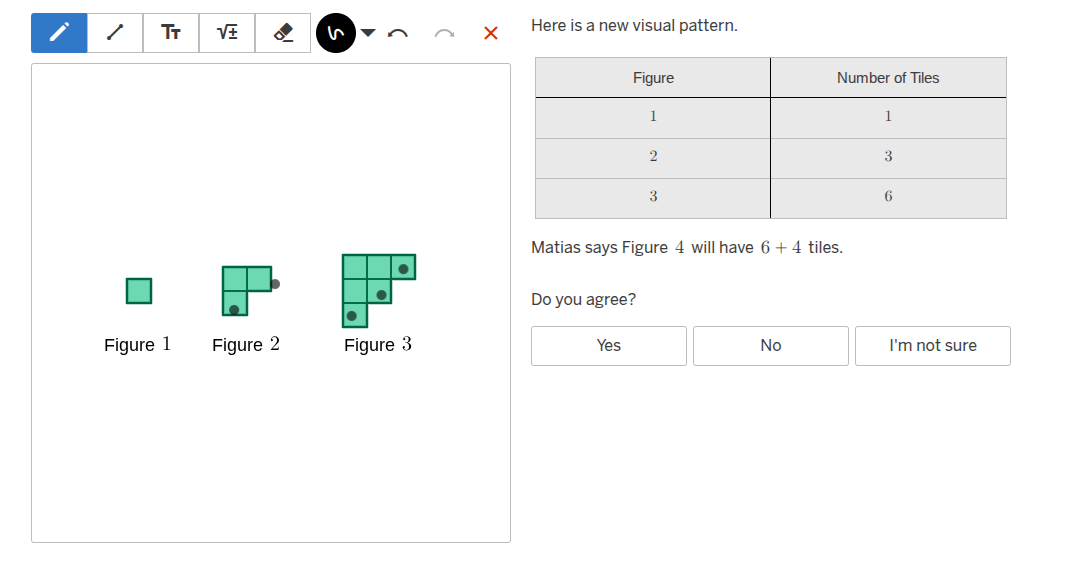
Figure : \,\text{tiles}
Figure : \,\text{tiles}
Total tile count for Figure is \,\text{tiles}.