R AND J
Juliet
distant relationship with lady Capulet
close relationship with nurse in which they become more and more distant
loves romeo
Juliet is a passionate character. When she first meets Romeo, she kisses him and later on, in the famous balcony scene, she declares her love for him.
The quote "I gave thee mine before thou didst request it." shows that Romeo requests that Juliet declares her love for him and Juliet simply replies that she has already done so. This shows how loving and passionate she is, as she has given her love and heart to Romeo. Furthermore, Juliet shows her passion when she refuses to marry Paris in Act 3 Scene 5. Lady Capulet had arranged a marriage between Juliet and Paris and Juliet refuses. Juliet says “I will not marry yet, and when I do, I swear It shall be Romeo, whom you know I hate Rather than Paris,”. This shows how passionate she is about her love for Romeo, risking getting put out on the streets by Capulet. This level of devotion for love and going against her parents shows how much passion is fuelling Juliet for the sake of her love.
Quotes
So tedious is this day
As is the night before some festival
To an impatient child that hath new robes
And may not wear them.
As Juliet expresses her sexual maturity by longing for her wedding night, she compares herself to an “impatient child.” This serves to remind the audience that Juliet is not yet fourteen. Throughout the play, Juliet matures and reaches major life events too early, which foreshadows that she will also die much too young.
I will kiss thy lips.
Haply some poison yet doth hang on them
To make me die with a restorative.
These are Juliet’s last words. She imagines the poison that has killed Romeo as a “restorative,” a medicine that can put an end to her suffering. One of the play’s major themes is the inseparability of good and evil, love and hate, poison and cure. Juliet’s death is tragic, but she also celebrates it as a way of escaping a life without her beloved.
Romeo
perceived as a highly moral character
lets emotions take the better of him
Quotes
O me, what fray was here?
Yet tell me not, for I have heard it all.
Here’s much to do with hate, but more with love.
These lines establish that Romeo is tired of the feud between the two families. He compares the families’ hatred to his own love for Rosaline, which establishes the close connection between love and violence running throughout the play.
I fear too early, for my mind misgives;
Some consequence, yet hanging in the stars,
Shall bitterly begin.
Romeo agrees to attend the Capulets’ ball, but he fears his decision may set off a chain of events that will end in tragedy. Throughout the play we get a strong sense that Romeo and Juliet cannot escape their fates. When Romeo says that the consequences of his decision are “hanging in the stars,” he reminds the audience that the “star-crossed” lovers of the Prologue are doomed to die.
But soft, what light through yonder window breaks?
It is the east, and Juliet is the sun
As Romeo approaches Juliet’s bedroom, he describes her in language drawn from astrology, such as suns, moons, and stars. This grandiose imagery suggests that Romeo believes his love for Juliet is not earthbound, but transcendent. Juliet herself is a force as powerful as the sun, the literal center of the universe. However, astrological imagery also reminds the audience that Romeo and Juliet are “star-crossed”—in other words, fated to die. The following lines read “arise, fair sun, and kill the envious moon,” suggesting that Romeo’s love for Juliet has supplanted his previous, weaker infatuation with Rosaline.
And fire-eyed fury be my conduct now.
Romeo, angered by Tybalt’s slaying of Mercutio, seeks to find revenge in killing Tybalt letting his anger guide him.
to say truth, Verona brags of him to be a virtuous and well govern’d youth (Capulet)
When Romeo is seen sneaking into the Capulet’s party and Tybalt wants to strike him dead, Capulet insists on leaving Romeo alone as he thinks of Romeo as a good person.
Mercutio
Mercurial Character
Uses Intellectual wit
caring for Romeo (close friends)
cynical
Mercutio is a deeply affectionate and caring friend of Romeo’s. For Mercutio, the true Romeo is the ‘sociable’ one, in other words the lively one. His battle of wits with Romeo has the specific intent to revitalise Romeo. He is a supportive friend that is genuinely happy to see Romeo being his usual, witty lively self rather than ‘groaning for love’. Thus. he knows exactly how to do so.
Mercutio’s wit has no other equal besides Romeo, his wittiness and comic character must be stressed. For him, the most important thing when “one” is ‘worn’ and old, is that the jest may remain.
Quotes
True, I talk of dreams, Which are the children of an idle brain, Begot of nothing but vain fantasy,”
Mercutio’s “Queen Mab” speech introduces us to an important aspect of his character. He is a cynical realist who finds dreams and fantasies ridiculous. Throughout the play Mercutio makes fun of Romeo’s fantasy of perfect romantic love, which invites the audience to question the seriousness and maturity of Romeo’s feelings for Juliet.
A plague o’ both your houses.
They have made worms’ meat of me.
When Mercutio is fatally injured due to the duel between him and Tybalt, he turns his cynical and realist eye on his own situation. He points out that the feud that has caused his death is pointless. While Romeo and Benvolio talk about Mercutio’s “soul” and “gallant spirit,” Mercutio himself describes his death in strictly physical and unromantic terms: he will be “worms’ meat.”
The Nurse
has a close relationship with Juliet
tries to present herself as a classy woman but fails
a comic character - her humour comes from ^
Quotes
Come Lammas Eve at night shall she be fourteen.
Susan and she, God rest all Christian souls
Were of an age.
Here the Nurse is counting down the days to Juliet’s birthday. The Nurse cares for Juliet like a parent. Juliet reminds her of her own daughter, Susan, who died young. Juliet therefore represents a surrogate daughter for the Nurse, and her link to the dead Susan foreshadows Juliet’s own premature death.
"Thou wast the prettiest babe that e'er I nursed. An I might live to see thee married once, I have my wish."
This shows that the nurse loves Juliet very much, as she is openly saying Juliet was the prettiest baby she had ever nursed and therefore looked after. This highlights the true connection that both the Nurse and Juliet have. The fact that it is the Nurse's wish to see Juliet married illustrates how motherly she is towards Juliet.
And ‘a speak any thing against me, I’ll take him down,
This shows that Nurse, trying to present herself as classy, fails to do so as she unawarely makes an inuendo.
Capulet
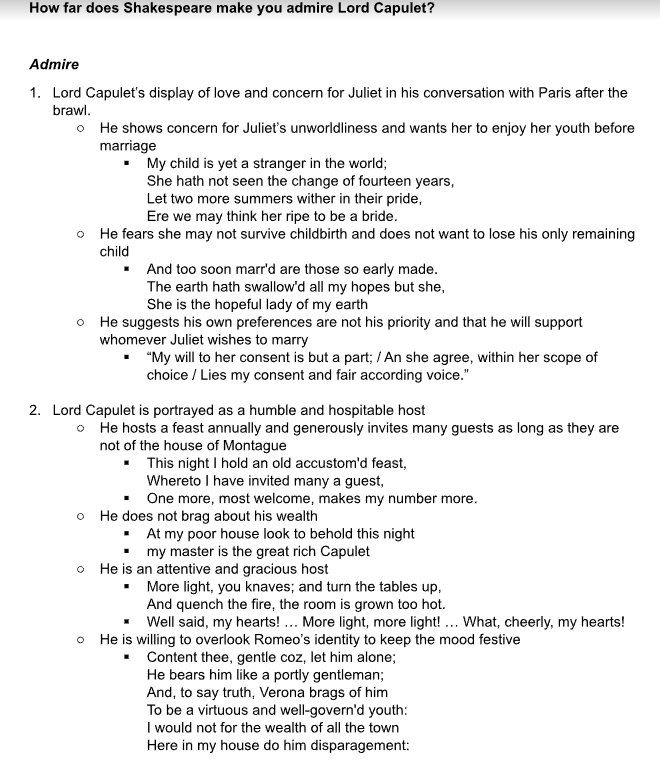
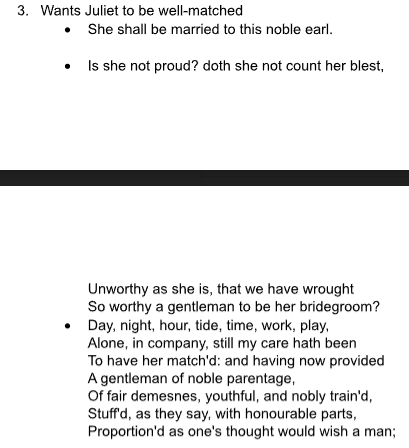
Powerful | As the head of the Capulet household, Capulet is powerful. At his party, Tybalt tells Capulet that Romeo is there and he is dishonouring the family name. Capulet rebukes Tybalt and says Romeo is a guest and they must treat their guests kindly. This angers Tybalt but he does what he is told, reluctantly. | "Content thee, gentle coz, let him alone... It is my will." | This shows that Capulet is powerful as he tells the fiery Tybalt to leave Romeo alone. Further on in his speech, Capulet gets angry when Tybalt questions him. This illustrates Capulet's power as he is in charge of a reputable household; he is the head of the family. |
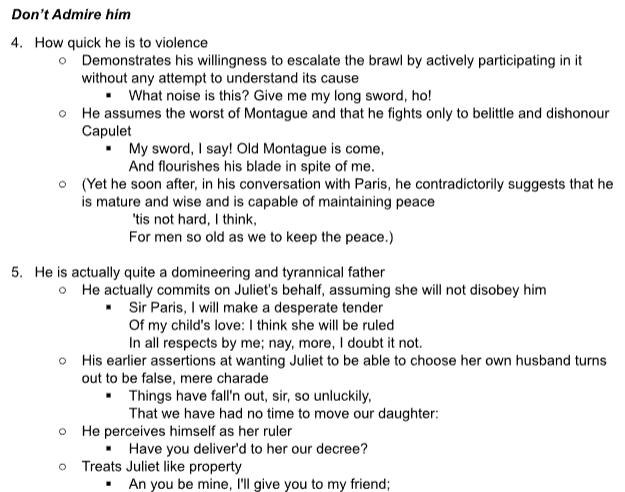
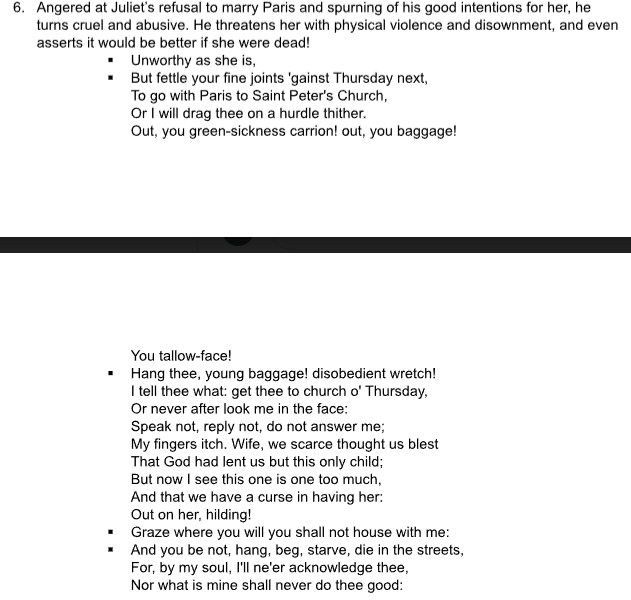
Stubborn | Capulet shows his stubbornness as he is shocked by his daughter's refusal to marry Paris and therefore threatens to disown her for displeasing him. | "I tell thee what: get thee to church a' Thursday or never after look me in the face." | This shows how stubborn Capulet is, as he is telling Juliet that if she doesn't obey him, she will no longer be a part of his family. The use of the "I" illustrates how authoritative Capulet is, as it is only his opinion that matters |
Lady Capulet
Selfish
Unknowing of her daughter, Juliet
"Talk not to me, for I'll not speak a word, Do as thou wilt, for I have done with thee." | This shows how Lady Capulet is selfish as she is unprepared to listen to Juliet as she cares more about her own safety and her relationship with her husband then she does for her own daughter. Shakespeare has made this speech very short to illustrate Lady Capulet's emotion and how she is not prepared to give Juliet any of her time. |
"Nurse, where's my daughter? Call her forth to me." | The question Lady Capulet directs at the Nurse illustrates how Lady Capulet isn't aware of where her daughter is or how she spends her free time. The use of the word 'daughter' illustrates how their relationship is formal, as she is referring to her as what she is, rather than who she is. It also shows how Lady Capulet is possessive over Juliet, as if Juliet belongs to he |
Lady Capulet, a central character in Romeo and Juliet, is Juliet’s mother and part of the influential Capulet family. She is depicted as formal, emotionally distant, and focused on maintaining family honor and social standing. Below is a deeper analysis of her character, relationships, and personality traits, along with supporting quotes from the play.
1. Relationship with Juliet:
Lady Capulet’s relationship with Juliet is distant and formal. Unlike the Nurse, who acts as a confidante and nurtures Juliet emotionally, Lady Capulet maintains a colder, more reserved relationship.
Arranged Marriage: Lady Capulet is eager to see Juliet married to Paris, valuing the match for its social and financial advantages. She says, “The valiant Paris seeks you for his love” (Act 1, Scene 3), showing her emphasis on a beneficial marriage rather than Juliet’s feelings.
When Juliet refuses to marry Paris, Lady Capulet’s reaction reveals her detachment: “I would the fool were married to her grave!” (Act 3, Scene 5). This line demonstrates her lack of empathy and harshness when Juliet disobeys her.
Emotional Distance: When Juliet appeals to her mother for help after Lord Capulet threatens to disown her, Lady Capulet coldly responds, “Talk not to me, for I’ll not speak a word; / Do as thou wilt, for I have done with thee” (Act 3, Scene 5). This further shows the distance between them and Lady Capulet’s unwillingness to support her daughter’s emotional needs.
2. Relationship with Lord Capulet:
Lady Capulet’s relationship with her husband, Lord Capulet, is defined by submission and deference. She generally supports his decisions, especially regarding Juliet’s marriage to Paris.
In the heated argument between Juliet and Lord Capulet about the marriage, Lady Capulet stands by her husband. When Lord Capulet scolds Juliet for her defiance, Lady Capulet does not intervene but echoes his sentiments: “Fie, fie! What, are you mad?” (Act 3, Scene 5). This reflects her loyalty to her husband's authority and her commitment to traditional family values.
3. Relationship with the Nurse:
Lady Capulet depends heavily on the Nurse to raise Juliet, suggesting that she has not played an active maternal role. From the start, it is clear that the Nurse knows Juliet intimately, while Lady Capulet struggles with how to address her daughter. For instance, when trying to discuss marriage, Lady Capulet immediately calls the Nurse back into the room to help: “Nurse, give leave awhile… This is the matter:—Nurse, come back again” (Act 1, Scene 3). This shows her discomfort and reliance on the Nurse for even basic conversations with Juliet.
4. Personality and Traits:
Cold and Pragmatic: Lady Capulet prioritizes family honor and status over Juliet’s personal desires. Her focus is on securing a high-status marriage for Juliet, as seen when she says, “So shall you share all that he doth possess” (Act 1, Scene 3), referring to Paris’s wealth and social standing. She is concerned with appearances and social advancement rather than Juliet’s happiness.
Conforming to Social Norms: Lady Capulet sees marriage as a duty and expects Juliet to follow the same path. She says, “I was your mother much upon these years / That you are now a maid” (Act 1, Scene 3), urging Juliet to marry early, as she did. This line underscores her view that young women must adhere to societal norms and marry as soon as possible.
Vengeful: Lady Capulet’s desire for revenge is most evident after Tybalt’s death. She is outraged and demands justice, insisting that Romeo be executed: “For blood of ours, shed blood of Montague” (Act 3, Scene 1). Her fury here reflects her fierce loyalty to her family, but it also shows a lack of consideration for Juliet’s feelings, as she is unaware of Juliet’s love for Romeo.
5. Role in the Play:
Lady Capulet represents the expectations of women in Verona’s patriarchal society. Her coldness toward Juliet highlights the tension between familial duty and personal happiness. She pushes Juliet into an arranged marriage and aligns with the idea that marriage is about social status, not love. Her rigid adherence to tradition and her emotional distance from Juliet reflect the societal pressures that ultimately contribute to the tragic outcome.
In sum, Lady Capulet’s character can be summarized as emotionally distant, loyal to her husband, and committed to family honor. Her inability to connect with Juliet and her strict adherence to societal norms play a significant role in the unfolding tragedy.
Friar Lawrence
1. Relationship with Romeo
Friar Laurence is a mentor and father figure to Romeo, offering both guidance and criticism. Although he cares for Romeo, his support also leads to impulsive decisions that have tragic consequences.
Skeptical of Romeo’s Sudden Love for Juliet: Upon hearing that Romeo has moved on from Rosaline to Juliet, the Friar chides him for his impulsive passion: “Is Rosaline, that thou didst love so dear, / So soon forsaken?” (Act 2, Scene 3). He questions Romeo’s ability to love deeply and views his change of heart with suspicion.
Cautions Romeo About Impulsiveness: The Friar frequently warns Romeo to be cautious, advising him, “Wisely and slow. They stumble that run fast” (Act 2, Scene 3). This quote reflects his role as a guiding figure, though Romeo’s rashness often prevails.
Agrees to Marry Romeo and Juliet to End the Feud: Despite his concerns, Friar Laurence agrees to marry the couple in the hope it will end the Montague-Capulet feud: “For this alliance may so happy prove / To turn your households' rancour to pure love” (Act 2, Scene 3). His optimism about the marriage’s potential reflects both his hope and naivety.
2. Relationship with Juliet
Friar Laurence becomes a crucial figure for Juliet after Romeo’s banishment. He devises risky plans to help her, but his decisions lead to unforeseen tragedy.
Offers the Sleeping Potion to Avoid Marriage to Paris: Friar Laurence, in an effort to protect Juliet’s autonomy, gives her a potion to simulate death: “Take thou this vial, being then in bed, / And this distilling liquor drink thou off” (Act 4, Scene 1). This drastic plan is a key moment in Juliet’s fate and in the Friar’s involvement in the tragic end.
Sympathizes with Juliet’s Desperation: When Juliet threatens to kill herself rather than marry Paris, the Friar empathizes with her plight and devises a plan to help her: “If, rather than to marry County Paris, / Thou hast the strength of will to slay thyself, / Then it is likely thou wilt undertake / A thing like death to chide away this shame” (Act 4, Scene 1). This shows his deep concern for her, though the consequences of this plan are disastrous.
Attempts to Console Juliet After Romeo’s Banishment: After Romeo’s exile, Friar Laurence tries to comfort Juliet and offers her a risky solution: “Hold, daughter, I do spy a kind of hope...” (Act 4, Scene 1). Though well-meaning, his attempt to soothe her despair through complex plans reflects his overconfidence in his ability to control outcomes.
3. Personality and Traits
Friar Laurence is philosophical and compassionate, yet his naivety and belief in fate lead him to make dangerous choices. He aims to mediate between the lovers and their families, though his plans often fall apart.
Philosophical View on Moderation: He advises Romeo to temper his passion, saying, “These violent delights have violent ends / And in their triumph die, like fire and powder” (Act 2, Scene 6). This reflects his belief that intense emotions can lead to destructive consequences, which foreshadows the tragic conclusion of the play.
Belief in Fate: Friar Laurence frequently invokes fate in his speeches. After realizing that Romeo did not receive the message about Juliet’s feigned death, he laments, “Unhappy fortune! By my brotherhood, / The letter was not nice but full of charge” (Act 5, Scene 2). His reliance on fate as a force that governs events is evident throughout the play.
Aware of the Dangers but Overconfident: Though he warns against the dangers of Romeo and Juliet’s passion, Friar Laurence’s own confidence in his plans blinds him to the risks: “In one respect I'll thy assistant be; / For this alliance may so happy prove / To turn your households' rancour to pure love” (Act 2, Scene 3). His faith in his schemes reflects his well-meaning but naive nature.
4. Role in the Play
Friar Laurence is both a facilitator of the lovers’ union and a catalyst for the tragedy. His actions directly influence the course of the story, from marrying Romeo and Juliet to devising the plan that leads to their deaths.
Key Role in the Secret Marriage: The Friar marries Romeo and Juliet in secret, believing their love will end the feud: “Come, come with me, and we will make short work, / For, by your leaves, you shall not stay alone” (Act 2, Scene 6). This clandestine action sets in motion the events leading to their tragic deaths.
Devises the Sleeping Potion Plan: His plan to fake Juliet’s death is central to the play’s tragic turn. He presents the potion to Juliet as a solution to her problems: “Take thou this vial, being then in bed, / And this distilling liquor drink thou off” (Act 4, Scene 1). However, his reliance on such a risky scheme highlights his shortsightedness.
Acknowledges His Role in the Tragedy: In the final act, Friar Laurence confesses his involvement in the deaths of Romeo and Juliet, taking responsibility for his part in the catastrophe: “I am the greatest, able to do least, / Yet most suspected, as the time and place / Doth make against me of this direful murder” (Act 5, Scene 3). His acknowledgment of his failings underscores his central role in the tragedy.
5. Relationship with the Feud
Friar Laurence is one of the few characters actively trying to reconcile the Montagues and Capulets. He sees the feud as senseless and destructive, and his hope for peace drives many of his actions.
Desires to End the Feud: The Friar’s decision to marry Romeo and Juliet is rooted in his desire to stop the families’ enmity: “For this alliance may so happy prove / To turn your households' rancour to pure love” (Act 2, Scene 3). This reflects his hope that love can heal the deep-seated hatred between the two families.
Attempts to Bring Peace Through the Lovers: Friar Laurence views Romeo and Juliet’s love as a potential bridge to end the conflict between their families: “Till Holy Church incorporate two in one” (Act 2, Scene 6). By marrying them, he hopes to create a bond that will unite the Montagues and Capulets, though this vision is tragically misguided.
Mediating Between the Families: Even after Romeo’s banishment and Juliet’s crisis, the Friar continues to try to mediate, offering solutions that, while well-intended, are ultimately ineffective. His plan for Juliet’s feigned death is an attempt to resolve the situation peacefully, though it backfires spectacularly: “Take thou this vial...” (Act 4, Scene 1). His role as a peacemaker is evident, but his reliance on extreme measures demonstrates the limits of his influence.
---
By using these key quotes and points, you can show a deep understanding of Friar Laurence’s character, his motivations, and the role he plays in Romeo and Juliet. His actions, though driven by a desire for peace, highlight the complexities of fate, love,
and the consequences of well-meaning yet flawed decisions.
lady capulet again
Here’s an expanded analysis of Lady Capulet’s character, now including three quotes for each of the key points. This will help you support your answers with strong evidence in your literature exam.
1. Relationship with Juliet
Lady Capulet has a distant and formal relationship with her daughter, Juliet. She often relies on the Nurse to handle motherly duties and is more focused on societal expectations than on nurturing Juliet emotionally.
Formal and Detached: When Lady Capulet first speaks to Juliet about marriage, she seems uncomfortable discussing personal matters and defers to the Nurse: “Nurse, give leave awhile, / We must talk in secret:—nurse, come back again” (Act 1, Scene 3). This shows her reliance on the Nurse for intimate discussions and her lack of close maternal connection with Juliet.
Focus on Juliet’s Marriage to Paris: Lady Capulet is eager to see Juliet married to Paris, emphasizing societal expectations over Juliet’s wishes: “Marry, that ‘marry’ is the very theme / I came to talk of” (Act 1, Scene 3). She views marriage as Juliet’s primary duty, reflecting her concern with social standing rather than Juliet’s happiness.
Pressures Juliet to Marry Paris: After Tybalt’s death, Lady Capulet becomes more forceful, urging Juliet to marry Paris despite her objections: “I would the fool were married to her grave!” (Act 3, Scene 5). Her harsh language shows her frustration and lack of empathy toward Juliet’s feelings, prioritizing family alliances over her daughter’s emotional well-being.
2. Relationship with Lord Capulet
Lady Capulet often defers to Lord Capulet’s authority, and while she expresses concern for Juliet, she does not openly oppose her husband’s will, even when she disagrees with him.
Obedient to Her Husband: When Lord Capulet berates Juliet for refusing to marry Paris, Lady Capulet does not defend her daughter, instead supporting her husband’s decision: “Here comes your father; tell him so yourself, / And see how he will take it at your hands” (Act 3, Scene 5). Her unwillingness to stand up to Lord Capulet highlights her passive role in the family dynamic.
Disagreement Without Confrontation: Although Lady Capulet initially agrees with her husband that Juliet is too young to marry, she does not challenge him when he changes his mind: “So shall you share all that he doth possess, / By having him, making yourself no less” (Act 1, Scene 3). This quote demonstrates her subtle shift to align with Lord Capulet’s view, prioritizing obedience over her own opinions.
Appeals to Lord Capulet’s Authority: When Juliet refuses the marriage to Paris, Lady Capulet tells her husband, “I have done with thee” (Act 3, Scene 5), signaling that she has given up trying to convince Juliet and leaving the matter in her husband’s hands. This quote shows how she relinquishes control to Lord Capulet, adhering to the traditional hierarchy of their marriage.
3. Personality and Traits
Lady Capulet is portrayed as cold, pragmatic, and concerned with appearances. She is focused on maintaining family honor and social status, which influences her treatment of Juliet.
Cold and Distant: When Juliet refuses to marry Paris, Lady Capulet cruelly distances herself, saying, “Talk not to me, for I’ll not speak a word. / Do as thou wilt, for I have done with thee” (Act 3, Scene 5). This quote underscores her emotional detachment and unwillingness to support her daughter in a time of crisis.
Pragmatic About Marriage: Lady Capulet views marriage in a practical, transactional way, urging Juliet to accept Paris because of his wealth and status: “The valiant Paris seeks you for his love” (Act 1, Scene 3). This quote shows her focus on the material benefits of marriage rather than Juliet’s personal feelings.
Vengeful Nature: After Tybalt’s death, Lady Capulet seeks revenge against Romeo, demanding that justice be served: “We will have vengeance for it, fear thou not” (Act 3, Scene 5). Her desire for revenge reveals her intense loyalty to her family, but also her harsh, unforgiving personality.
4. Role in the Play
Lady Capulet is a secondary character who primarily reinforces the expectations of society and family. She embodies the traditional values of arranged marriages and family honor, which conflict with Juliet’s desires for autonomy and love.
Pressures Juliet into the Marriage with Paris: Lady Capulet’s role is pivotal in driving the conflict between Juliet’s personal desires and her family’s expectations: “Well, think of marriage now; younger than you, / Here in Verona, ladies of esteem, / Are made already mothers” (Act 1, Scene 3). She encourages Juliet to marry young, reflecting the societal norms that drive the play’s tension.
Advocates for Revenge After Tybalt’s Death: Her vengeful speech after Tybalt’s death plays a role in escalating the conflict, as she demands that Romeo be punished: “For blood of ours, shed blood of Montague” (Act 3, Scene 1). This quote reveals her commitment to the family feud, further intensifying the animosity between the Montagues and Capulets.
Complicit in Juliet’s Downfall: Although Lady Capulet is not the primary antagonist, her insistence on Juliet marrying Paris contributes to Juliet’s desperation. “I would the fool were married to her grave!” (Act 3, Scene 5) reveals the depth of her frustration with Juliet’s defiance, unwittingly pushing her daughter toward a tragic fate.
5. Relationship with the Feud
Lady Capulet is deeply entrenched in the family feud, loyal to the Capulet name and eager to see Romeo punished for Tybalt’s death. She represents the older generation’s commitment to the conflict, contrasting with the younger generation’s desire for peace.
Fuels the Feud with Her Desire for Revenge: After Tybalt’s death, Lady Capulet becomes one of the driving forces behind the escalation of violence, declaring that Romeo must die for his actions: “Romeo slew Tybalt; Romeo must not live” (Act 3, Scene 1). This quote shows her intense loyalty to her family and her investment in the feud.
Blind Loyalty to the Capulet Family: Her belief that Romeo must be punished demonstrates her inability to see beyond the conflict between the families: “We will have vengeance for it, fear thou not” (Act 3, Scene 5). Her unwavering support of the feud shows her unwillingness to consider reconciliation or forgiveness.
Blinded by Hate After Tybalt’s Death: Lady Capulet’s hatred for the Montagues intensifies after Tybalt is killed, as she calls for the Prince to execute Romeo: “I beg for justice, which thou, prince, must give: / Romeo slew Tybalt; Romeo must not live” (Act 3, Scene 1). This shows how deeply entrenched she is in the feud, unwilling to consider any perspective other than vengeance for her family.
---
By using these quotes and character analysis points, you can demonstrate a nuanced understanding of Lady Capulet’s role in Romeo and Juliet and her contribution to the play’s tragic outcome.